Home
Class 12
CHEMISTRY
The configuration of eight compounds, a ...

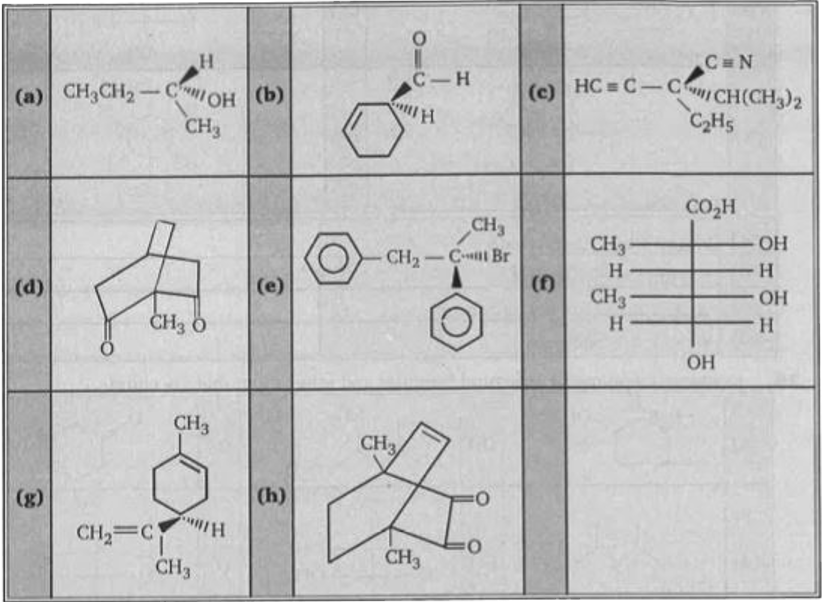
The configuration of eight compounds, a through h are shown below, using various kind of stereo representations. To answer the question given below, write (a through h) indicating your choice.

Which configuration has more than one stereogenic center?

Text Solution

Verified by Experts

The correct Answer is:

f,h
Promotional Banner

Topper's Solved these Questions

  • ISOMERISM (STRUCTURAL & STEREOISOMERISM)

    MS CHOUHAN|Exercise LEVEL 2 (SUBJECTIVE PROBLEMS)|17 Videos
  • ISOMERISM (STRUCTURAL & STEREOISOMERISM)

    MS CHOUHAN|Exercise LEVEL 2 (SUBJECTIVE PROBLEMS)|17 Videos
  • HYDROCARBONS (ALKYNES)

    MS CHOUHAN|Exercise Level -1|32 Videos
  • IUPAC NAME

    MS CHOUHAN|Exercise LEVEL-2 (SUBJECTIVE PROBLEMS ) |1 Videos

Similar Questions

Explore conceptually related problems

. A raindrop falling from a height .h. above ground, attains a near terminal velocity when it has fallen through a height (3/4)h. Which of the diagrams shown below correctly shows the change in kinetic and potential energy of the drop during its fall up to the ground?

You have done experiments for testing various food components in rice, potato, milk, curd, egg with required chemicals reagents. You know well about indications as you did in the class room with your friends. Make a table and write the results as given below. 1) Which foods item contain more fat ?

The following questions consist of two statements, one labelled as 'Statement I' and the other 'Statement II'. You have to examine these two statements carefully and decide if the Statement I and the Statement II, are individually true and if so, whether the Statement II is the correct explanation for the given Statement I. Select your answer to these items using the codes given below and then select the correct option. Statement 1 : sin^(-1)(sin5) gt x^(2)-4x has many solutions lying in the interval (2-sqrt(9-2pi), 2+sqrt(9-2pi)) Statement 2 : Sin^(-1)(Sin5)=5-2pi

Think of this puzzle What do you need to find a chosen number from this square? Four of the clues below are true but do nothing to help in finding the number. Four of the clues are necessary for finding it. Here are eight clues to use: a. The number is greater than 9. b. The number is not a multiple of 10. c. The number is a multiple of 7. d. The number is odd. e. The number is not a multiple of 11. f. The number is less than 200. g. Its ones digit is larger than its tens digit. h. Its tens digit is odd. What is the number? Can you sort out the four clues that help and the four clues that do not help in finding it? First follow the clues and strike off the number which comes out from it. Like - from the first clue we come to know that the number is not from 1 to 9. (strike off numbers from 1 to 9). After completing the puzzle, see which clue is important and which is not?

An orbital is designated by certain values of first three quantum numbers (n, l and m) and according to Pauli.s exclusion principle, no two electrons in a atom can have all the for quantum numbers equal. N, l and m denote size, shape and orientation of the orbital. The permissible values of n are 1,2,3.... prop while that of 1 are all possible integral values from 0 to n-n. Orbitals with same values of n and 1 but different values of m (where m can have any integral values from 1 to +1 including zero) are of equal energy and are called degenerate orbitals. However degeneracy is destroyed in homogeneous external magnetic field due to different extent of interaction between the applied field and internal electronic magnet of different orbitals differing in orientations. In octahedral magnetic field external magnetic field as oriented along axes while in tetrahedral field the applied field actas more in between the axes than that on the axes themselves. For 1=0, 1,2,3,...., the states (called sub-shells) are denoted by the symbol s,p,d,f.....respectively. After f, the subshells are denoted by letters alphabetically 1 determines orbital angular motion (L) of electron as L = sqrt(l(l+1))(h)/(2pi) ON the other hand, m determines Z-component of orbital angular momentum as L_(Z) = m((h)/(2pi)) Hund.s rule states that in degenerate orbitals electrons do not pair up unless and until each each orbitals has got an electron with parallesl spins Besides orbital motion,an electron also posses spin-motion. Spin may be clockwise and anticloskwise. Both these spin motions are called two spins states of electrons characterized by spin Q.N (s) : s = +(1)/(2) and = -(1)/(2) respectively The sum of spin Q.N. of all the electrons is called total spin(s) and 2s+1 is called spin multiplicity of the configuration as a whole. The spin angular momentum of an electron is written as L_(s) = sqrt(s(s+1))(h)/(2pi) According to Hund.s rule, the distribution of electron within the various orbitals of a given sub-shell is one which is associated with

NaBH_(4) is ionic compound contain BH_(4)^(-) tetrahydridoborate ion and in solid state NaBH_(4) has sodium chloride structure. Not all tetrahydridoborates are ionic. The beryllium, aluminium and transition metal borohydrides become increasingly covalent and volatile. In these type of tetrabydrido borate the BH_(4)^(-) form covalent bond with metal ion. One or more H atoms in a BH_(4)^(-) act as a bridged bond to metal, forming a three centre bond with two electrons shared by three atoms. The BH_(4)^(-) is usually in that it may fonn one two or three such three centre bonds to the metal ion when fonns covalent bond. Be(BH_(4))_(2) and AI(BH_(4))_(3) are covalent and structures are given below: Select incorrect statement about ' Li [AIH_(4)]

NaBH_(4) is ionic compound contain BH_(4)^(-) tetrahydridoborate ion and in solid state NaBH_(4) has sodium chloride structure. Not all tetrahydridoborates are ionic. The beryllium, aluminium and transition metal borohydrides become increasingly covalent and volatile. In these type of tetrabydrido borate the BH_(4)^(-) form covalent bond with metal ion. One or more H atoms in a BH_(4)^(-) act as a bridged bond to metal, forming a three centre bond with two electrons shared by three atoms. The BH_(4)^(-) is usually in that it may fonn one two or three such three centre bonds to the metal ion when fonns covalent bond. Be(BH_(4))_(2) and AI(BH_(4))_(3) are covalent and structures are given below:

MS CHOUHAN-ISOMERISM (STRUCTURAL & STEREOISOMERISM)-LEVEL 2
  1. The configuration of eight compounds, a through h are shown below, usi...

    Text Solution

    |

  2. The configuration of eight compounds, a through h are shown below, usi...

    Text Solution

    |

  3. The configuration of eight compounds, a through h are shown below, usi...

    Text Solution

    |

  4. The configuration of eight compounds, a through h are shown below, usi...

    Text Solution

    |

  5. The structural formula of ten compounds, (I) through (X) are drawn bel...

    Text Solution

    |

  6. The structure of one of the enantiomers of the amino acid cysteine is ...

    Text Solution

    |

  7. Identify the following double bonds either E, Z or None (N) in the com...

    Text Solution

    |

  8. (a) Bongkrekic acid is a toxic compound produced by Pseudomonas cocove...

    Text Solution

    |

  9. Designate the following double bonds as E, Z or none (N) configuration...

    Text Solution

    |

  10. The following compounds may exist as two or more stereoisomers. These ...

    Text Solution

    |

  11. Find relationship between given pair :

    Text Solution

    |

  12. Structural formula of compound (A) is following: The correct stat...

    Text Solution

    |

  13. Structural formula of compound (A) is following: Number of plane ...

    Text Solution

    |

  14. Match the column. (Matrix)

    Text Solution

    |

  15. Match the column. (Matrix)

    Text Solution

    |

  16. Draw a most stable conformation (N - C) bond in the following compound...

    Text Solution

    |

  17. Find total number of stereoisomers for each compound given below : (...

    Text Solution

    |

  18. Find the total number of stereoisomer for each compound :

    Text Solution

    |

  19. Match the column :

    Text Solution

    |

  20. Find sum of stereoisomer of following compound.

    Text Solution

    |
