Home
Class 12
CHEMISTRY
Wolff rearrangement When alpha-Diazok...

Wolff rearrangement
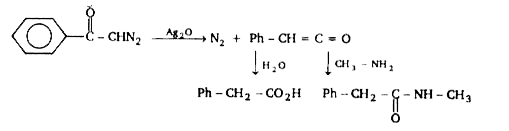
When `alpha`-Diazoketones are photo-irradiated or heated at high temperature or reacted with silver oxide or silver salts at room temperature, they loose nitrogen and rearrange to form ketene.
The ketenes reacts rapidly with water, alcohol and amines. Therefore, the reactions called Wolff-rearrangement.


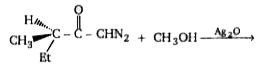
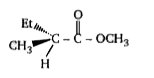
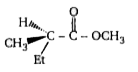
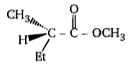
Major product of the reaction is :

A

B

C

D

None of these

Text Solution

Verified by Experts

The correct Answer is:

D

During rearrangement configuration not change
Promotional Banner

Topper's Solved these Questions

  • CARBENE AND NITRENE

    MS CHOUHAN|Exercise LEVEL-2 |5 Videos
  • CARBENE AND NITRENE

    MS CHOUHAN|Exercise LEVEL-2 |5 Videos
  • BIOMOLECULES

    MS CHOUHAN|Exercise LEVEL - 2|5 Videos
  • CARBOXYLIC ACID AND THEIR DERIVATIVES

    MS CHOUHAN|Exercise LEVEL-2( SUBJECTIVE PROBLEMS)|1 Videos

Similar Questions

Explore conceptually related problems

Amines are less reactive in substitution reactions. Their reactivity is much lesser than alcohols and alkylflourides towards substitution. Protonation of the amino group makes it a better leaving group, but not nearly as good a leaving group as a protonated alcohol. Protonated amino groups cannot be displaced by OH^(-) because it would react immediately with the acidic hydrogen which would convert it in to a poor nucleophile. The leaving group in quartenary ammonium ion has about the same leaving tendency as a protonated amino group but does not have acidic hydrogen. The reaction of a quartenary ammonium ion with hydroxide ion is known as Hoffmann elimination reaction. The leaving group is tertiary amine. Since a tertiary amine is only a moderately good leaving group, the reaction requires heat. The carbon to which the tertiary amine is attached is designated as alpha carbon. When the hydroxide ion starts to remove a beta H from a quartenary ammonium ion, the leaving group does not immediately start to leave because a tertiary amine is not a good leaving group. As a result, a partial negative charge builds up on the carbon from which the proton is removed. The compounds 'C' in question number 31 on heating with moist silver oxide gives

Chemical reactions are invariably assocated with the transfer of energy either in the form of heat or light. In the laboratory, heat changes in physical and chemical processes are measured with an instrument called calorimeter. Heat change in the process is calculated as: q= ms DeltaT , s= specific heat = c Delta T , c= heat capacity Heat of reaction at constant volume is measured using bomb calorimeter. qv= Delta U= internal energy change. Heat of reaction at constant pressure is measured using simple or water calorimeter. q_(p) = Delta H, q_(p) = q_(v) + P Delta V, DeltaH = DeltaU + Delta nRT The amount of energy released during a chemical change depnds on the physical state of reactants and products, the condition of pressure, temperature and volume at which the reaction is carried out. The variation of heat of reaction with temperature and pressure is given by Kirchhoff's equation: (DeltaH_(2)- DeltaH_(1))/(TT_(2)-T_(1)) = DeltaC_(P) (At constant pressure), (DeltaU_(2)- DeltaU_(1))/(TT_(2)-T_(1)) = DeltaC_(V) (At constant volume) The heat capacity of bomb calorimeter (with its contents) is 500J/K. When 0.1g of CH_(4) was burnt in this calorimeter the temperature rose by 2^(@)C . The value of DeltaU per mole will be

MS CHOUHAN-CARBENE AND NITRENE -LEVEL-2 (Comprehension)
  1. Hoffmann bromamide reaction involves conversion of a carboxylic acid a...

    Text Solution

    |

  2. Hoffmann bromamide reaction involves conversion of a carboxylic acid a...

    Text Solution

    |

  3. Hoffmann bromamide reaction involves conversion of a carboxylic acid a...

    Text Solution

    |

  4. Hoffmann bromamide reaction involves conversion of a carboxylic acid a...

    Text Solution

    |

  5. Given is mechanism of Beckmann rearrangement. Rate determining...

    Text Solution

    |

  6. Given is mechanism of Beckmann rearrangement. On treatment ...

    Text Solution

    |

  7. Given is mechanism of Beckmann rearrangement. Which of the fol...

    Text Solution

    |

  8. Given is mechanism of Beckmann rearrangement. Product (A) o...

    Text Solution

    |

  9. Consider the given reaction for preparation of alkyne. (Fritsch reacti...

    Text Solution

    |

  10. Consider the given reaction for preparation of alkyne. (Fritsch reacti...

    Text Solution

    |

  11. Consider the given reaction for preparation of alkyne. (Fritsch reacti...

    Text Solution

    |

  12. Consider the given reaction for preparation of alkyne. (Fritsch reacti...

    Text Solution

    |

  13. Wolff rearrangement When alpha-Diazoketones are photo-irradiated or...

    Text Solution

    |

  14. Wolff rearrangement When alpha-Diazoketones are photo-irradiated or...

    Text Solution

    |

  15. Wolff rearrangement When alpha-Diazoketones are photo-irradiated or...

    Text Solution

    |

  16. Wolff rearrangement When alpha-Diazoketones are photo-irradiated or...

    Text Solution

    |

  17. Wolff rearrangement When alpha-Diazoketones are photo-irradiated or...

    Text Solution

    |

  18. Wolff rearrangement When alpha-Diazoketones are photo-irradiated or...

    Text Solution

    |

  19. Wolff rearrangement When alpha-Diazoketones are photo-irradiated or...

    Text Solution

    |
