Home
Class 12
CHEMISTRY
Wolff rearrangement When alpha-Diazok...

Wolff rearrangement
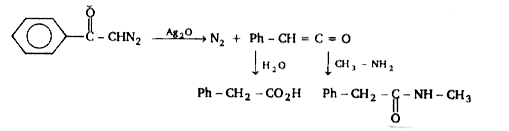
When `alpha`-Diazoketones are photo-irradiated or heated at high temperature or reacted with silver oxide or silver salts at room temperature, they loose nitrogen and rearrange to form ketene.
The ketenes reacts rapidly with water, alcohol and amines. Therefore, the reactions called Wolff-rearrangement.

`Ph- overset(N_(2))overset(||)C-CH_(2)OCH_(3) underset(Delta)to (A)90%`, product (A) is :

A

`Ph-CH=CH-OH`

B

`Ph-CH=CH-OCH_(3)`

C

`CH_(3)-CH=CH-O-Ph`

D

`CH_(3)-CH=CH-OH`

Text Solution

Verified by Experts

The correct Answer is:

B

Insertion reaction
Promotional Banner

Topper's Solved these Questions

  • CARBENE AND NITRENE

    MS CHOUHAN|Exercise LEVEL-2 |5 Videos
  • CARBENE AND NITRENE

    MS CHOUHAN|Exercise LEVEL-2 |5 Videos
  • BIOMOLECULES

    MS CHOUHAN|Exercise LEVEL - 2|5 Videos
  • CARBOXYLIC ACID AND THEIR DERIVATIVES

    MS CHOUHAN|Exercise LEVEL-2( SUBJECTIVE PROBLEMS)|1 Videos

Similar Questions

Explore conceptually related problems

Aldehydes undergo disproportionation reaction in presence of aqueous NaOH. Simultaneous oxidation and reduction of a compound is scientifically called as disproportionation Aldehydes having no alpha -hydrogen show this reaction called Cannizzaro's reaction. Few exceptions are also there to this generalisation The reaction may be represented as C_6 H_5 -CHO C_6 H_5 underset(C_6 H_5 COONa +C_6 H_5 CH_2 OH) underset(|) (CHO) underset(Delta) overset(NaOH)to intramolecular cannizzaro reacation is also possible The product formed in the following reaction will be : {:(CHO) ,( | ) ,(CHO):} overset(NaOH) to product

An organic compound (A) underset(Cl)underset(|)CH_2 - CH_2 - underset(Cl)underset(CH_2) on reduction with red P_4 and Hl gives propane (A) on hydrolysis by an alkali followed by oxidation gives B(C_3 H_4 O_4) , which on heating gives (C). Both (B) and (C) gice effervescencence with sodium hydrogen carbonate. (B) on reacting with alcohol gives (D) , C_7 H_(12) O_8 a well known synthetic reagent. Now answer the following questions. (D) +benzaladehyde underset((ii) H^+)overset((i) "pyridine," Delta)to manor product (E). The product (E) is

An organic compound (A) underset(Cl)underset(|)CH_2 - CH_2 - underset(Cl)underset(CH_2) on reduction with red P_4 and Hl gives propane (A) on hydrolysis by an alkali followed by oxidation gives B(C_3 H_4 O_4) , which on heating gives (C). Both (B) and (C) gice effervescencence with sodium hydrogen carbonate. (B) on reacting with alcohol gives (D) , C_7 H_(12) O_8 a well known synthetic reagent. Now answer the following questions. Compound (A) underset((ii) H^+)overset((i) KCN//C_2H_2OH)to product (G). The product (G) is

Chemical reactions are invariably associated with the transfer of energy either in the form of hear or light. In the laboratory, heat changes in physical and chemical processes are measured with an instrument called calorimeter. Heat change in the process is calculated as: q= ms Delta T , s= Specific heat = c Delta T = Heat capacity. Heat of reaction at constant pressure is measured using simple or water calorimeter. Q_(v)= Delta U = Internal energy change, Q_(P) = DeltaH, Q_(P) = Q_(V) + P Delta V and DeltaH = Delta U+ Delta nRT . The amount of energy released during a chemical change depends on the physical state of reactants and products, the condition of pressure, temperature and volume at which the reaction is carried out. The variation of heat of reaction with temperature and pressure is given by Kirchoff's equation: (DeltaH_(2) - DeltaH_(1))/(T_(2)-T_(1))= Delta C_(P) (At constant pressure), (DeltaU_(2) - DeltaU_(1))/(T_(2)-T_(1)) = DeltaC_(V) (At constant volume) The enthalpy change (DeltaH) for the reaction N_(2) (g) + 3H_(2)(g) rarr 2NH_(3)(g) is -92.38kJ at 298 K. The internal energy change DeltaU at 298 K is

alpha - amino acids are high melting crystalline solids because of the zwitterion structure. They are moderately soluble in water. In acidic medium, alpha - amino acids exist as cations (I) and thus migrate towards cathode under the influence of an electric field. On the other hand, in alkaline medium, alpha - amino acids exist as anions (III) and thus migrate towards anode under the influence of an electric field. However, at some intermediate value of p^(H) , the concentration of the cationic form (I) and anionic form (III) will become equal and consequently the alpha - amino acid will exist primarily as the neutral dipolar ion (II). At this p^(H) , there would be no net migration of the amino acid in an electric field. This p^(H) at which there is no net migration of the amino acid under the influence of an applied electric field is called isoelectric point (pI). Each amino acid has a characteristic isoelectric point. The pH of an amino acid that does not have an ionisable side chain such as alanine isd average of pK_(a) values of the carboxyl group and the protonated amino group. H_(3)overset(+)(N)-overset("R")overset("|")("C")H-COOH overset(" "OH^(-)" ")underset(" "H^(+)" ")hArr H_(3)overset(+)(N)-underset("Zwitterion (II)")(overset("R")overset("|")("C")H)-COO^(-)overset(" "OH^(-)" ")underset(" "H^(+)" ")hArr underset((III))(overset(+)(N)-overset("R")overset("|")("C")H)-COO^(-) Further, the alpha - carbon of all the amino acids (except glycine) is chiral (asymmetric) and hence amino acids can exist in teo stereoisomeric forms i.e., D and L. However, all the nautrally occurring amino acids belong to the L - series. underset("L(-)Glyceraldehyde")(HO-overset("CHO ")overset("| ")underset(" "CH_(2)OH)underset("| ")("C ")-H)" " underset("L-Amino acid")(H_(2)N-overset("COOH")overset("| ")underset("R ")underset("| ")("C ")-H) Which of structural formula of lysine (NH_(2)-overset("COOH")overset("| ")("C ")H-CH_(2)-CH_(2)-CH_(2)-CH_(2)NH_(2)) at pH 13 ?

alpha - amino acids are high melting crystalline solids because of the zwitterion structure. They are moderately soluble in water. In acidic medium, alpha - amino acids exist as cations (I) and thus migrate towards cathode under the influence of an electric field. On the other hand, in alkaline medium, alpha - amino acids exist as anions (III) and thus migrate towards anode under the influence of an electric field. However, at some intermediate value of p^(H) , the concentration of the cationic form (I) and anionic form (III) will become equal and consequently the alpha - amino acid will exist primarily as the neutral dipolar ion (II). At this p^(H) , there would be no net migration of the amino acid in an electric field. This p^(H) at which there is no net migration of the amino acid under the influence of an applied electric field is called isoelectric point (pI). Each amino acid has a characteristic isoelectric point. The pH of an amino acid that does not have an ionisable side chain such as alanine isd average of pK_(a) values of the carboxyl group and the protonated amino group. H_(3)overset(+)(N)-overset("R")overset("|")("C")H-COOH overset(" "OH^(-)" ")underset(" "H^(+)" ")hArr H_(3)overset(+)(N)-underset("Zwitterion (II)")(overset("R")overset("|")("C")H)-COO^(-)overset(" "OH^(-)" ")underset(" "H^(+)" ")hArr underset((III))(overset(+)(N)-overset("R")overset("|")("C")H)-COO^(-) Further, the alpha - carbon of all the amino acids (except glycine) is chiral (asymmetric) and hence amino acids can exist in teo stereoisomeric forms i.e., D and L. However, all the nautrally occurring amino acids belong to the L - series. underset("L(-)Glyceraldehyde")(HO-overset("CHO ")overset("| ")underset(" "CH_(2)OH)underset("| ")("C ")-H)" " underset("L-Amino acid")(H_(2)N-overset("COOH")overset("| ")underset("R ")underset("| ")("C ")-H) In alanine, carboxyl group ionises at pK_(a1)=2.34 and ammonium ion at pK_(a2)=9.69 . The isoelectric point of the amino acid is at p^(H) .

alpha - amino acids are high melting crystalline solids because of the zwitterion structure. They are moderately soluble in water. In acidic medium, alpha - amino acids exist as cations (I) and thus migrate towards cathode under the influence of an electric field. On the other hand, in alkaline medium, alpha - amino acids exist as anions (III) and thus migrate towards anode under the influence of an electric field. However, at some intermediate value of p^(H) , the concentration of the cationic form (I) and anionic form (III) will become equal and consequently the alpha - amino acid will exist primarily as the neutral dipolar ion (II). At this p^(H) , there would be no net migration of the amino acid in an electric field. This p^(H) at which there is no net migration of the amino acid under the influence of an applied electric field is called isoelectric point (pI). Each amino acid has a characteristic isoelectric point. The pH of an amino acid that does not have an ionisable side chain such as alanine isd average of pK_(a) values of the carboxyl group and the protonated amino group. H_(3)overset(+)(N)-overset("R")overset("|")("C")H-COOH overset(" "OH^(-)" ")underset(" "H^(+)" ")hArr H_(3)overset(+)(N)-underset("Zwitterion (II)")(overset("R")overset("|")("C")H)-COO^(-)overset(" "OH^(-)" ")underset(" "H^(+)" ")hArr underset((III))(overset(+)(N)-overset("R")overset("|")("C")H)-COO^(-) Further, the alpha - carbon of all the amino acids (except glycine) is chiral (asymmetric) and hence amino acids can exist in teo stereoisomeric forms i.e., D and L. However, all the nautrally occurring amino acids belong to the L - series. underset("L(-)Glyceraldehyde")(HO-overset("CHO ")overset("| ")underset(" "CH_(2)OH)underset("| ")("C ")-H)" " underset("L-Amino acid")(H_(2)N-overset("COOH")overset("| ")underset("R ")underset("| ")("C ")-H) N - terminus of the peptide structure is on the

Olefins can be halogenated in the allylic position by number of reagents of which N-bromo succinimide (NBS) is the most common. When this reagent is used the reaction is known as WohlZiegler bromination. Other N-bromoamides have also been used. To a much lesser extent allylic chlorination has been carried out with N-chloro-succinimide. N-Chloro-N-cyclohexyl benzene sulphonamide or t-hypochlorite when the allylic radical intermediate is unsymmetrical allylic rearrangement takes place so that the mixture of both possible products is obtained. CH_3 - CH_2 -CH = CH_2underset(hv)overset(NBS)(to) CH_3 - CH = CH - CH_2 - Br + CH_3 - undersetoverset(|)(Br)(C ) - CH = CH_2 NBS is also a highly regioselective brominating agent at other positions, including positions a to a carbonyl group.

Olefins can be halogenated in the allylic position by number of reagents of which N-bromo succinimide (NBS) is the most common. When this reagent is used the reaction is known as WohlZiegler bromination. Other N-bromoamides have also been used. To a much lesser extent allylic chlorination has been carried out with N-chloro-succinimide. N-Chloro-N-cyclohexyl benzene sulphonamide or t-hypochlorite when the allylic radical intermediate is unsymmetrical allylic rearrangement takes place so that the mixture of both possible products is obtained. CH_3 - CH_2 -CH = CH_2underset(hv)overset(NBS)(to) CH_3 - CH = CH - CH_2 - Br + CH_3 - undersetoverset(|)(Br)(C ) - CH = CH_2 NBS is also a highly regioselective brominating agent at other positions, including positions a to a carbonyl group.

Olefins can be halogenated in the allylic position by number of reagents of which N-bromo succinimide (NBS) is the most common. When this reagent is used the reaction is known as WohlZiegler bromination. Other N-bromoamides have also been used. To a much lesser extent allylic chlorination has been carried out with N-chloro-succinimide. N-Chloro-N-cyclohexyl benzene sulphonamide or t-hypochlorite when the allylic radical intermediate is unsymmetrical allylic rearrangement takes place so that the mixture of both possible products is obtained. CH_3 - CH_2 -CH = CH_2underset(hv)overset(NBS)(to) CH_3 - CH = CH - CH_2 - Br + CH_3 - undersetoverset(|)(Br)(C ) - CH = CH_2 NBS is also a highly regioselective brominating agent at other positions, including positions a to a carbonyl group. Which of the following is allylic chlorinating agent ?

MS CHOUHAN-CARBENE AND NITRENE -LEVEL-2 (Comprehension)
  1. Hoffmann bromamide reaction involves conversion of a carboxylic acid a...

    Text Solution

    |

  2. Hoffmann bromamide reaction involves conversion of a carboxylic acid a...

    Text Solution

    |

  3. Hoffmann bromamide reaction involves conversion of a carboxylic acid a...

    Text Solution

    |

  4. Hoffmann bromamide reaction involves conversion of a carboxylic acid a...

    Text Solution

    |

  5. Given is mechanism of Beckmann rearrangement. Rate determining...

    Text Solution

    |

  6. Given is mechanism of Beckmann rearrangement. On treatment ...

    Text Solution

    |

  7. Given is mechanism of Beckmann rearrangement. Which of the fol...

    Text Solution

    |

  8. Given is mechanism of Beckmann rearrangement. Product (A) o...

    Text Solution

    |

  9. Consider the given reaction for preparation of alkyne. (Fritsch reacti...

    Text Solution

    |

  10. Consider the given reaction for preparation of alkyne. (Fritsch reacti...

    Text Solution

    |

  11. Consider the given reaction for preparation of alkyne. (Fritsch reacti...

    Text Solution

    |

  12. Consider the given reaction for preparation of alkyne. (Fritsch reacti...

    Text Solution

    |

  13. Wolff rearrangement When alpha-Diazoketones are photo-irradiated or...

    Text Solution

    |

  14. Wolff rearrangement When alpha-Diazoketones are photo-irradiated or...

    Text Solution

    |

  15. Wolff rearrangement When alpha-Diazoketones are photo-irradiated or...

    Text Solution

    |

  16. Wolff rearrangement When alpha-Diazoketones are photo-irradiated or...

    Text Solution

    |

  17. Wolff rearrangement When alpha-Diazoketones are photo-irradiated or...

    Text Solution

    |

  18. Wolff rearrangement When alpha-Diazoketones are photo-irradiated or...

    Text Solution

    |

  19. Wolff rearrangement When alpha-Diazoketones are photo-irradiated or...

    Text Solution

    |
