Home
Class 12
CHEMISTRY
Taking into account the stability of var...

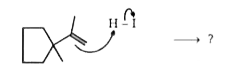
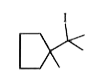
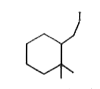
Taking into account the stability of various cycloalkanes and carbocations, as well as the rules governing mechanisms of carbocation rearrangements, what is the most likely product of this reaction ?

A

B

C

D

Text Solution

Verified by Experts

The correct Answer is:

B

Ring expansion take place.
Promotional Banner

Topper's Solved these Questions

  • HYDROCARBONS (ALKENES)

    MS CHOUHAN|Exercise LEVEL-2|22 Videos
  • HYDROCARBONS (ALKANES)

    MS CHOUHAN|Exercise LEVEL - 2|11 Videos
  • HYDROCARBONS (ALKYNES)

    MS CHOUHAN|Exercise Level -1|32 Videos

Similar Questions

Explore conceptually related problems

Alkenes undergo electrophilic addition with many reagents like HX, H_2O , HOCI etc. Except in the case of addition of X_2^(-) in other additions carbocation is formed as intermediate. The rate of such reactions depends on the stability of carbocation. Rearrangements and ring expansion are also common in such reactions. Propene on reaction with HI in presence of peroxide will give

Alkenes undergo electrophilic addition with many reagents like HX, H_2O , HOCI etc. Except in the case of addition of X_2^(-) in other additions carbocation is formed as intermediate. The rate of such reactions depends on the stability of carbocation. Rearrangements and ring expansion are also common in such reactions. 1-methylcyclohex-1-ene is subjected to hydro-boration oxidation. The product is

Alkenes undergo electrophilic addition with many reagents like HX, H_2O , HOCI etc. Except in the case of addition of X_2^(-) in other additions carbocation is formed as intermediate. The rate of such reactions depends on the stability of carbocation. Rearrangements and ring expansion are also common in such reactions. The correct order of reactivity of the following towards electrophilic addition is P) Vinyl chloride Q) Pent-2-ene R) 3-methyl pent-2-ene S) 2,3-dimethyl but-2-ene

Carbocations are species in which central carbon carries positive charge. If the charge on the carbocations gets cocentrated or lo-calized the carbocation becomes unstable. The two factors which account for stability of carbocations are inductive effect and hyper conjugation (no bond resonance). Inductive effect is minor factor and hyper conjugation is major factor. Which is most stable carbocation

Carbocations are species in which central carbon carries positive charge. If the charge on the carbocations gets cocentrated or lo-calized the carbocation becomes unstable. The two factors which account for stability of carbocations are inductive effect and hyper conjugation (no bond resonance). Inductive effect is minor factor and hyper conjugation is major factor. n-propyl carbocation rearranges to isopropyl carbocation by shift of

Carbonyl compounds give different oxidation products with different reagents .Several oxidising agents can be used to oxidise carbonyy compounds .Ammonical silver nitate (tollens reagent ) oxidises aliphatic as well as aromatic aldehydes . R-CHO overset("Tollens reagents ") to R-COOh +Ag (silver mirror ) strong oxidatising agents like KMnO_4 //H^+ ,HNO_3 ,K_2 Cr_2 O_7 //H^+ oxidise Aldehydes as well as ketons . open chain ketons in oxidation give mixture of two carbonylic acids . oxidation as well as ketons of unsymmetrical ketons takes place according to popoff's rule .According to this rule alpha - carbon whose bond breaks in oxidation always belongs to the alkyl group which has more number of carbons which of the following is most reactive towards oxidation ?

Carbonyl compounds give different oxidation products with different reagents .Several oxidising agents can be used to oxidise carbonyy compounds .Ammonical silver nitate (tollens reagent ) oxidises aliphatic as well as aromatic aldehydes . R-CHO overset("Tollens reagents ") to R-COOh +Ag (silver mirror ) strong oxidatising agents like KMnO_4 //H^+ ,HNO_3 ,K_2 Cr_2 O_7 //H^+ oxidise Aldehydes as well as ketons . open chain ketons in oxidation give mixture of two carbonylic acids . oxidation as well as ketons of unsymmetrical ketons takes place according to popoff's rule .According to this rule alpha - carbon whose bond breaks in oxidation always belongs to the alkyl group which has more number of carbons the reagent which oxidise only aliphatic ketone is :

Carbonyl compounds give different oxidation products with different reagents .Several oxidising agents can be used to oxidise carbonyy compounds .Ammonical silver nitate (tollens reagent ) oxidises aliphatic as well as aromatic aldehydes . R-CHO overset("Tollens reagents ") to R-COOh +Ag (silver mirror ) strong oxidatising agents like KMnO_4 //H^+ ,HNO_3 ,K_2 Cr_2 O_7 //H^+ oxidise Aldehydes as well as ketons . open chain ketons in oxidation give mixture of two carbonylic acids . oxidation as well as ketons of unsymmetrical ketons takes place according to popoff's rule .According to this rule alpha - carbon whose bond breaks in oxidation always belongs to the alkyl group which has more number of carbons Tollens reagent gives positive test with

MS CHOUHAN-HYDROCARBONS (ALKENES)-LEVEL-2
  1. Taking into account the stability of various cycloalkanes and carbocat...

    Text Solution

    |

  2. In each reagent box write a letter designating the best reagent and co...

    Text Solution

    |

  3. Propene (CH3 – CH = CH2) can be transformed to compounds (a to j) list...

    Text Solution

    |

  4. In each reaction box write a single letter designating the best reagen...

    Text Solution

    |

  5. Match the reagents a-j with products A-J. There is one best product fo...

    Text Solution

    |

  6. Match the column :

    Text Solution

    |

  7. Match the column I with column II and with column III (Matrix).

    Text Solution

    |

  8. Match the column I and II.

    Text Solution

    |

  9. Sum of molecular mass of A, B, C, D (i.e. A+B + C + D) is equal to :

    Text Solution

    |

  10. underset("(all isomers) ")(C2FClBrl) underset(Ni) overset(H2)to (A)(ex...

    Text Solution

    |

  11. Match the following columns

    Text Solution

    |

  12. Vladimir Markovnikov rule : Alkenes undergo electrophilic addition rea...

    Text Solution

    |

  13. Vladimir Markovnikov rule : Alkenes undergo electrophilic addition rea...

    Text Solution

    |

  14. Vladimir Markovnikov rule : Alkenes undergo electrophilic addition rea...

    Text Solution

    |

  15. Vladimir Markovnikov rule : Alkenes undergo electrophilic addition rea...

    Text Solution

    |

  16. Vladimir Markovnikov rule : Alkenes undergo electrophilic addition rea...

    Text Solution

    |

  17. Vladimir Markovnikov rule : Alkenes undergo electrophilic addition rea...

    Text Solution

    |

  18. CH3 - CH2-CH=CH2+CH2 OH overset(H^(o+))to CH3-CH2- underset(OCH3) un...

    Text Solution

    |

  19. CH3 - CH2-CH=CH2+CH2 OH overset(H^(o+))to CH3-CH2- underset(OCH3) un...

    Text Solution

    |

  20. CH3 - CH2-CH=CH2+CH2 OH overset(H^(o+))to CH3-CH2- underset(OCH3) un...

    Text Solution

    |

  21. CH3 - CH2-CH=CH2+CH2 OH overset(H^(o+))to CH3-CH2- underset(OCH3) un...

    Text Solution

    |

