Home
Class 12
CHEMISTRY
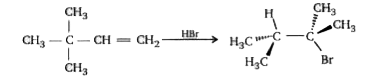
Consider the addition of HBr to 3,3-Dime...

Consider the addition of HBr to 3,3-Dimethyl-1-butene shown below. What is the best mechanistic explanation for the formation of the observed product ?

A

Protonation of the alkene followed by a hydride shift and addition of bromide to the carbocation

B

Double bond shift in the alkene following by the protonation and addition of bromide to the carbocation

C

Addition of bromide to the alkene followed by a double bond shift and protonation

D

Protonation of the alkene followed by a methyl shift and addition of bromide to the carbocation

Text Solution

Verified by Experts

The correct Answer is:
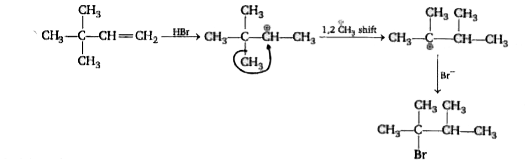
D

Promotional Banner

Topper's Solved these Questions

  • HYDROCARBONS (ALKENES)

    MS CHOUHAN|Exercise LEVEL-2|22 Videos
  • HYDROCARBONS (ALKANES)

    MS CHOUHAN|Exercise LEVEL - 2|11 Videos
  • HYDROCARBONS (ALKYNES)

    MS CHOUHAN|Exercise Level -1|32 Videos

Similar Questions

Explore conceptually related problems

The stability of 2,3-dimethyl but-2-ene is more than 2-butene. This can best be explained in terms of

In the addition of HBr to 1, 3-buta diene, one product is called the kinetic product and the other is called the thermodynamic product. Which of the following description applies to kinetic product? a) 1, 2 product b) 1, 4 product c) most stable d) least stable e) formed slowest f) formed fastest g) formed at low pressure h) formed at high temperature i) most substituted alkene j) least substituted alkene k) bromide attack at most substituted site l) bromide attack at least substituted site

What is the thermodynamic product obtained from the addition of 1 mole of HBr to 1,3-butadiene?

Sulphide ion in alkaline solution reacts with solid sulphur to form polysulphide ions having formulae S_2^(2-) , S_3^(2-) , S_4^(2-) and so on. The equilibrium constant for the formation of S_2^(2-) is 12(K_1) and for the formation of S_3^(2-) is 132(K_2) both from S and S^(2-) . What is the equilibrium constant for the formation of S_3^(2-) from S_2^(2-) and S ?

What is the quadratic polynomial the sum of whose zeroes id (-3)/(2) and the product of the zeroes is -1

What is the quadratic polynomial whose sum of zeroes is (-3)/2 and the product of zeroes is -1 .

1) The -=C-H unit of an alkyne is more acidic than a C – H unit of an alkene or alkane, allowing acetylene and terminal alkynes to be converted to their conjugate bases -= C . 2) Unlike alkenes, alkynes are reduced by metals, especially Li, Na and K. 3) Unlike alkenes, alkynes can undergo nucleophilic as well as electrophilic addition. Which of the following best describes what happens in the first step in the mechanism of the reaction shown? CH_3 CH_2CH_2CHBr_2 + 3NaNH_2 overset(NH_3)to CH_3CH_2C -=CNa +2NaBr +3NH_3

MS CHOUHAN-HYDROCARBONS (ALKENES)-LEVEL-2
  1. Consider the addition of HBr to 3,3-Dimethyl-1-butene shown below. Wha...

    Text Solution

    |

  2. In each reagent box write a letter designating the best reagent and co...

    Text Solution

    |

  3. Propene (CH3 – CH = CH2) can be transformed to compounds (a to j) list...

    Text Solution

    |

  4. In each reaction box write a single letter designating the best reagen...

    Text Solution

    |

  5. Match the reagents a-j with products A-J. There is one best product fo...

    Text Solution

    |

  6. Match the column :

    Text Solution

    |

  7. Match the column I with column II and with column III (Matrix).

    Text Solution

    |

  8. Match the column I and II.

    Text Solution

    |

  9. Sum of molecular mass of A, B, C, D (i.e. A+B + C + D) is equal to :

    Text Solution

    |

  10. underset("(all isomers) ")(C2FClBrl) underset(Ni) overset(H2)to (A)(ex...

    Text Solution

    |

  11. Match the following columns

    Text Solution

    |

  12. Vladimir Markovnikov rule : Alkenes undergo electrophilic addition rea...

    Text Solution

    |

  13. Vladimir Markovnikov rule : Alkenes undergo electrophilic addition rea...

    Text Solution

    |

  14. Vladimir Markovnikov rule : Alkenes undergo electrophilic addition rea...

    Text Solution

    |

  15. Vladimir Markovnikov rule : Alkenes undergo electrophilic addition rea...

    Text Solution

    |

  16. Vladimir Markovnikov rule : Alkenes undergo electrophilic addition rea...

    Text Solution

    |

  17. Vladimir Markovnikov rule : Alkenes undergo electrophilic addition rea...

    Text Solution

    |

  18. CH3 - CH2-CH=CH2+CH2 OH overset(H^(o+))to CH3-CH2- underset(OCH3) un...

    Text Solution

    |

  19. CH3 - CH2-CH=CH2+CH2 OH overset(H^(o+))to CH3-CH2- underset(OCH3) un...

    Text Solution

    |

  20. CH3 - CH2-CH=CH2+CH2 OH overset(H^(o+))to CH3-CH2- underset(OCH3) un...

    Text Solution

    |

  21. CH3 - CH2-CH=CH2+CH2 OH overset(H^(o+))to CH3-CH2- underset(OCH3) un...

    Text Solution

    |

