Home
Class 12
CHEMISTRY
Hydroboration of 1-methylcyclopentene us...

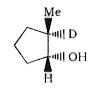
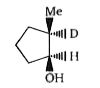
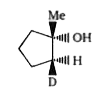
Hydroboration of 1-methylcyclopentene using `B_2 D_6`, followed by treatment with alkaline hydrogen peroxide, gives

A

B

C

D

Text Solution

Verified by Experts

The correct Answer is:

A

Hydroboration-oxidation take place (syn addition).
Promotional Banner

Topper's Solved these Questions

  • HYDROCARBONS (ALKENES)

    MS CHOUHAN|Exercise LEVEL-2|22 Videos
  • HYDROCARBONS (ALKANES)

    MS CHOUHAN|Exercise LEVEL - 2|11 Videos
  • HYDROCARBONS (ALKYNES)

    MS CHOUHAN|Exercise Level -1|32 Videos

Similar Questions

Explore conceptually related problems

Hydroboration is a reaction in which the boron hydride acts as an electrophile, R_2BH adds to a carbon - carbon double which acts as a nucleophile Organoborane compound The organoborane compound then is oxidised by treatment with hydrogen peroxide in aqueous sodium hydroxide to from alcohol. The OH group enters the carbon atom from the same side where the boron atom was present. Hence this reaction is highly regioselective and the boron atom attacheto that carbon atom which is less sterically hindred. Hydroboration oxidation and acid hydration will not give the same products in case of

Hydroboration is a reaction in which the boron hydride acts as an electrophile, R_2BH adds to a carbon - carbon double which acts as a nucleophile Organoborane compound The organoborane compound then is oxidised by treatment with hydrogen peroxide in aqueous sodium hydroxide to from alcohol. The OH group enters the carbon atom from the same side where the boron atom was present. Hence this reaction is highly regioselective and the boron atom attacheto that carbon atom which is less sterically hindred. Hydroboration oxidation and acid hydration will not give the same products in case of

Hydroboration is a reaction in which the boron hydride acts as an electrophile, R_2BH adds to a carbon - carbon double which acts as a nucleophile Organoborane compound The organoborane compound then is oxidised by treatment with hydrogen peroxide in aqueous sodium hydroxide to from alcohol. The OH group enters the carbon atom from the same side where the boron atom was present. Hence this reaction is highly regioselective and the boron atom attacheto that carbon atom which is less sterically hindred.

Hydroboration is a reaction in which the boron hydride acts as an electrophile, R_2BH adds to a carbon - carbon double which acts as a nucleophile Organoborane compound The organoborane compound then is oxidised by treatment with hydrogen peroxide in aqueous sodium hydroxide to from alcohol. The OH group enters the carbon atom from the same side where the boron atom was present. Hence this reaction is highly regioselective and the boron atom attacheto that carbon atom which is less sterically hindred.

Which of the following undergoes reduction with hydrogen peroxide in an alkaline medium ?

Which of the following does not give hydrogen peroxide on hydrolysis?

1,2-Dibromopropane on treatment with X moles of NaNH_2 followed by treatment with ethyl bromide gave a pentyne. The value of X is

Give the structures of the major organic products from 3-ethyl-2-pentene using (i) HBr in the presence of peroxide and (ii) HCl in the presence of peroxide.

MS CHOUHAN-HYDROCARBONS (ALKENES)-LEVEL-2
  1. Hydroboration of 1-methylcyclopentene using B2 D6, followed by treatme...

    Text Solution

    |

  2. In each reagent box write a letter designating the best reagent and co...

    Text Solution

    |

  3. Propene (CH3 – CH = CH2) can be transformed to compounds (a to j) list...

    Text Solution

    |

  4. In each reaction box write a single letter designating the best reagen...

    Text Solution

    |

  5. Match the reagents a-j with products A-J. There is one best product fo...

    Text Solution

    |

  6. Match the column :

    Text Solution

    |

  7. Match the column I with column II and with column III (Matrix).

    Text Solution

    |

  8. Match the column I and II.

    Text Solution

    |

  9. Sum of molecular mass of A, B, C, D (i.e. A+B + C + D) is equal to :

    Text Solution

    |

  10. underset("(all isomers) ")(C2FClBrl) underset(Ni) overset(H2)to (A)(ex...

    Text Solution

    |

  11. Match the following columns

    Text Solution

    |

  12. Vladimir Markovnikov rule : Alkenes undergo electrophilic addition rea...

    Text Solution

    |

  13. Vladimir Markovnikov rule : Alkenes undergo electrophilic addition rea...

    Text Solution

    |

  14. Vladimir Markovnikov rule : Alkenes undergo electrophilic addition rea...

    Text Solution

    |

  15. Vladimir Markovnikov rule : Alkenes undergo electrophilic addition rea...

    Text Solution

    |

  16. Vladimir Markovnikov rule : Alkenes undergo electrophilic addition rea...

    Text Solution

    |

  17. Vladimir Markovnikov rule : Alkenes undergo electrophilic addition rea...

    Text Solution

    |

  18. CH3 - CH2-CH=CH2+CH2 OH overset(H^(o+))to CH3-CH2- underset(OCH3) un...

    Text Solution

    |

  19. CH3 - CH2-CH=CH2+CH2 OH overset(H^(o+))to CH3-CH2- underset(OCH3) un...

    Text Solution

    |

  20. CH3 - CH2-CH=CH2+CH2 OH overset(H^(o+))to CH3-CH2- underset(OCH3) un...

    Text Solution

    |

  21. CH3 - CH2-CH=CH2+CH2 OH overset(H^(o+))to CH3-CH2- underset(OCH3) un...

    Text Solution

    |
