Home
Class 12
CHEMISTRY
Propene (CH3 – CH = CH2) can be transfor...

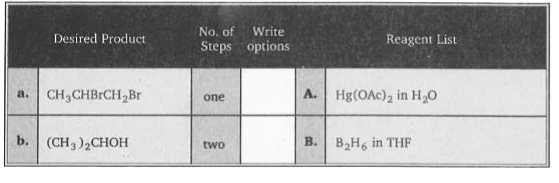
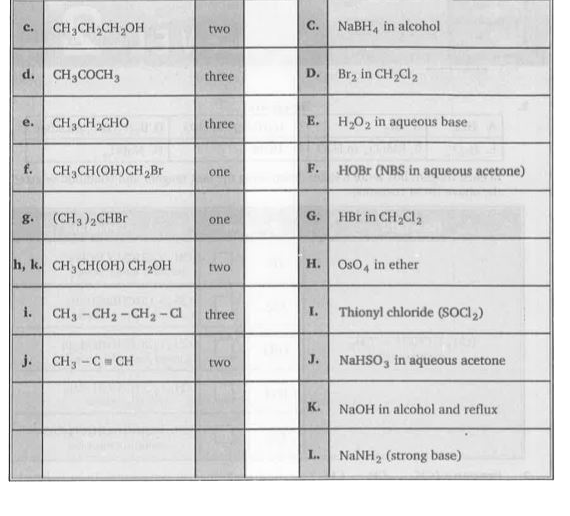
Propene `(CH_3 – CH = CH_2) `can be transformed to compounds (a to j) listed in the left-hand column. Write letter designating the reagent, you believe will achieve desired transformation. In the case of a multi step sequence write the reagent in the order they are to be used.

Text Solution

Verified by Experts

The correct Answer is:

a-D; b-A, C; c-B, E; d - A, C, F; e-B, E, F;f-F;g-G; h-I, K; i-B, E, I; J-D, L

(a) Halogenation (b) Oxymercuration-De-mercuration reaction (OMDM reaction) (c) Hydroboration-oxidation reaction (HBO reaction)
` (d) CH_3 CH =CH_2 overset(OMDM) to CH_3 - overset(O )overset(||)C-CH_3 underset("oxidising agent ")overset(HOBr)to CH_3 - CH_2 -CHO`
(f) Halohydrin formation (g) Markovnikoff addition (h) Oxidation reaction
`(i) CH_3-CH=CH_2 overset(HBO)to CH_3 -CH_2 -CH_2 -CH_2 -OH underset("Darzene process ")overset("SOCl_2)to CH_3 -CH_2 -CH_2 -Cl +SO_2 +HCl`
(j) Halogenation and elimination.
Promotional Banner

Topper's Solved these Questions

  • HYDROCARBONS (ALKENES)

    MS CHOUHAN|Exercise LEVEL-2|22 Videos
  • HYDROCARBONS (ALKANES)

    MS CHOUHAN|Exercise LEVEL - 2|11 Videos
  • HYDROCARBONS (ALKYNES)

    MS CHOUHAN|Exercise Level -1|32 Videos

Similar Questions

Explore conceptually related problems

Olefins can be halogenated in the allylic position by number of reagents of which N-bromo succinimide (NBS) is the most common. When this reagent is used the reaction is known as WohlZiegler bromination. Other N-bromoamides have also been used. To a much lesser extent allylic chlorination has been carried out with N-chloro-succinimide. N-Chloro-N-cyclohexyl benzene sulphonamide or t-hypochlorite when the allylic radical intermediate is unsymmetrical allylic rearrangement takes place so that the mixture of both possible products is obtained. CH_3 - CH_2 -CH = CH_2underset(hv)overset(NBS)(to) CH_3 - CH = CH - CH_2 - Br + CH_3 - undersetoverset(|)(Br)(C ) - CH = CH_2 NBS is also a highly regioselective brominating agent at other positions, including positions a to a carbonyl group.

Olefins can be halogenated in the allylic position by number of reagents of which N-bromo succinimide (NBS) is the most common. When this reagent is used the reaction is known as WohlZiegler bromination. Other N-bromoamides have also been used. To a much lesser extent allylic chlorination has been carried out with N-chloro-succinimide. N-Chloro-N-cyclohexyl benzene sulphonamide or t-hypochlorite when the allylic radical intermediate is unsymmetrical allylic rearrangement takes place so that the mixture of both possible products is obtained. CH_3 - CH_2 -CH = CH_2underset(hv)overset(NBS)(to) CH_3 - CH = CH - CH_2 - Br + CH_3 - undersetoverset(|)(Br)(C ) - CH = CH_2 NBS is also a highly regioselective brominating agent at other positions, including positions a to a carbonyl group.

Olefins can be halogenated in the allylic position by number of reagents of which N-bromo succinimide (NBS) is the most common. When this reagent is used the reaction is known as WohlZiegler bromination. Other N-bromoamides have also been used. To a much lesser extent allylic chlorination has been carried out with N-chloro-succinimide. N-Chloro-N-cyclohexyl benzene sulphonamide or t-hypochlorite when the allylic radical intermediate is unsymmetrical allylic rearrangement takes place so that the mixture of both possible products is obtained. CH_3 - CH_2 -CH = CH_2underset(hv)overset(NBS)(to) CH_3 - CH = CH - CH_2 - Br + CH_3 - undersetoverset(|)(Br)(C ) - CH = CH_2 NBS is also a highly regioselective brominating agent at other positions, including positions a to a carbonyl group. Which of the following is allylic chlorinating agent ?

Hydrogen bonding is said to be formed, -when sightly acidic hydrogen-atom attached to a strongly, electronegative fluorine, oxygen or nitrogen atom. is held with weak. electrostatic forces by the non-bonded pair of electrons of another atom. The co-ordination number of hydrogen in such cases is two. It acts as a bridge between two atoms, to one of which it is covalently bonded and to other attached through electrostatic forces, also called hydrogen bond. Though the hydrogen atoms in a methyl group are not polarised, if an electronegative group like chloro, carbonyl, nitro or cyano (in order to increase electronegativity) is attached to it, the C-H bond gets polarised due to the inductive effect and the hydrogen atom becomes slightly acidic resulting in the formation of weak hydrogen bonds. Though a weak bond the H-bond effects is large number of the physical properties of compounds some of which are - Boiling points of liquids - Solubility of polar compounds in polar solvents (containig H attached with strong electronegative atom) - Viscosity of liquids . Acidity Which of the following combinations can involve hydrogen bonding I) Mixture of KF and HF " " II) Mixture of CH_(3)COCH_(3) and CHCI_(3) III) Mixture of NH_(4) CI and H_(2)O" " IV) Mixture of CH_(3) and H_(2)O

Following is the list of four halides. Select correct sequence of decreasing order of reactivity for Spi reaction using the codes given below I) C_6H_5-underset(CH_3)underset(|)(CH)-Br " " II) C_6H_5 - CH_2 - Br III) C_6H_5-underset(CH_3)underset(|)(CH)-I " " iv) C_6H_5-CH_2-I

Propyne overset("Na(l))underset(Delta)rarrX+1/2H_(2),Xoverset(CH_3)underset(Delta)rarrY Which of the following reagents can be used to distinguish Y from propyne?

R- overset(O) overset(||) C-R overset(?) to R- CH_2 -R identify numbers of reagent that can be used be used for above conversion . (a) Zn -Hg //HCI " " (b ) LIAIH_4 " "(c ) CHCI_3 +NaOH (d ) N_2H_4 //overset(Ө)(OH) " " (e ) {:(CH_2 -SH ),(|),(CH_2 -SH ):} , H_2 //Ni " " (f ) SeO_2

MS CHOUHAN-HYDROCARBONS (ALKENES)-LEVEL-2
  1. In each reagent box write a letter designating the best reagent and co...

    Text Solution

    |

  2. Propene (CH3 – CH = CH2) can be transformed to compounds (a to j) list...

    Text Solution

    |

  3. In each reaction box write a single letter designating the best reagen...

    Text Solution

    |

  4. Match the reagents a-j with products A-J. There is one best product fo...

    Text Solution

    |

  5. Match the column :

    Text Solution

    |

  6. Match the column I with column II and with column III (Matrix).

    Text Solution

    |

  7. Match the column I and II.

    Text Solution

    |

  8. Sum of molecular mass of A, B, C, D (i.e. A+B + C + D) is equal to :

    Text Solution

    |

  9. underset("(all isomers) ")(C2FClBrl) underset(Ni) overset(H2)to (A)(ex...

    Text Solution

    |

  10. Match the following columns

    Text Solution

    |

  11. Vladimir Markovnikov rule : Alkenes undergo electrophilic addition rea...

    Text Solution

    |

  12. Vladimir Markovnikov rule : Alkenes undergo electrophilic addition rea...

    Text Solution

    |

  13. Vladimir Markovnikov rule : Alkenes undergo electrophilic addition rea...

    Text Solution

    |

  14. Vladimir Markovnikov rule : Alkenes undergo electrophilic addition rea...

    Text Solution

    |

  15. Vladimir Markovnikov rule : Alkenes undergo electrophilic addition rea...

    Text Solution

    |

  16. Vladimir Markovnikov rule : Alkenes undergo electrophilic addition rea...

    Text Solution

    |

  17. CH3 - CH2-CH=CH2+CH2 OH overset(H^(o+))to CH3-CH2- underset(OCH3) un...

    Text Solution

    |

  18. CH3 - CH2-CH=CH2+CH2 OH overset(H^(o+))to CH3-CH2- underset(OCH3) un...

    Text Solution

    |

  19. CH3 - CH2-CH=CH2+CH2 OH overset(H^(o+))to CH3-CH2- underset(OCH3) un...

    Text Solution

    |

  20. CH3 - CH2-CH=CH2+CH2 OH overset(H^(o+))to CH3-CH2- underset(OCH3) un...

    Text Solution

    |
