Home
Class 12
CHEMISTRY
Vladimir Markovnikov rule : Alkenes unde...

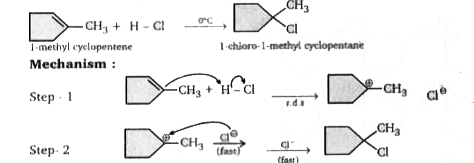
Vladimir Markovnikov rule : Alkenes undergo electrophilic addition reactions. It is triggered by the acid acting as a electrophile toward t-electrons of the double bond. Markovnikov's rule states that when an unsymmetrically substituted alkene reacts with a hydrogen halide, the hydrogen atom adds to the carbon that has the greater number of hydrogen, e.g.,

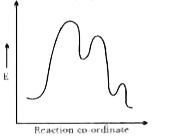
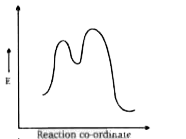
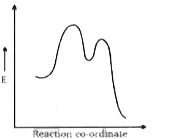
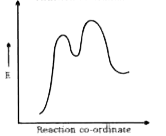
What is the energy profile for the given reaction ?

A

B

C

D

Text Solution

Verified by Experts

The correct Answer is:

C

Promotional Banner

Topper's Solved these Questions

  • HYDROCARBONS (ALKENES)

    MS CHOUHAN|Exercise LEVEL-2|22 Videos
  • HYDROCARBONS (ALKANES)

    MS CHOUHAN|Exercise LEVEL - 2|11 Videos
  • HYDROCARBONS (ALKYNES)

    MS CHOUHAN|Exercise Level -1|32 Videos

Similar Questions

Explore conceptually related problems

Hydroboration is a reaction in which the boron hydride acts as an electrophile, R_2BH adds to a carbon - carbon double which acts as a nucleophile Organoborane compound The organoborane compound then is oxidised by treatment with hydrogen peroxide in aqueous sodium hydroxide to from alcohol. The OH group enters the carbon atom from the same side where the boron atom was present. Hence this reaction is highly regioselective and the boron atom attacheto that carbon atom which is less sterically hindred. Hydroboration oxidation and acid hydration will not give the same products in case of

Hydroboration is a reaction in which the boron hydride acts as an electrophile, R_2BH adds to a carbon - carbon double which acts as a nucleophile Organoborane compound The organoborane compound then is oxidised by treatment with hydrogen peroxide in aqueous sodium hydroxide to from alcohol. The OH group enters the carbon atom from the same side where the boron atom was present. Hence this reaction is highly regioselective and the boron atom attacheto that carbon atom which is less sterically hindred. Hydroboration oxidation and acid hydration will not give the same products in case of

Hydroboration is a reaction in which the boron hydride acts as an electrophile, R_2BH adds to a carbon - carbon double which acts as a nucleophile Organoborane compound The organoborane compound then is oxidised by treatment with hydrogen peroxide in aqueous sodium hydroxide to from alcohol. The OH group enters the carbon atom from the same side where the boron atom was present. Hence this reaction is highly regioselective and the boron atom attacheto that carbon atom which is less sterically hindred.

Hydroboration is a reaction in which the boron hydride acts as an electrophile, R_2BH adds to a carbon - carbon double which acts as a nucleophile Organoborane compound The organoborane compound then is oxidised by treatment with hydrogen peroxide in aqueous sodium hydroxide to from alcohol. The OH group enters the carbon atom from the same side where the boron atom was present. Hence this reaction is highly regioselective and the boron atom attacheto that carbon atom which is less sterically hindred.

Markovnikov addition takes place with unsymmetrical alkenes. The positive part of the reagent gets connected to the double bonded carbon with more number of hydrogens. In presence of peroxide and in special cases addition takes place against Markovnikov rule. In which of the following compound addition takes place against Markovnikov rule

Markovnikov addition takes place with unsymmetrical alkenes. The positive part of the reagent gets connected to the double bonded carbon with more number of hydrogens. In presence of peroxide and in special cases addition takes place against Markovnikov rule. Addition of HCl or HI does not take place against ,Markoņikoff even in presence of peroxide, The reason is

Markovnikov addition takes place with unsymmetrical alkenes. The positive part of the reagent gets connected to the double bonded carbon with more number of hydrogens. In presence of peroxide and in special cases addition takes place against Markovnikov rule. 1-methyl cyclohenene on hydroboroation it will give

Amines are less reactive in substitution reactions. Their reactivity is much lesser than alcohols and alkylflourides towards substitution. Protonation of the amino group makes it a better leaving group, but not nearly as good a leaving group as a protonated alcohol. Protonated amino groups cannot be displaced by OH^(-) because it would react immediately with the acidic hydrogen which would convert it in to a poor nucleophile. The leaving group in quartenary ammonium ion has about the same leaving tendency as a protonated amino group but does not have acidic hydrogen. The reaction of a quartenary ammonium ion with hydroxide ion is known as Hoffmann elimination reaction. The leaving group is tertiary amine. Since a tertiary amine is only a moderately good leaving group, the reaction requires heat. The carbon to which the tertiary amine is attached is designated as alpha carbon. When the hydroxide ion starts to remove a beta H from a quartenary ammonium ion, the leaving group does not immediately start to leave because a tertiary amine is not a good leaving group. As a result, a partial negative charge builds up on the carbon from which the proton is removed. The compounds 'C' in question number 31 on heating with moist silver oxide gives

MS CHOUHAN-HYDROCARBONS (ALKENES)-LEVEL-2
  1. In each reaction box write a single letter designating the best reagen...

    Text Solution

    |

  2. Match the reagents a-j with products A-J. There is one best product fo...

    Text Solution

    |

  3. Match the column :

    Text Solution

    |

  4. Match the column I with column II and with column III (Matrix).

    Text Solution

    |

  5. Match the column I and II.

    Text Solution

    |

  6. Sum of molecular mass of A, B, C, D (i.e. A+B + C + D) is equal to :

    Text Solution

    |

  7. underset("(all isomers) ")(C2FClBrl) underset(Ni) overset(H2)to (A)(ex...

    Text Solution

    |

  8. Match the following columns

    Text Solution

    |

  9. Vladimir Markovnikov rule : Alkenes undergo electrophilic addition rea...

    Text Solution

    |

  10. Vladimir Markovnikov rule : Alkenes undergo electrophilic addition rea...

    Text Solution

    |

  11. Vladimir Markovnikov rule : Alkenes undergo electrophilic addition rea...

    Text Solution

    |

  12. Vladimir Markovnikov rule : Alkenes undergo electrophilic addition rea...

    Text Solution

    |

  13. Vladimir Markovnikov rule : Alkenes undergo electrophilic addition rea...

    Text Solution

    |

  14. Vladimir Markovnikov rule : Alkenes undergo electrophilic addition rea...

    Text Solution

    |

  15. CH3 - CH2-CH=CH2+CH2 OH overset(H^(o+))to CH3-CH2- underset(OCH3) un...

    Text Solution

    |

  16. CH3 - CH2-CH=CH2+CH2 OH overset(H^(o+))to CH3-CH2- underset(OCH3) un...

    Text Solution

    |

  17. CH3 - CH2-CH=CH2+CH2 OH overset(H^(o+))to CH3-CH2- underset(OCH3) un...

    Text Solution

    |

  18. CH3 - CH2-CH=CH2+CH2 OH overset(H^(o+))to CH3-CH2- underset(OCH3) un...

    Text Solution

    |

  19. CH3 - CH2-CH=CH2+CH2 OH overset(H^(o+))to CH3-CH2- underset(OCH3) un...

    Text Solution

    |

  20. Match the column I and II :

    Text Solution

    |

