Home
Class 12
CHEMISTRY
Vladimir Markovnikov rule : Alkenes unde...

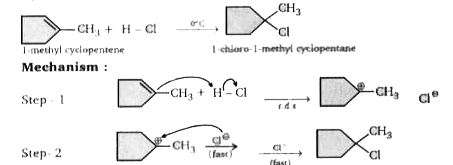
Vladimir Markovnikov rule : Alkenes undergo electrophilic addition reactions. It is triggered by the acid acting as a electrophile toward t-electrons of the double bond. Markovnikov's rule states that when an unsymmetrically substituted alkene reacts with a hydrogen halide, the hydrogen atom adds to the carbon that has the greater number of hydrogen, e.g.,

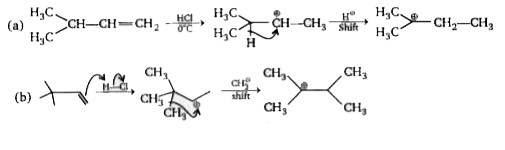
In which of following reactions carbocation rearrangement is possible ?

A

`(CH_3)_2 CH-CH=CH_2 underset(O^@ C)overset(HCl)to`

B

`(CH_3)_3 C - CH= CH_2 underset(0^@C//Cl_4 )overset(HBr)to`

C

`ph -CH_2 - CH-CH_2 underset(C Cl_4) overset(HBr)to `

D

All of these

Text Solution

Verified by Experts

The correct Answer is:
D

Promotional Banner

Topper's Solved these Questions

  • HYDROCARBONS (ALKENES)

    MS CHOUHAN|Exercise LEVEL-2|22 Videos
  • HYDROCARBONS (ALKANES)

    MS CHOUHAN|Exercise LEVEL - 2|11 Videos
  • HYDROCARBONS (ALKYNES)

    MS CHOUHAN|Exercise Level -1|32 Videos

Similar Questions

Explore conceptually related problems

Markovnikov addition takes place with unsymmetrical alkenes. The positive part of the reagent gets connected to the double bonded carbon with more number of hydrogens. In presence of peroxide and in special cases addition takes place against Markovnikov rule. 1-methyl cyclohenene on hydroboroation it will give

The products of bond breaking, shown below, are not stable, and cannot be isolated for prolonged study. Such species are referred to as reactive intermediate, and are belived to be transient intermediates in many reactions. The general structures and names of four such intermediates are, Charged Intermediates Uncharged Intermediates Carbocations (called carbonium ions in the older literature) are electrophiles and carbananions are nucleophiles. Carbenes have only a valence shell sextet of electrons and are therefore electron deficient. In this sense they are elecrophiles, but the non-bonding electron pair also gives carbenes nucleophilic character. As a rule, the electrophilic character dominates carbene reactivity. Carbon radicals have only seven valence electrons, and may be considered electron deficient, however, they do not in general bond to nucleophilic electron pair, so their chemistry exhibits differences from that of conventional electrophiles. Radical intermediates are often called free radicals. Intermediates are in general stabilised with conjugation, electron donating and electron with drawing groups. Which of the following carbo cations is more stable?

Markovnikov addition takes place with unsymmetrical alkenes. The positive part of the reagent gets connected to the double bonded carbon with more number of hydrogens. In presence of peroxide and in special cases addition takes place against Markovnikov rule. In which of the following compound addition takes place against Markovnikov rule

Alkenes undergo electrophilic addition with many reagents like HX, H_2O , HOCI etc. Except in the case of addition of X_2^(-) in other additions carbocation is formed as intermediate. The rate of such reactions depends on the stability of carbocation. Rearrangements and ring expansion are also common in such reactions. The correct order of reactivity of the following towards electrophilic addition is P) Vinyl chloride Q) Pent-2-ene R) 3-methyl pent-2-ene S) 2,3-dimethyl but-2-ene

Hydroboration is a reaction in which the boron hydride acts as an electrophile, R_2BH adds to a carbon - carbon double which acts as a nucleophile Organoborane compound The organoborane compound then is oxidised by treatment with hydrogen peroxide in aqueous sodium hydroxide to from alcohol. The OH group enters the carbon atom from the same side where the boron atom was present. Hence this reaction is highly regioselective and the boron atom attacheto that carbon atom which is less sterically hindred. Hydroboration oxidation and acid hydration will not give the same products in case of

Hydroboration is a reaction in which the boron hydride acts as an electrophile, R_2BH adds to a carbon - carbon double which acts as a nucleophile Organoborane compound The organoborane compound then is oxidised by treatment with hydrogen peroxide in aqueous sodium hydroxide to from alcohol. The OH group enters the carbon atom from the same side where the boron atom was present. Hence this reaction is highly regioselective and the boron atom attacheto that carbon atom which is less sterically hindred. Hydroboration oxidation and acid hydration will not give the same products in case of

Hydroboration is a reaction in which the boron hydride acts as an electrophile, R_2BH adds to a carbon - carbon double which acts as a nucleophile Organoborane compound The organoborane compound then is oxidised by treatment with hydrogen peroxide in aqueous sodium hydroxide to from alcohol. The OH group enters the carbon atom from the same side where the boron atom was present. Hence this reaction is highly regioselective and the boron atom attacheto that carbon atom which is less sterically hindred.

Hydroboration is a reaction in which the boron hydride acts as an electrophile, R_2BH adds to a carbon - carbon double which acts as a nucleophile Organoborane compound The organoborane compound then is oxidised by treatment with hydrogen peroxide in aqueous sodium hydroxide to from alcohol. The OH group enters the carbon atom from the same side where the boron atom was present. Hence this reaction is highly regioselective and the boron atom attacheto that carbon atom which is less sterically hindred.

Hydrogen bonding is said to be formed, -when sightly acidic hydrogen-atom attached to a strongly, electronegative fluorine, oxygen or nitrogen atom. is held with weak. electrostatic forces by the non-bonded pair of electrons of another atom. The co-ordination number of hydrogen in such cases is two. It acts as a bridge between two atoms, to one of which it is covalently bonded and to other attached through electrostatic forces, also called hydrogen bond. Though the hydrogen atoms in a methyl group are not polarised, if an electronegative group like chloro, carbonyl, nitro or cyano (in order to increase electronegativity) is attached to it, the C-H bond gets polarised due to the inductive effect and the hydrogen atom becomes slightly acidic resulting in the formation of weak hydrogen bonds. Though a weak bond the H-bond effects is large number of the physical properties of compounds some of which are - Boiling points of liquids - Solubility of polar compounds in polar solvents (containig H attached with strong electronegative atom) - Viscosity of liquids . Acidity Which of the following combinations can involve hydrogen bonding I) Mixture of KF and HF " " II) Mixture of CH_(3)COCH_(3) and CHCI_(3) III) Mixture of NH_(4) CI and H_(2)O" " IV) Mixture of CH_(3) and H_(2)O

MS CHOUHAN-HYDROCARBONS (ALKENES)-LEVEL-2
  1. In each reaction box write a single letter designating the best reagen...

    Text Solution

    |

  2. Match the reagents a-j with products A-J. There is one best product fo...

    Text Solution

    |

  3. Match the column :

    Text Solution

    |

  4. Match the column I with column II and with column III (Matrix).

    Text Solution

    |

  5. Match the column I and II.

    Text Solution

    |

  6. Sum of molecular mass of A, B, C, D (i.e. A+B + C + D) is equal to :

    Text Solution

    |

  7. underset("(all isomers) ")(C2FClBrl) underset(Ni) overset(H2)to (A)(ex...

    Text Solution

    |

  8. Match the following columns

    Text Solution

    |

  9. Vladimir Markovnikov rule : Alkenes undergo electrophilic addition rea...

    Text Solution

    |

  10. Vladimir Markovnikov rule : Alkenes undergo electrophilic addition rea...

    Text Solution

    |

  11. Vladimir Markovnikov rule : Alkenes undergo electrophilic addition rea...

    Text Solution

    |

  12. Vladimir Markovnikov rule : Alkenes undergo electrophilic addition rea...

    Text Solution

    |

  13. Vladimir Markovnikov rule : Alkenes undergo electrophilic addition rea...

    Text Solution

    |

  14. Vladimir Markovnikov rule : Alkenes undergo electrophilic addition rea...

    Text Solution

    |

  15. CH3 - CH2-CH=CH2+CH2 OH overset(H^(o+))to CH3-CH2- underset(OCH3) un...

    Text Solution

    |

  16. CH3 - CH2-CH=CH2+CH2 OH overset(H^(o+))to CH3-CH2- underset(OCH3) un...

    Text Solution

    |

  17. CH3 - CH2-CH=CH2+CH2 OH overset(H^(o+))to CH3-CH2- underset(OCH3) un...

    Text Solution

    |

  18. CH3 - CH2-CH=CH2+CH2 OH overset(H^(o+))to CH3-CH2- underset(OCH3) un...

    Text Solution

    |

  19. CH3 - CH2-CH=CH2+CH2 OH overset(H^(o+))to CH3-CH2- underset(OCH3) un...

    Text Solution

    |

  20. Match the column I and II :

    Text Solution

    |

