Home
Class 12
CHEMISTRY
Vladimir Markovnikov rule : Alkenes unde...

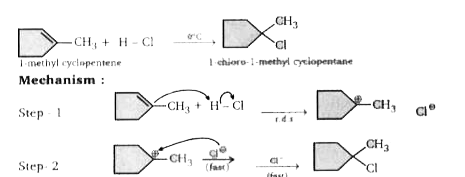
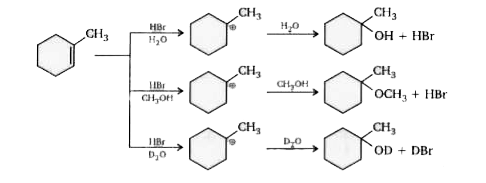
Vladimir Markovnikov rule : Alkenes undergo electrophilic addition reactions. It is triggered by the acid acting as a electrophile toward t-electrons of the double bond. Markovnikov's rule states that when an unsymmetrically substituted alkene reacts with a hydrogen halide, the hydrogen atom adds to the carbon that has the greater number of hydrogen, e.g.,

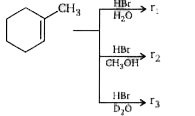
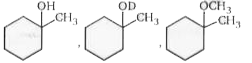
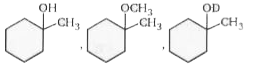
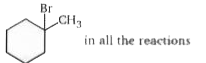
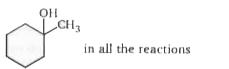
Identify the major products `r_1, r_2, and r_3` in the given reactions.

A

B

C

D

Text Solution

Verified by Experts

The correct Answer is:
B

Promotional Banner

Topper's Solved these Questions

  • HYDROCARBONS (ALKENES)

    MS CHOUHAN|Exercise LEVEL-2|22 Videos
  • HYDROCARBONS (ALKANES)

    MS CHOUHAN|Exercise LEVEL - 2|11 Videos
  • HYDROCARBONS (ALKYNES)

    MS CHOUHAN|Exercise Level -1|32 Videos

Similar Questions

Explore conceptually related problems

Why does benzene undergo electrophilic substitution reactions easily?

Why does benzene undergo electrophilic substitution reactions easily?

Which species will undergo electrophilic substitution reaction most easily?

Discuss Markovnikov's rule and Kharash effect.

The reagent used for getting trans alkene from alkyl substituted acetylene with hydrogen is

C_(6)H_(5)-O-R when treated with hydrogen halide gives

When alkyl substituted acetylene undergoes addition with hydrogen in presence of Lindlar's catalyst, the alkene formed is

Name the gas evolved when acetic acid is react with sodium hydrogen carbonate.

When a greater number of electrons from excited hydrogen atoms reach the ground state, then

When a greater number of electrons from excited hydrogen atoms reach the ground state, then

MS CHOUHAN-HYDROCARBONS (ALKENES)-LEVEL-2
  1. In each reaction box write a single letter designating the best reagen...

    Text Solution

    |

  2. Match the reagents a-j with products A-J. There is one best product fo...

    Text Solution

    |

  3. Match the column :

    Text Solution

    |

  4. Match the column I with column II and with column III (Matrix).

    Text Solution

    |

  5. Match the column I and II.

    Text Solution

    |

  6. Sum of molecular mass of A, B, C, D (i.e. A+B + C + D) is equal to :

    Text Solution

    |

  7. underset("(all isomers) ")(C2FClBrl) underset(Ni) overset(H2)to (A)(ex...

    Text Solution

    |

  8. Match the following columns

    Text Solution

    |

  9. Vladimir Markovnikov rule : Alkenes undergo electrophilic addition rea...

    Text Solution

    |

  10. Vladimir Markovnikov rule : Alkenes undergo electrophilic addition rea...

    Text Solution

    |

  11. Vladimir Markovnikov rule : Alkenes undergo electrophilic addition rea...

    Text Solution

    |

  12. Vladimir Markovnikov rule : Alkenes undergo electrophilic addition rea...

    Text Solution

    |

  13. Vladimir Markovnikov rule : Alkenes undergo electrophilic addition rea...

    Text Solution

    |

  14. Vladimir Markovnikov rule : Alkenes undergo electrophilic addition rea...

    Text Solution

    |

  15. CH3 - CH2-CH=CH2+CH2 OH overset(H^(o+))to CH3-CH2- underset(OCH3) un...

    Text Solution

    |

  16. CH3 - CH2-CH=CH2+CH2 OH overset(H^(o+))to CH3-CH2- underset(OCH3) un...

    Text Solution

    |

  17. CH3 - CH2-CH=CH2+CH2 OH overset(H^(o+))to CH3-CH2- underset(OCH3) un...

    Text Solution

    |

  18. CH3 - CH2-CH=CH2+CH2 OH overset(H^(o+))to CH3-CH2- underset(OCH3) un...

    Text Solution

    |

  19. CH3 - CH2-CH=CH2+CH2 OH overset(H^(o+))to CH3-CH2- underset(OCH3) un...

    Text Solution

    |

  20. Match the column I and II :

    Text Solution

    |

