Home
Class 12
CHEMISTRY
An halide C5H(11)Br on treatment with al...

An halide `C_5H_(11)Br` on treatment with alc. KOH give 2-pentene only. The halide will be :

A

`CH_(3)-CH_(2)-CH_(2)-CH_(2)-CH_(2)-Br`

B

`CH_(3)-CH_(3)-CH_(2)-underset(Br)underset(|)CH-CH_3`

C

`CH_(3)-CH_(2)-underset(Br)underset(|)CH-CH_2-CH_3`

D

`CH_(3)-overset(CH_3)overset(|)CH-underset(Br)underset(|)C-CH_3`

Text Solution

Verified by Experts

The correct Answer is:
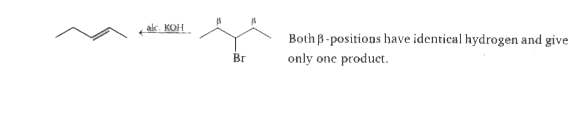
C

Promotional Banner

Topper's Solved these Questions

  • ALKYL HALIDES (ELIMINATION REACTION)

    MS CHOUHAN|Exercise LEVEL-2|25 Videos
  • ALDEHYDES AND KETONES

    MS CHOUHAN|Exercise LEVEL-2|20 Videos
  • ALKYL HALIDES (SUBSTITUTION REACTIONS)

    MS CHOUHAN|Exercise LEVEL-2|41 Videos

Similar Questions

Explore conceptually related problems

H_2O_2 on treatment with chlorine gives :

A primary alkyl halide C_(4)H_(9) Br (A) reacted with alcoholic KOH to give compound B . B on reaction with HBr yields C which is an isomer of A . When A is reacted with sodium metal forms D , C_(6) H_(8) which is different from the compound formed when n-butylbromide is reacted with sodium . Give the structural formulae of A-D and write equations for all the reactions .

The Compound C_6H_5 CH_2 CH(CH_3)Cl on heating with alc. KOH gives

Primary alkyl halide C_(4)H_(9)Br (a) reacted with alcoholic KOH to give compound (b). Compound (b) is reacted with HBr to give (c) which is an isomer of (a). When (a) is reacted with sodium metal it gives compound (d), C_(8)H_(18) which is different from the compound formed when n-butyl bromide is reacted with sodium. Give the structural formula of (a) and write the equations for all the reactions.

An organic compound A(C_4 H_7 C_(13)) yields (B) when treated with aq. KOH. (B) upon treatment with C_2 H_5 OH in presence of acid gave (C) which upon reducing with LiAIH_4 gave (D) and (E). (B) upon treatment with NH_3 followed by heating with P_4 O_(10) and subsequent hydrolysis gives back (B). Sodium salt of (B) on Kolbe's electrolysis gave 2, 3-dimethylbutane at anode. The dehydration of compound (D) gives

An organic compound A(C_4 H_7 C_(13)) yields (B) when treated with aq. KOH. (B) upon treatment with C_2 H_5 OH in presence of acid gave (C) which upon reducing with LiAIH_4 gave (D) and (E). (B) upon treatment with NH_3 followed by heating with P_4 O_(10) and subsequent hydrolysis gives back (B). Sodium salt of (B) on Kolbe's electrolysis gave 2, 3-dimethylbutane at anode. Structural formula of compound (C) is

An organic compound A(C_4 H_7 C_(13)) yields(B) when treated with aq. KOH. (B) upon treatment with C_2 H_5 OH in presence of acid gave (C) which upon reducing with LiAIH_4 gave (D) and (E). (B) upon treatment with NH_3 followed by heating with P_4 O_(10) and subsequent hydrolysis gives back(B). Sodium salt of (B) on Kolbe's electrolysis gave 2, 3-dimethylbutane at anode. Structural formula of compound (C) is

An organic compound A(C_4 H_7 C_(13)) yields (B) when treated with aq. KOH. (B) upon treatment with C_2 H_5 OH in presence of acid gave (C) which upon reducing with LiAIH_4 gave (D) and (E). (B) upon treatment with NH_3 followed by heating with P_4 O_(10) and subsequent hydrolysis gives back (B). Sodium salt of (B) on Kolbe's electrolysis gave 2, 3-dimethylbutane at anode. Compound (D) and (E) respectively are

An organic compound A(C_4 H_7 C_(13)) yields(B) when treated with aq. KOH. (B) upon treatment with C_2 H_5 OH in presence of acid gave (C) which upon reducing with LiAIH_4 gave (D) and (E). (B) upon treatment with NH_3 followed by heating with P_4 O_(10) and subsequent hydrolysis gives back(B). Sodium salt of (B) on Kolbe's electrolysis gave 2, 3-dimethylbutane at anode. Compound (D) and (E) respectively are

An organic compound A(C_4 H_7 C_(13)) yields (B) when treated with aq. KOH. (B) upon treatment with C_2 H_5 OH in presence of acid gave (C) which upon reducing with LiAIH_4 gave (D) and (E). (B) upon treatment with NH_3 followed by heating with P_4 O_(10) and subsequent hydrolysis gives back (B). Sodium salt of (B) on Kolbe's electrolysis gave 2, 3-dimethylbutane at anode. The IUPAC name of compound (A) is

