
Home
Class 12
CHEMISTRY
Comprehension E2 raction rarr Elimina...

Comprehension
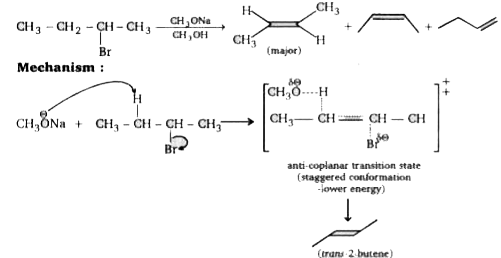
`E_2` raction `rarr` Elimination bimolecular
In the general mechanism of the `E_2` reaction a strong base abstract a proton on a carbon atom adjacent to the one of the leaving group. As the abstracts a proton , a double bond forms and the leaving group leaves.
Product (A) and (B) are :

A

A = cis, B = cis

B

A = trans, B= cis

C

A= trans, B = trans

D

A = cis, B= trans

Text Solution

Verified by Experts

Consider conformer.
Promotional Banner

Topper's Solved these Questions

  • ALKYL HALIDES (ELIMINATION REACTION)

    MS CHOUHAN|Exercise LEVEL-2|25 Videos
  • ALDEHYDES AND KETONES

    MS CHOUHAN|Exercise LEVEL-2|20 Videos
  • ALKYL HALIDES (SUBSTITUTION REACTIONS)

    MS CHOUHAN|Exercise LEVEL-2|41 Videos

Similar Questions

Explore conceptually related problems

In elimination reactions, generally atoms or groups from adjacent carbon atoms in the substrate molecule are removed and a multiple bond is formed

Amines are less reactive in substitution reactions. Their reactivity is much lesser than alcohols and alkylflourides towards substitution. Protonation of the amino group makes it a better leaving group, but not nearly as good a leaving group as a protonated alcohol. Protonated amino groups cannot be displaced by OH^(-) because it would react immediately with the acidic hydrogen which would convert it in to a poor nucleophile. The leaving group in quartenary ammonium ion has about the same leaving tendency as a protonated amino group but does not have acidic hydrogen. The reaction of a quartenary ammonium ion with hydroxide ion is known as Hoffmann elimination reaction. The leaving group is tertiary amine. Since a tertiary amine is only a moderately good leaving group, the reaction requires heat. The carbon to which the tertiary amine is attached is designated as alpha carbon. When the hydroxide ion starts to remove a beta H from a quartenary ammonium ion, the leaving group does not immediately start to leave because a tertiary amine is not a good leaving group. As a result, a partial negative charge builds up on the carbon from which the proton is removed. Which of the following statements are true regarding Hoffmann elimination ?

Amines are less reactive in substitution reactions. Their reactivity is much lesser than alcohols and alkylflourides towards substitution. Protonation of the amino group makes it a better leaving group, but not nearly as good a leaving group as a protonated alcohol. Protonated amino groups cannot be displaced by OH^(-) because it would react immediately with the acidic hydrogen which would convert it in to a poor nucleophile. The leaving group in quartenary ammonium ion has about the same leaving tendency as a protonated amino group but does not have acidic hydrogen. The reaction of a quartenary ammonium ion with hydroxide ion is known as Hoffmann elimination reaction. The leaving group is tertiary amine. Since a tertiary amine is only a moderately good leaving group, the reaction requires heat. The carbon to which the tertiary amine is attached is designated as alpha carbon. When the hydroxide ion starts to remove a beta H from a quartenary ammonium ion, the leaving group does not immediately start to leave because a tertiary amine is not a good leaving group. As a result, a partial negative charge builds up on the carbon from which the proton is removed. Which of the following statements is correct?

Amines are less reactive in substitution reactions. Their reactivity is much lesser than alcohols and alkylflourides towards substitution. Protonation of the amino group makes it a better leaving group, but not nearly as good a leaving group as a protonated alcohol. Protonated amino groups cannot be displaced by OH^(-) because it would react immediately with the acidic hydrogen which would convert it in to a poor nucleophile. The leaving group in quartenary ammonium ion has about the same leaving tendency as a protonated amino group but does not have acidic hydrogen. The reaction of a quartenary ammonium ion with hydroxide ion is known as Hoffmann elimination reaction. The leaving group is tertiary amine. Since a tertiary amine is only a moderately good leaving group, the reaction requires heat. The carbon to which the tertiary amine is attached is designated as alpha carbon. When the hydroxide ion starts to remove a beta H from a quartenary ammonium ion, the leaving group does not immediately start to leave because a tertiary amine is not a good leaving group. As a result, a partial negative charge builds up on the carbon from which the proton is removed. The compounds 'C' in question number 31 on heating with moist silver oxide gives

Electrophilic substitutions are characteristic reaction of aromatic compounds. In this reaction hydrogen of the aromatic ring is replaced by an electophile because hydrogen in the form of HR is very good leaving group. -COOH and -SO_3H are also good leaving groups when they are present either at ortho or at para to the highly activating groups like -NH_2 and -OH. Which one of the following compounds will be most unreactive towards electrophilic substitution reaction?

Electrophilic substitutions are characteristic reaction of aromatic compounds. In this reaction hydrogen of the aromatic ring is replaced by an electophile because hydrogen in the form of HR is very good leaving group. -COOH and -SO_3H are also good leaving groups when they are present either at ortho or at para to the highly activating groups like -NH_2 and -OH. Benzene sulphonic acid is converted into benzene by

(A) Methoxy benzene can be prepared by the reaction of C_6H_5 ONa and CH_3 Br but not by the reaction of C_6H_5Br with CH_3 ONa (R) C_6H_5-Br is not a good substrate for SN? reaction because attack of nucleophile from back side of leaving group is hindered by the ring and also double bond character will be developed between carbon and bromine

(A) Anhydrous ZnCl_2 is used in reaction of alcohols with HCI. (R) ZnCl, forms a complex with oxygen of alcohol and converts - OH into a much better leaving group.

