Home
Class 12
CHEMISTRY
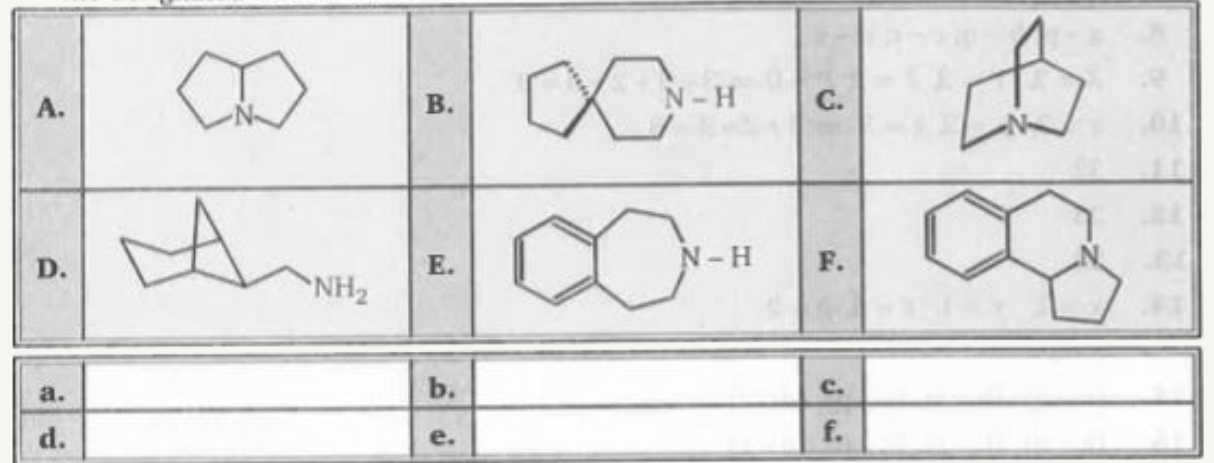
For each of the following amines (A thro...

For each of the following amines (A through D), exhaustive methylation (treatment with excess methyl iodide), followed by Hoffmann elimination (heating with AgOH), repeated as necessaJy, removes the nitrogen atom in the form oftrimethylamine. Indicate the numberof repetitive Hoffmann eliminations required to remove the nitrogen by a number (1 to 4) in the designated answer sheet.

Text Solution

Verified by Experts

Number of C-N bond is equal to number of Hoffmann exhaustive elimination.
Promotional Banner

Topper's Solved these Questions

  • ALKYL HALIDES (ELIMINATION REACTION)

    MS CHOUHAN|Exercise LEVEL-2|25 Videos
  • ALDEHYDES AND KETONES

    MS CHOUHAN|Exercise LEVEL-2|20 Videos
  • ALKYL HALIDES (SUBSTITUTION REACTIONS)

    MS CHOUHAN|Exercise LEVEL-2|41 Videos

Similar Questions

Explore conceptually related problems

Amines are less reactive in substitution reactions. Their reactivity is much lesser than alcohols and alkylflourides towards substitution. Protonation of the amino group makes it a better leaving group, but not nearly as good a leaving group as a protonated alcohol. Protonated amino groups cannot be displaced by OH^(-) because it would react immediately with the acidic hydrogen which would convert it in to a poor nucleophile. The leaving group in quartenary ammonium ion has about the same leaving tendency as a protonated amino group but does not have acidic hydrogen. The reaction of a quartenary ammonium ion with hydroxide ion is known as Hoffmann elimination reaction. The leaving group is tertiary amine. Since a tertiary amine is only a moderately good leaving group, the reaction requires heat. The carbon to which the tertiary amine is attached is designated as alpha carbon. When the hydroxide ion starts to remove a beta H from a quartenary ammonium ion, the leaving group does not immediately start to leave because a tertiary amine is not a good leaving group. As a result, a partial negative charge builds up on the carbon from which the proton is removed. Which of the following statements are true regarding Hoffmann elimination ?

Amines are less reactive in substitution reactions. Their reactivity is much lesser than alcohols and alkylflourides towards substitution. Protonation of the amino group makes it a better leaving group, but not nearly as good a leaving group as a protonated alcohol. Protonated amino groups cannot be displaced by OH^(-) because it would react immediately with the acidic hydrogen which would convert it in to a poor nucleophile. The leaving group in quartenary ammonium ion has about the same leaving tendency as a protonated amino group but does not have acidic hydrogen. The reaction of a quartenary ammonium ion with hydroxide ion is known as Hoffmann elimination reaction. The leaving group is tertiary amine. Since a tertiary amine is only a moderately good leaving group, the reaction requires heat. The carbon to which the tertiary amine is attached is designated as alpha carbon. When the hydroxide ion starts to remove a beta H from a quartenary ammonium ion, the leaving group does not immediately start to leave because a tertiary amine is not a good leaving group. As a result, a partial negative charge builds up on the carbon from which the proton is removed. The compounds 'C' in question number 31 on heating with moist silver oxide gives

Amines are less reactive in substitution reactions. Their reactivity is much lesser than alcohols and alkylflourides towards substitution. Protonation of the amino group makes it a better leaving group, but not nearly as good a leaving group as a protonated alcohol. Protonated amino groups cannot be displaced by OH^(-) because it would react immediately with the acidic hydrogen which would convert it in to a poor nucleophile. The leaving group in quartenary ammonium ion has about the same leaving tendency as a protonated amino group but does not have acidic hydrogen. The reaction of a quartenary ammonium ion with hydroxide ion is known as Hoffmann elimination reaction. The leaving group is tertiary amine. Since a tertiary amine is only a moderately good leaving group, the reaction requires heat. The carbon to which the tertiary amine is attached is designated as alpha carbon. When the hydroxide ion starts to remove a beta H from a quartenary ammonium ion, the leaving group does not immediately start to leave because a tertiary amine is not a good leaving group. As a result, a partial negative charge builds up on the carbon from which the proton is removed. Which of the following statements is correct?

Hydrogen bonding is said to be formed, -when sightly acidic hydrogen-atom attached to a strongly, electronegative fluorine, oxygen or nitrogen atom. is held with weak. electrostatic forces by the non-bonded pair of electrons of another atom. The co-ordination number of hydrogen in such cases is two. It acts as a bridge between two atoms, to one of which it is covalently bonded and to other attached through electrostatic forces, also called hydrogen bond. Though the hydrogen atoms in a methyl group are not polarised, if an electronegative group like chloro, carbonyl, nitro or cyano (in order to increase electronegativity) is attached to it, the C-H bond gets polarised due to the inductive effect and the hydrogen atom becomes slightly acidic resulting in the formation of weak hydrogen bonds. Though a weak bond the H-bond effects is large number of the physical properties of compounds some of which are - Boiling points of liquids - Solubility of polar compounds in polar solvents (containig H attached with strong electronegative atom) - Viscosity of liquids . Acidity Which of the following combinations can involve hydrogen bonding I) Mixture of KF and HF " " II) Mixture of CH_(3)COCH_(3) and CHCI_(3) III) Mixture of NH_(4) CI and H_(2)O" " IV) Mixture of CH_(3) and H_(2)O

The equation of Schroedinger for the hydrogen atom in the time-independet, non-relativistic form is a partial differential equation involving the position coordinates (x, y and z). The potential energy term for the proton-electron system is spherically symmetric of the form -1//4pi in_(0) xx (e^(2)//r) . THus it is advantages to change over from the cartesian coordinates (x,y and z) to the spherical polar coordinates, (r, theta and phi ). In this form the equation become separable in the radial part involving r and the angular part involving theta and phi . The probability of locating the electron within a volume element d tau = 4pi r^(2)dr is then given |Psi|^(2)(4pir^(2)dr) , where Psi is a function of r, theta and phi . With proper conditions imposed on Psi , the treatment yields certain functions, Psi , known as atomic orbitals which are solutions of the equations. Each function Psi correspods to quantum number n, l and m, the principal, the azimuthal and the magnetic quantum number respectively, n has values 1, 2, 3,...., l has values 0, 1, 2, ....(n-1) for each value of n and m (n-1) for each value of n and m (m_(l)) has values =1, +(l+1),...1,0,-1,-2...-l i.e., (2l+1) values for each value of l. In addition a further quantum number called pin had to be introduced with values +-1//2 . Any set of four values for n, l , m and s characterizes a spin orbital. Pauli.s exclusion principle states that a given spin orbital can accomodate not more than electron. Further the values l = 0, l=1, l=2, l=3 are designated s,p,d and f orbitals respectively. Which of the following diagrams corresponds to the 2s orbital ?
