Home
Class 12
CHEMISTRY
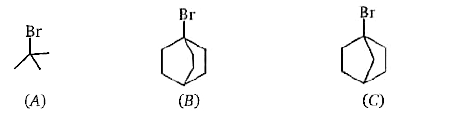
Rate of S(N^2) reaction is :...

Rate of `S_(N^2)` reaction is :

A

`(B) gt (A) gt (C)`

B

`(C) gt (A) gt (B)`

C

`(A) gt (B) gt (C)`

D

`(A) gt (C) gt (B)`

Text Solution

Verified by Experts

The correct Answer is:
C

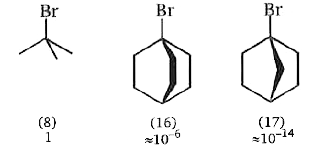
The effect of structure on relative reactivity may be seen particularly clearly when a halogen atom is located at the bridgehead of a bicyclic system. Thus the following rates were observed for solvolysis in 80% aqueous ethanol at `25^@`
All are tertiaryhalides so that attack by the `S_(N^2)` mode would notbe expected to occur on (16) or (17) any more than it did on (8). `S_(N^2)` attack .from the back. on the carbon atom carrying Br would in any case be prevented in (16) and (17) both sterically by their cagelike structure, and also by the impossibility of forcing their fairly rigid framework through transition states with the required planardistribution ofbonds to the bridgehead carbon atom. Solvolysis via rate- limiting formation ofthe ion pair `(S_(N^1))` as happens with (8) is also inhibited because the resultant carbocations from (16) and (17) would be unable, because of their rigid frameworks, to stabilise themselves by collapsing to the stable planar state. These carbocation intermediates are thus ofvery much higher energy level than usual, and therefore are formed only slowly and with reluctance. The very greatly reduced solvolysis rate of (17) compared with (16) reflects the greater rigidity about the bridgehead (cationic) carbon with a one carbon (17), than with a two- carbon (16), bridge.
Promotional Banner

Topper's Solved these Questions

  • 5C ALKYL HALIDES

    MS CHOUHAN|Exercise LEVEL-2 |3 Videos
  • 5C ALKYL HALIDES

    MS CHOUHAN|Exercise LEVEL-2 (SUBJECTIVE PROBLEMS)|1 Videos
  • ALCOHOL,ETHERS AND EPOXIDES

    MS CHOUHAN|Exercise SUBJECTIVE PROBLEMS|1 Videos

Similar Questions

Explore conceptually related problems

S_N2 reactions are

Which of the following is an example of S_(N^2) reaction ?

Most reactive halide towards S_(N^1) reaction is

Predict the order of reactivity of the following compounds in S_(n^(1)) and S_(N^(2)) reactions : The four isomeric bromobutanes,

The organic chloro compound , which shows complete stereo chemical inversion during S_(N^2) reaction is

The rate of a reaction is given as , rate = k[X]^(3//2) [Y]^(-1//2) What is the order of the reaction ? If Y is taken large in excess , write the rate equation.

(A) Units of rate of reaction are independent of order of the reaction (R ) Rate of reaction is the change in concentration of reactants in unit time

What is the stereochemical result of S_(N)^(1) and S_(N) ^(2) reactions ?

(A): S_(N^(2)) reaction takes place in single step. (R): S_(N^(2)) reaction involves the reactivity order of alkyl halides as 1^@ gt 2^@ gt 3^@ halides.