Home
Class 12
CHEMISTRY
Consider the pairs ofethers, numbered I ...

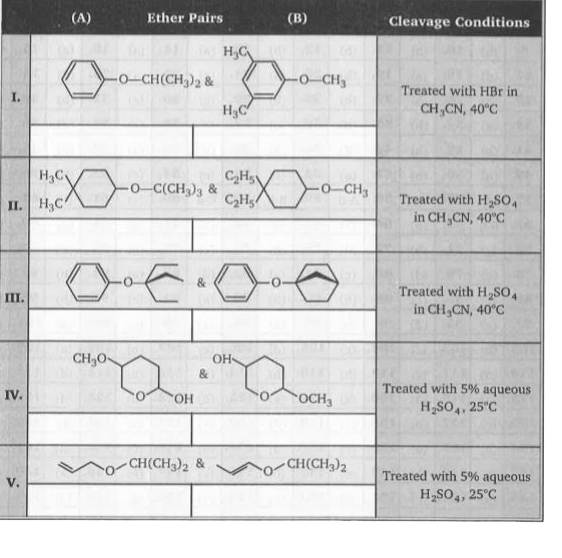
Consider the pairs ofethers, numbered I throughV, shown below. To the right of each pairis a description of reaction conditions to be applied to each. One compound of the pair will react more rapidly than the other.
Which ether of the two will be more rapidly cleaved?
Write your answer in box.

Text Solution

Verified by Experts

The correct Answer is:
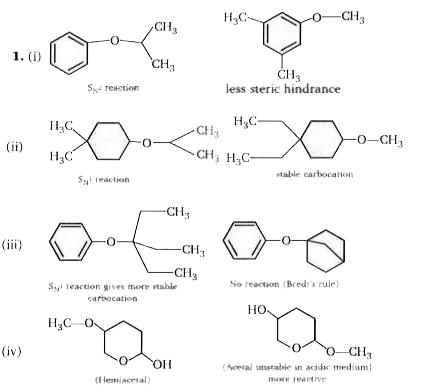
I-B ; II - A; III-A ; IV - B; V -B

Promotional Banner

Topper's Solved these Questions

  • ALCOHOL,ETHERS AND EPOXIDES

    MS CHOUHAN|Exercise SUBJECTIVE PROBLEMS|1 Videos
  • ALCOHOL,ETHERS AND EPOXIDES

    MS CHOUHAN|Exercise SUBJECTIVE PROBLEMS|1 Videos
  • 5C ALKYL HALIDES

    MS CHOUHAN|Exercise LEVEL-2 (SUBJECTIVE PROBLEMS)|1 Videos
  • ALDEHYDES AND KETONES

    MS CHOUHAN|Exercise LEVEL-2|20 Videos

Similar Questions

Explore conceptually related problems

It is very commonly thought that the sciences and humanities are producing two cultures which are opposed to each other. Science is even accused of not being sympathetic to the well-being of society. All this is due to the debatable use made by some scientists of their discoveries. However, science has now become increasingly aware of its responsibility towards society. Consequently, many scientists are of the opinion that science should be defined in humanistic terms. According, I.I. Rabi defines science as follows : "Science is an adventure of the whole human race to learn to live in and perhaps to love the universe in which they are. To be a part of it is to understand it, to understand oneself, to begin to feel that there is a capacity within man far beyond that he felt he had, of an infinite extension of human possibilities - not just on the material side..." Rabi proposes that science be taught “with a certain historical understanding, with a certain philosophical understanding, with a social understanding and a human understanding". At the moment, we are dealing with physics and one might well ask if we can define physics also in humanistic terms. Gerald Halton provides us with a relevant definition of physics. According to him : "Physics is a sequence of related ideas whose pursuit provides one with the cumulative effect of an even higher vantage point and a more encompassing view of the working of nature. Physics is neither an isolated bloodless body of facts and theories with mere vocational usefulness, nor a glorious entertainment restricted to an elite of specalists. Rather students of physics may leave them unprepared for their own time. They can be neither participants nor even intelligent spectators in one of the great adventures”. It will be no exaggeration if we say that the fate of society is linked to physics as whatever is thought or discovered in physics immediately affects the society. Our intellegence lies in applying physics to solve the pressing problems that the society faces and not to annihilate it. According to I.I Rabi

In table-3 write the names of the organisms in the appropriate box according to where i they can be found. You could put the name of one organism in more than one column. If you put the organism in the colon in 'some other place', try to mention the place where you could find it.Some examples are filled in to help you. Copy the table 3 in your notebook. Try to enhance the list as much as you can. In which column will you put a frog?

An organic compound having a carbon attached to four different groups is optically active. But is it that opposite is also true? That is, do all optically active organic compounds have chiral carbons? Not necessarily. Presence or absence of chiral centre is not the sufficient criteria for optical activity. The ultimate criteria is presence or absence of either plane or centre of symmetry. Two compounds which are non superimposable mirror images of each other are called enantiomers. If a compound contains more than one chiral carbon, new words are required to describe the relationship between various stereisomers of the compound. Those words are diastereomers and mesomers. Optically active compounds among the following is

The sinle quantum number by Neil.s Bohr and the appearance of several spectral lines in a particular series of Hspectrum, suggest that there more than one quantum to explain all the quantized properties of an electron in a particular energy level inside the atom. If fact when the properties of the electron is transformed from Cartesian co-ordinate to polar co-ordinates then it becomes the function of r, theta and phi suggesting three independet quantum numbers. In addition to this a fourth quantum number is required to consider the spinning behaviour of an electron. The principal quantum number n suggest the orbit number in which electron revolves, Azimuthal quantum number 1 suggest the shape of orbitals, magnetic quantum number m, gives orientation of orbital in presence of external magnetic field, while spin quantum number s, gives direction of an electron about its own axis n != 0 values of "1" ranges in between 0 to (n-1), while m depends upon 1. Total number values of m = 21+1, and "m" ranges in between -1 to +1 including 0. For each electron spin will be +-(1)/(2) The two unpaired electron present in C-atom are different w.r.t their

An orbital is designated by certain values of first three quantum numbers (n, l and m) and according to Pauli.s exclusion principle, no two electrons in a atom can have all the for quantum numbers equal. N, l and m denote size, shape and orientation of the orbital. The permissible values of n are 1,2,3.... prop while that of 1 are all possible integral values from 0 to n-n. Orbitals with same values of n and 1 but different values of m (where m can have any integral values from 1 to +1 including zero) are of equal energy and are called degenerate orbitals. However degeneracy is destroyed in homogeneous external magnetic field due to different extent of interaction between the applied field and internal electronic magnet of different orbitals differing in orientations. In octahedral magnetic field external magnetic field as oriented along axes while in tetrahedral field the applied field actas more in between the axes than that on the axes themselves. For 1=0, 1,2,3,...., the states (called sub-shells) are denoted by the symbol s,p,d,f.....respectively. After f, the subshells are denoted by letters alphabetically 1 determines orbital angular motion (L) of electron as L = sqrt(l(l+1))(h)/(2pi) ON the other hand, m determines Z-component of orbital angular momentum as L_(Z) = m((h)/(2pi)) Hund.s rule states that in degenerate orbitals electrons do not pair up unless and until each each orbitals has got an electron with parallesl spins Besides orbital motion,an electron also posses spin-motion. Spin may be clockwise and anticloskwise. Both these spin motions are called two spins states of electrons characterized by spin Q.N (s) : s = +(1)/(2) and = -(1)/(2) respectively The sum of spin Q.N. of all the electrons is called total spin(s) and 2s+1 is called spin multiplicity of the configuration as a whole. The spin angular momentum of an electron is written as L_(s) = sqrt(s(s+1))(h)/(2pi) According to Hund.s rule, the distribution of electron within the various orbitals of a given sub-shell is one which is associated with

An orbital is designated by certain values of first three quantum numbers (n, l and m) and according to Pauli.s exclusion principle, no two electrons in a atom can have all the for quantum numbers equal. N, l and m denote size, shape and orientation of the orbital. The permissible values of n are 1,2,3.... prop while that of 1 are all possible integral values from 0 to n-n. Orbitals with same values of n and 1 but different values of m (where m can have any integral values from 1 to +1 including zero) are of equal energy and are called degenerate orbitals. However degeneracy is destroyed in homogeneous external magnetic field due to different extent of interaction between the applied field and internal electronic magnet of different orbitals differing in orientations. In octahedral magnetic field external magnetic field as oriented along axes while in tetrahedral field the applied field actas more in between the axes than that on the axes themselves. For 1=0, 1,2,3,...., the states (called sub-shells) are denoted by the symbol s,p,d,f.....respectively. After f, the subshells are denoted by letters alphabetically 1 determines orbital angular motion (L) of electron as L = sqrt(l(l+1))(h)/(2pi) ON the other hand, m determines Z-component of orbital angular momentum as L_(Z) = m((h)/(2pi)) Hund.s rule states that in degenerate orbitals electrons do not pair up unless and until each each orbitals has got an electron with parallesl spins Besides orbital motion,an electron also posses spin-motion. Spin may be clockwise and anticloskwise. Both these spin motions are called two spins states of electrons characterized by spin Q.N (s) : s = +(1)/(2) and = -(1)/(2) respectively The sum of spin Q.N. of all the electrons is called total spin(s) and 2s+1 is called spin multiplicity of the configuration as a whole. The spin angular momentum of an electron is written as L_(s) = sqrt(s(s+1))(h)/(2pi) The orbital angular momentum of electron (l=1) makes an angles of 45^(@) from Z-axis. The L_(z) of electron will be

Passage-III : The binary compounds of oxygen with other elements are called oxides. They are classified either depending upon their acid - base characteristics or on the basis of oxygen content. a ) Normal oxides : These oxides which contain oxygen atoms as permitted by the normal oxidation number, i.e., -2. Normal oxide may be acidic, basic, amphoteric or neutral. b) Polyoxides : The oxides which contain oxygen atoms different than those permitted by the normal oxidation number of -2. i) Peroxides : Two oxygen atoms are linked to each other and oxygen has -I oxidation number. They contain (O-O)^(2) unit. ii) Superoxides : These oxides contain (O-O)^(-1) units, i.e., each O-atom has oxidation number -1//2 . c ) Suboxides : These contain low content of oxygen than expected. d) Mixed oxides : These oxides are made of two simpler oxides. Which of the following pairs contains neutral oxides ?

Passage-III : The binary compounds of oxygen with other elements are called oxides. They are classified either depending upon their acid - base characteristics or on the basis of oxygen content. a ) Normal oxides : These oxides which contain oxygen atoms as permitted by the normal oxidation number, i.e., -2. Normal oxide may be acidic, basic, amphoteric or neutral. b) Polyoxides : The oxides which contain oxygen atoms different than those permitted by the normal oxidation number of -2. i) Peroxides : Two oxygen atoms are linked to each other and oxygen has -I oxidation number. They contain (O-O)^(2) unit. ii) Superoxides : These oxides contain (O-O)^(-1) units, i.e., each O-atom has oxidation number -1//2 . c ) Suboxides : These contain low content of oxygen than expected. d) Mixed oxides : These oxides are made of two simpler oxides. Which of the following pairs contains mixed oxides?

MS CHOUHAN-ALCOHOL,ETHERS AND EPOXIDES-LEVEL-2
  1. Consider the pairs ofethers, numbered I throughV, shown below. To the ...

    Text Solution

    |

  2. Based on the above isomer answer the following (A to F). Which isome...

    Text Solution

    |

  3. Based on the above isomer answer the following (A to F). Which isome...

    Text Solution

    |

  4. Based on the above isomer answer the following (A to F). Which isome...

    Text Solution

    |

  5. Based on the above isomer answer the following (A to F). Which isome...

    Text Solution

    |

  6. Based on the above isomer answer the following (A to F). Which isome...

    Text Solution

    |

  7. Based on the above isomer answer the following (A to F). Which isome...

    Text Solution

    |

  8. Conversion (CH3 - CH3 rarr CH3 - CH2 - OH) " alkane " rarr alcohol is...

    Text Solution

    |

  9. Conversion R -CH2 - OH rarr R -CHO can be done by :

    Text Solution

    |

  10. Conversion R-CHO rarr R - CO2 H can be done by

    Text Solution

    |

  11. Coversion R - CO2H rarr R - CHO can be done by :

    Text Solution

    |

  12. Coversion R - CHO rarr R - CH2 -OH can be done by :

    Text Solution

    |

  13. Reduction R - CH2 - OH rarr R - CH3 can be done by :

    Text Solution

    |

  14. Which of the following is true for 3- methylbutanal ?

    Text Solution

    |

  15. This problem is an introduction to the planning of multistep syntheses...

    Text Solution

    |

  16. Which of the following is true for 3- methyl-2-butanone?

    Text Solution

    |

  17. Which of these methods would serve to prepare 1-phenyl-2-propanol?

    Text Solution

    |

  18. Match the Column (I) and (II) .

    Text Solution

    |

  19. Match the Column (I) and (II) .

    Text Solution

    |

  20. Ratio ofmoles of formaldehyde obtained in the reaction (1) and reactio...

    Text Solution

    |

