Home
Class 12
CHEMISTRY
Consider reactions A through F. Those ca...

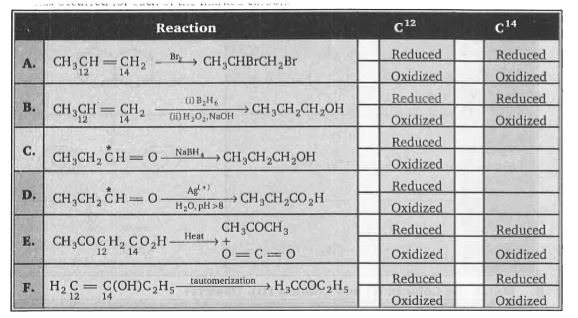
Consider reactions A through F. Those carbon atoms undergoing change, as part of a functional group, are marked as `C^(12),C^(14)` or starred. In the cases shown, each carbon atom has either been reduced or oxidized. Your job is to identify the change in oxidation state that has occurred for each of the marked carbon.

Text Solution

Verified by Experts

The correct Answer is:

A : both are oxidized; B : `C^(12)` is reduced, `C^(14)` is oxidized; C : reduced; D : oxidized; E : `C^(12)` is reduced, `C^(14)` is oxidized; F : `C^(12)` is reduced, `C^(14)` is oxidized

A : both are oxidized , B : `C^(12)` is reduced, `C^(14)` is oxidized , C : reduced , D : oxidized , E : `C^(12)` is reduced, `C^(14)` is oxidized , F : `C^(12)` is reduced, `C^(14)` is oxidized
Promotional Banner

Topper's Solved these Questions

  • ALDEHYDES AND KETONES

    MS CHOUHAN|Exercise LEVEL-2|20 Videos
  • ALCOHOL,ETHERS AND EPOXIDES

    MS CHOUHAN|Exercise SUBJECTIVE PROBLEMS|1 Videos
  • ALKYL HALIDES (ELIMINATION REACTION)

    MS CHOUHAN|Exercise LEVEL-2|25 Videos

Similar Questions

Explore conceptually related problems

Amines are less reactive in substitution reactions. Their reactivity is much lesser than alcohols and alkylflourides towards substitution. Protonation of the amino group makes it a better leaving group, but not nearly as good a leaving group as a protonated alcohol. Protonated amino groups cannot be displaced by OH^(-) because it would react immediately with the acidic hydrogen which would convert it in to a poor nucleophile. The leaving group in quartenary ammonium ion has about the same leaving tendency as a protonated amino group but does not have acidic hydrogen. The reaction of a quartenary ammonium ion with hydroxide ion is known as Hoffmann elimination reaction. The leaving group is tertiary amine. Since a tertiary amine is only a moderately good leaving group, the reaction requires heat. The carbon to which the tertiary amine is attached is designated as alpha carbon. When the hydroxide ion starts to remove a beta H from a quartenary ammonium ion, the leaving group does not immediately start to leave because a tertiary amine is not a good leaving group. As a result, a partial negative charge builds up on the carbon from which the proton is removed. The compounds 'C' in question number 31 on heating with moist silver oxide gives

For a spontaneous reaction, the free energy change must be negative. DeltaG=DeltaH-TDeltaS is the enthalpy change during the reaction. T is absolute temperature, and AS is the change in entropy during the reaction. Consider a reaction such as the formation ofan oxide . M+O_(2) MO Dloxygen is used wp in the course of this reaction. Gases have a more random structure (less ordered) than liquid or solids consequently gases have a higher entropy than liquids and solids, in this reaction (entropy or randomness) decreases, hence is negative. Thus, the temperature is raised the DeltaS becomes more negative. Since, TDeltaS is subtracted in the equation, then SG becomes less negative. Thus, the free energy changes increases with the increase in temperature. The free energy changes that occur when one mole of common reactant in this case dioxygen) is we may e plotted graphically against temperature for a number of reactions of metals to their oxides. The following plot is called an Ellingham diagram for metal oxide. Understanding of Ellingham diagram is extremely important for the efficient extraction of metals. Free energy change of Hg and Mg for the convertion to oxides the slope of DeltaG . T has been changed above the boiling points of the given metal because

Carbon has large number of allotropes of which crystalline forms are diamond, graphite and fullerenes. Amorphous forms are coal, coke wood charcoal animal charcoal, lamp black, gas carbon, petroleum coke, sugar charcoal (Atomic radius of C = 0.77A^(@) ) In graphite which have several fused hexagonal ring of benzene the hybridization state of each carbon atom and the bond order of each carbon-carbon bond are respectively

Passage-III : The binary compounds of oxygen with other elements are called oxides. They are classified either depending upon their acid - base characteristics or on the basis of oxygen content. a ) Normal oxides : These oxides which contain oxygen atoms as permitted by the normal oxidation number, i.e., -2. Normal oxide may be acidic, basic, amphoteric or neutral. b) Polyoxides : The oxides which contain oxygen atoms different than those permitted by the normal oxidation number of -2. i) Peroxides : Two oxygen atoms are linked to each other and oxygen has -I oxidation number. They contain (O-O)^(2) unit. ii) Superoxides : These oxides contain (O-O)^(-1) units, i.e., each O-atom has oxidation number -1//2 . c ) Suboxides : These contain low content of oxygen than expected. d) Mixed oxides : These oxides are made of two simpler oxides. Which of the following pairs contains neutral oxides ?

Passage-III : The binary compounds of oxygen with other elements are called oxides. They are classified either depending upon their acid - base characteristics or on the basis of oxygen content. a ) Normal oxides : These oxides which contain oxygen atoms as permitted by the normal oxidation number, i.e., -2. Normal oxide may be acidic, basic, amphoteric or neutral. b) Polyoxides : The oxides which contain oxygen atoms different than those permitted by the normal oxidation number of -2. i) Peroxides : Two oxygen atoms are linked to each other and oxygen has -I oxidation number. They contain (O-O)^(2) unit. ii) Superoxides : These oxides contain (O-O)^(-1) units, i.e., each O-atom has oxidation number -1//2 . c ) Suboxides : These contain low content of oxygen than expected. d) Mixed oxides : These oxides are made of two simpler oxides. Which of the following pairs contains mixed oxides?

Passage-III : The binary compounds of oxygen with other elements are called oxides. They are classified either depending upon their acid - base characteristics or on the basis of oxygen content. a ) Normal oxides : These oxides which contain oxygen atoms as permitted by the normal oxidation number, i.e., -2. Normal oxide may be acidic, basic, amphoteric or neutral. b) Polyoxides : The oxides which contain oxygen atoms different than those permitted by the normal oxidation number of -2. i) Peroxides : Two oxygen atoms are linked to each other and oxygen has -I oxidation number. They contain (O-O)^(2) unit. ii) Superoxides : These oxides contain (O-O)^(-1) units, i.e., each O-atom has oxidation number -1//2 . c ) Suboxides : These contain low content of oxygen than expected. d) Mixed oxides : These oxides are made of two simpler oxides. Which of the following oxides is paramagnetic in nature?

Passage-III : The binary compounds of oxygen with other elements are called oxides. They are classified either depending upon their acid - base characteristics or on the basis of oxygen content. a ) Normal oxides : These oxides which contain oxygen atoms as permitted by the normal oxidation number, i.e., -2. Normal oxide may be acidic, basic, amphoteric or neutral. b) Polyoxides : The oxides which contain oxygen atoms different than those permitted by the normal oxidation number of -2. i) Peroxides : Two oxygen atoms are linked to each other and oxygen has -I oxidation number. They contain (O-O)^(2) unit. ii) Superoxides : These oxides contain (O-O)^(-1) units, i.e., each O-atom has oxidation number -1//2 . c ) Suboxides : These contain low content of oxygen than expected. d) Mixed oxides : These oxides are made of two simpler oxides. Which pair of species is referred to as suboxides?

The necessary condition for a molecule to exhibit optical isomerism is dissymmetry or chiral. Thus all organic compounds which contain one as symetric carbon atom are chiral and exist in two stereoisomers. Although the two forms have the same structure, they have different arrangements of groups about the as symmetric carbon. In fact, they represent as symetric molecules. They do not have a plane of symmetry. They are related to each other as an object to its mirror image and are non superimposable. The two structures actually stand for dextro or (+) and leavo or (-) isomers. Since they are related each other as mirror images, they are commonly called enantiomers. Consider the following structures A,B,C,D Which of the following statements is not correct

The necessary condition for a molecule to exhibit optical isomerism is dissymmetry or chiral. Thus all organic compounds which contain one assymetric carbon atom are chiral and exist in two stereoisomers. Although the two forms have the same structure, they have different arrangements of groups about the assymmetric carbon. In fact, they represent assymetric molecules. They do not have a plane of symmetry. They are related to each other as an object to its miror image and are non superimposable. The two structures actually stand for dextro or (+) and leavo or (-) isomers. Since they are related each other as mirror images, they are commonly called enantiomers. Consider the following structers A,B,C,D Which of the following statements is not correctConsider the following structers A,B,C,D Which of the following statements is not correct

Mutarotation is the change in specific rotation of an optically active compound in solution with time to an equilibrium value. Interconversion is possible only if sugar has anomeric hydroxyl group i.e., sugar is reducing. Diastereomers which differ in configuration of chiral carbon developed in hemiacetal formation are called anomers. Epimers are a pair of stereoisomers which differ in the configuration about one of its chiral carbon On which carbon atom glucose and galactose differ in the position of -H and -OH groups?

MS CHOUHAN-ALDEHYDES AND KETONES-LEVEL-2
  1. Select the best choice for example (A to L) from the examples (a to n)...

    Text Solution

    |

  2. The following questions refer to the compounds (A to G) shown below :

    Text Solution

    |

  3. Match of the column :

    Text Solution

    |

  4. Complete the following table.

    Text Solution

    |

  5. Consider the following reactions and answer A and B. Suggest a re...

    Text Solution

    |

  6. Yield of each step as actually carried out in the laboratory is given ...

    Text Solution

    |

  7. Degree of unsaturation present in compound (A + B + C) is ?

    Text Solution

    |

  8. Within each set, which compound should be more reactive toward carbony...

    Text Solution

    |

  9. Match the Column (I) and Column (II). (Matrix)

    Text Solution

    |

  10. Consider reactions A through F. Those carbon atoms undergoing change, ...

    Text Solution

    |

  11. Consider the possible formation of an aldehyde or ketone product when ...

    Text Solution

    |

  12. Wittig reaction : The reaction of a phosphorus ylide with an aldehyd...

    Text Solution

    |

  13. Wittig reaction : The reaction of a phosphorus ylide with an aldehyd...

    Text Solution

    |

  14. Wittig reaction : The reaction of a phosphorus ylide with an aldehyd...

    Text Solution

    |

  15. Wittig reaction : The reaction of a phosphorus ylide with an aldehyd...

    Text Solution

    |

  16. Wittig reaction : The reaction of a phosphorus ylide with an aldehyd...

    Text Solution

    |

  17. Wittig reaction : The reaction of a phosphorus ylide with an aldehyd...

    Text Solution

    |

  18. Match the column :

    Text Solution

    |

  19. Reactant (A) is :

    Text Solution

    |

  20. Product (B) is :

    Text Solution

    |
