
Home
Class 12
CHEMISTRY
Wittig reaction : The reaction of a ph...

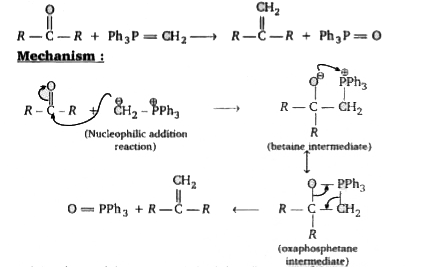
Wittig reaction :
The reaction of a phosphorus ylide with an aldehyde (or) ketone introduces a carbon-carbon double bond is place of the carbonyl bond.

Driving froce of the reaction is high bond energy of (P = O). `(DeltaH=-ve)`.
, Major product (A) is

A

cis-2-butene

B

trans-2-butene

C

iso-butene

D

1-butene

Text Solution

Verified by Experts

The correct Answer is:

B

`PPh_(3)` and O should be on same side.
Hence trans-2-butene will be formed.
Promotional Banner

Topper's Solved these Questions

  • ALDEHYDES AND KETONES

    MS CHOUHAN|Exercise LEVEL-2|20 Videos
  • ALCOHOL,ETHERS AND EPOXIDES

    MS CHOUHAN|Exercise SUBJECTIVE PROBLEMS|1 Videos
  • ALKYL HALIDES (ELIMINATION REACTION)

    MS CHOUHAN|Exercise LEVEL-2|25 Videos

Similar Questions

Explore conceptually related problems

In the above reaction the major product is shown, which is formed through the intermediate (carbocation given below: Which bond will migrate to form above product ?

According to V.B.T. a covalent bond is formed by the overlapping of half filled atomic orbitals with electron spinning in the opposite direction. The strength of a bond depends on extent of overlapping. Double bond energy is not twice that of single bond energy because a double bond is made up of a weak a bond and strong o bond. More energy is required to break the bond between the carbon atoms in

Two chemical reactions are described below.(ii) Carbon and hydrogen bond together to form a molecule of methane (CH4). give A) The valence of each of the atoms involved in the reaction.,B) The Lewis structure of the product that is formed.

In elimination reactions, generally atoms or groups from adjacent carbon atoms in the substrate molecule are removed and a multiple bond is formed

Carbonyl compounds give different oxidation products with different reagents .Several oxidising agents can be used to oxidise carbonyy compounds .Ammonical silver nitate (tollens reagent ) oxidises aliphatic as well as aromatic aldehydes . R-CHO overset("Tollens reagents ") to R-COOh +Ag (silver mirror ) strong oxidatising agents like KMnO_4 //H^+ ,HNO_3 ,K_2 Cr_2 O_7 //H^+ oxidise Aldehydes as well as ketons . open chain ketons in oxidation give mixture of two carbonylic acids . oxidation as well as ketons of unsymmetrical ketons takes place according to popoff's rule .According to this rule alpha - carbon whose bond breaks in oxidation always belongs to the alkyl group which has more number of carbons the reagent which oxidise only aliphatic ketone is :

Carbonyl compounds give different oxidation products with different reagents .Several oxidising agents can be used to oxidise carbonyy compounds .Ammonical silver nitate (tollens reagent ) oxidises aliphatic as well as aromatic aldehydes . R-CHO overset("Tollens reagents ") to R-COOh +Ag (silver mirror ) strong oxidatising agents like KMnO_4 //H^+ ,HNO_3 ,K_2 Cr_2 O_7 //H^+ oxidise Aldehydes as well as ketons . open chain ketons in oxidation give mixture of two carbonylic acids . oxidation as well as ketons of unsymmetrical ketons takes place according to popoff's rule .According to this rule alpha - carbon whose bond breaks in oxidation always belongs to the alkyl group which has more number of carbons which of the following is most reactive towards oxidation ?

Aryl halides are less reactive than alkyl halides due to the presence partial double character of C - X bond in aryl halides. Arly halides undergo nucleophilic substitution reactions, if electron withdrawing groups are introduced in ortho & para - positions in aryl halides. The reaction mechanism involves two steps. Keeping these points in view answer the following questions. Which of the following is the correct order of reactivity of the aryl halides with a given nucleophile

Aryl halides are less reactive than alkyl halides due to the presence partial double character of C - X bond in aryl halides. Arly halides undergo nucleophilic substitution reactions, if electron withdrawing groups are introduced in ortho & para - positions in aryl halides. The reaction mechanism involves two steps. Keeping these points in view answer the following questions. The number of resonance structure possible for chlorobenzene is

Aryl halides are less reactive than alkyl halides due to the presence partial double character of C - X bond in aryl halides. Arly halides undergo nucleophilic substitution reactions, if electron withdrawing groups are introduced in ortho & para - positions in aryl halides. The reaction mechanism involves two steps. Keeping these points in view answer the following questions. Which compound undergo nucleophilic substitution under mild conditions

(A) Carboxylic acids contain a carbonyl group but do not give characteristic reactions of the carbonyl group. (R) Double bond character of C = O bond in carboxylic acids is greatly reduced due to resonance, as compared to that in aldehydes and ketones.

MS CHOUHAN-ALDEHYDES AND KETONES-LEVEL-2
  1. Select the best choice for example (A to L) from the examples (a to n)...

    Text Solution

    |

  2. The following questions refer to the compounds (A to G) shown below :

    Text Solution

    |

  3. Match of the column :

    Text Solution

    |

  4. Complete the following table.

    Text Solution

    |

  5. Consider the following reactions and answer A and B. Suggest a re...

    Text Solution

    |

  6. Yield of each step as actually carried out in the laboratory is given ...

    Text Solution

    |

  7. Degree of unsaturation present in compound (A + B + C) is ?

    Text Solution

    |

  8. Within each set, which compound should be more reactive toward carbony...

    Text Solution

    |

  9. Match the Column (I) and Column (II). (Matrix)

    Text Solution

    |

  10. Consider reactions A through F. Those carbon atoms undergoing change, ...

    Text Solution

    |

  11. Consider the possible formation of an aldehyde or ketone product when ...

    Text Solution

    |

  12. Wittig reaction : The reaction of a phosphorus ylide with an aldehyd...

    Text Solution

    |

  13. Wittig reaction : The reaction of a phosphorus ylide with an aldehyd...

    Text Solution

    |

  14. Wittig reaction : The reaction of a phosphorus ylide with an aldehyd...

    Text Solution

    |

  15. Wittig reaction : The reaction of a phosphorus ylide with an aldehyd...

    Text Solution

    |

  16. Wittig reaction : The reaction of a phosphorus ylide with an aldehyd...

    Text Solution

    |

  17. Wittig reaction : The reaction of a phosphorus ylide with an aldehyd...

    Text Solution

    |

  18. Match the column :

    Text Solution

    |

  19. Reactant (A) is :

    Text Solution

    |

  20. Product (B) is :

    Text Solution

    |
