
Home
Class 12
CHEMISTRY
Wittig reaction : The reaction of a ph...

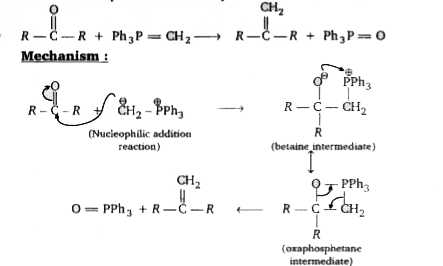
Wittig reaction :
The reaction of a phosphorus ylide with an aldehyde (or) ketone introduces a carbon-carbon double bond is place of the carbonyl bond.

Driving froce of the reaction is high bond energy of (P = O). `(DeltaH=-ve)`.
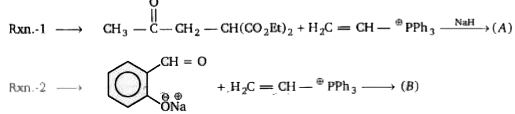
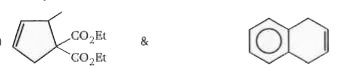
Identify major product in given intramolecular wittig reaction :

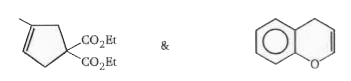
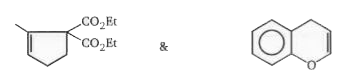
Product (A) and (B) respectively are :

A

B

C

D

Text Solution

Verified by Experts

The correct Answer is:

A
Promotional Banner

Topper's Solved these Questions

  • ALDEHYDES AND KETONES

    MS CHOUHAN|Exercise LEVEL-2|20 Videos
  • ALCOHOL,ETHERS AND EPOXIDES

    MS CHOUHAN|Exercise SUBJECTIVE PROBLEMS|1 Videos
  • ALKYL HALIDES (ELIMINATION REACTION)

    MS CHOUHAN|Exercise LEVEL-2|25 Videos

Similar Questions

Explore conceptually related problems

In the above reaction the major product is shown, which is formed through the intermediate (carbocation given below: Which bond will migrate to form above product ?

(A) Carboxylic acids contain a carbonyl group but do not give characteristic reactions of the carbonyl group. (R) Double bond character of C = O bond in carboxylic acids is greatly reduced due to resonance, as compared to that in aldehydes and ketones.

Two chemical reactions are described below.(ii) Carbon and hydrogen bond together to form a molecule of methane (CH4). give A) The valence of each of the atoms involved in the reaction.,B) The Lewis structure of the product that is formed.

Compare acetylene and benzene with respect to the following: (a) hybridisation of carbon atoms, (b) percentage compositions of C and H, (c ) product of ozonolysis and (d) reaction with Baeyer's reagent.

Chemical reactions are invariably assocated with the transfer of energy either in the form of heat or light. In the laboratory, heat changes in physical and chemical processes are measured with an instrument called calorimeter. Heat change in the process is calculated as: q= ms DeltaT , s= specific heat = c Delta T , c= heat capacity Heat of reaction at constant volume is measured using bomb calorimeter. qv= Delta U= internal energy change. Heat of reaction at constant pressure is measured using simple or water calorimeter. q_(p) = Delta H, q_(p) = q_(v) + P Delta V, DeltaH = DeltaU + Delta nRT The amount of energy released during a chemical change depnds on the physical state of reactants and products, the condition of pressure, temperature and volume at which the reaction is carried out. The variation of heat of reaction with temperature and pressure is given by Kirchhoff's equation: (DeltaH_(2)- DeltaH_(1))/(TT_(2)-T_(1)) = DeltaC_(P) (At constant pressure), (DeltaU_(2)- DeltaU_(1))/(TT_(2)-T_(1)) = DeltaC_(V) (At constant volume) DeltaC_(P) for a reaction is given by 0.2T cal/deg. Its enthalpy of reaction at 10K is -14.2 kcal. Its enthalpy of reaction at 100K in kcal will be

Aryl halides are less reactive than alkyl halides due to the presence partial double character of C - X bond in aryl halides. Arly halides undergo nucleophilic substitution reactions, if electron withdrawing groups are introduced in ortho & para - positions in aryl halides. The reaction mechanism involves two steps. Keeping these points in view answer the following questions. Which of the following is the correct order of reactivity of the aryl halides with a given nucleophile

The instantaneous rate of an elementary chamical reactkon aA+bBhArr cC+dD can be given by rate =K_(f)[A]^(a)[B]^(b)-K_(b)[C]^(c)[D]^(d) where K_(f) and K_(b) are rate constants for forward and backward reactions respectively for the reversible reaction. If the reaction is an irreversible one, the rate is expressed as, rate =K[A]^(a)[B]^(b) where K is rate contant for the given irreversible rate of disappearance of A is a/b times the rate of disappearance of B. The variation of rate constant K with temperature is expressed in terms of Arrhenius equation: K=Ae^(-E_(a)//RT) whereas the ratio (K_(f))/(K_(b)) is expressed in terms of van't Hoff isochore: (K_(f))/(K_(b))=Ae^(-DeltaH//RT) , where E_(a) and DeltaH are energy of activation and heat of reaction respectively. For an elementary reaction aAto product, the graph plotted log([-d[A]])/(dt) vs log[A]_(t) gives a straight line with intercept equal to 0.6 and showing an angle of 45^(@) then

Chemical reactions are invariably assocated with the transfer of energy either in the form of heat or light. In the laboratory, heat changes in physical and chemical processes are measured with an instrument called calorimeter. Heat change in the process is calculated as: q= ms DeltaT , s= specific heat = c Delta T , c= heat capacity Heat of reaction at constant volume is measured using bomb calorimeter. qv= Delta U= internal energy change. Heat of reaction at constant pressure is measured using simple or water calorimeter. q_(p) = Delta H, q_(p) = q_(v) + P Delta V, DeltaH = DeltaU + Delta nRT The amount of energy released during a chemical change depnds on the physical state of reactants and products, the condition of pressure, temperature and volume at which the reaction is carried out. The variation of heat of reaction with temperature and pressure is given by Kirchhoff's equation: (DeltaH_(2)- DeltaH_(1))/(TT_(2)-T_(1)) = DeltaC_(P) (At constant pressure), (DeltaU_(2)- DeltaU_(1))/(TT_(2)-T_(1)) = DeltaC_(V) (At constant volume) The heat capacity of bomb calorimeter (with its contents) is 500J/K. When 0.1g of CH_(4) was burnt in this calorimeter the temperature rose by 2^(@)C . The value of DeltaU per mole will be

The products of bond breaking, shown below, are not stable, and cannot be isolated for prolonged study. Such species are referred to as reactive intermediate, and are belived to be transient intermediates in many reactions. The general structures and names of four such intermediates are, Charged Intermediates Uncharged Intermediates Carbocations (called carbonium ions in the older literature) are electrophiles and carbananions are nucleophiles. Carbenes have only a valence shell sextet of electrons and are therefore electron deficient. In this sense they are elecrophiles, but the non-bonding electron pair also gives carbenes nucleophilic character. As a rule, the electrophilic character dominates carbene reactivity. Carbon radicals have only seven valence electrons, and may be considered electron deficient, however, they do not in general bond to nucleophilic electron pair, so their chemistry exhibits differences from that of conventional electrophiles. Radical intermediates are often called free radicals. Intermediates are in general stabilised with conjugation, electron donating and electron with drawing groups. Which of the following is relatively an unstable intermediate compared to rest ?

The products of bond breaking, shown below, are not stable, and cannot be isolated for prolonged study. Such species are referred to as reactive intermediate, and are belived to be transient intermediates in many reactions. The general structures and names of four such intermediates are, Charged Intermediates Uncharged Intermediates Carbocations (called carbonium ions in the older literature) are electrophiles and carbananions are nucleophiles. Carbenes have only a valence shell sextet of electrons and are therefore electron deficient. In this sense they are elecrophiles, but the non-bonding electron pair also gives carbenes nucleophilic character. As a rule, the electrophilic character dominates carbene reactivity. Carbon radicals have only seven valence electrons, and may be considered electron deficient, however, they do not in general bond to nucleophilic electron pair, so their chemistry exhibits differences from that of conventional electrophiles. Radical intermediates are often called free radicals. Intermediates are in general stabilised with conjugation, electron donating and electron with drawing groups. Which of the following carbo cations is more stable?

MS CHOUHAN-ALDEHYDES AND KETONES-LEVEL-2
  1. Select the best choice for example (A to L) from the examples (a to n)...

    Text Solution

    |

  2. The following questions refer to the compounds (A to G) shown below :

    Text Solution

    |

  3. Match of the column :

    Text Solution

    |

  4. Complete the following table.

    Text Solution

    |

  5. Consider the following reactions and answer A and B. Suggest a re...

    Text Solution

    |

  6. Yield of each step as actually carried out in the laboratory is given ...

    Text Solution

    |

  7. Degree of unsaturation present in compound (A + B + C) is ?

    Text Solution

    |

  8. Within each set, which compound should be more reactive toward carbony...

    Text Solution

    |

  9. Match the Column (I) and Column (II). (Matrix)

    Text Solution

    |

  10. Consider reactions A through F. Those carbon atoms undergoing change, ...

    Text Solution

    |

  11. Consider the possible formation of an aldehyde or ketone product when ...

    Text Solution

    |

  12. Wittig reaction : The reaction of a phosphorus ylide with an aldehyd...

    Text Solution

    |

  13. Wittig reaction : The reaction of a phosphorus ylide with an aldehyd...

    Text Solution

    |

  14. Wittig reaction : The reaction of a phosphorus ylide with an aldehyd...

    Text Solution

    |

  15. Wittig reaction : The reaction of a phosphorus ylide with an aldehyd...

    Text Solution

    |

  16. Wittig reaction : The reaction of a phosphorus ylide with an aldehyd...

    Text Solution

    |

  17. Wittig reaction : The reaction of a phosphorus ylide with an aldehyd...

    Text Solution

    |

  18. Match the column :

    Text Solution

    |

  19. Reactant (A) is :

    Text Solution

    |

  20. Product (B) is :

    Text Solution

    |
