Home
Class 10
PHYSICS
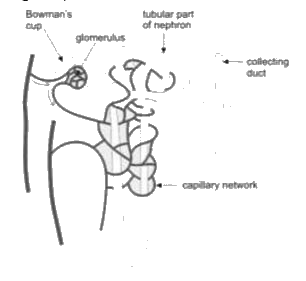
Observe the image of a single nephron. ...

Observe the image of a single nephron.

The amount of liquid passing through in the form of glomerular filtrate is approximately 150- 180 litres per day whereas the amount of urine flowing out of all the nephrons is only 1.5 to 1.8 litres per day.
Water is getting reabsorbed.
In which part of the nephron could the water be getting reabsorbed?

A

in the Bowman's cup

B

in the long tubular part

C

in the collecting duct

D

in the glomerulus

Text Solution

Verified by Experts

The correct Answer is:

B
Promotional Banner

Topper's Solved these Questions

  • PRACTICE PAPER 2022

    CBSE MODEL PAPER|Exercise Multiple Choice Questions|60 Videos
  • CASE STUDY QUESTIONS CLASS 10TH EXAM 2020-21

    CBSE MODEL PAPER|Exercise MCQs|239 Videos
  • QUESTION BANK 2021

    CBSE MODEL PAPER|Exercise QUESTIONS|60 Videos

Similar Questions

Explore conceptually related problems

The maximum amount of electrolytes and water (70-80 per cent) from the glomerular filtrate is reabsorbed in which part of the nephron?

Reabsorption of useful substances back into the blood from the filtrate in a nephron occurs in or In which part of kidney, Glucose and amino acids are reabsorbed The maximum amount of electrolytes and water (70-80 Percent) from the glomerular filtrate is reabsorbed in which part of the nephron

Read the passage given below and answer the question: Adenosine triphosphate (ATP) is the energy-carrying molecule found in the cells of all living things. ATP captures chemical energy obtained from the breakdown of food molecules and releases it to fuel other cellular processes. ATP is a nucleotide that consists of three main structures: the nitrogenous base, adenine, the sugar, ribose, and a chain of three phosphate groups bound to ribose. The phosphate tail of ATP is the actual power source which the cell taps. Available energy is contained in the bonds between the phosphates and is released when they are broken, which occurs through the addition of a water molecule (a process called hydrolysis). Usually only the outer phosphate is removed from ATP to yield energy, when this occurs ATP is converted to adenosine diphosphate (ADP), the form of the nucleotide having only two phosphates. The importance of ATP (adenosine triphosphate) as the main source of chemical energy in living matter and its involvement in cellular processes has long been recognized. The primary mechanism whereby higher organisms, including humans, generate ATP is through mitochondrial oxidative phosphorylation. For the majority of organs, the main metabolic fuel is glucose, which in the presence of oxygen undergoes complete combustion to CO_2 and H_2O : C_6H_(12)O_6 + 6O_2 rarr 6CO_2 + 6H_2O + "energy" The free energy (AG) liberated in this exergonic (AG is negative) reaction is partially trapped as ATP in two consecutive processes: glycolysis (cytosol) and oxidative phosphorylation (mitochondria). The first produces 2 mol of ATP per mol of glucose, and the second 36 mol of ATP per mol of glucose. Thus, oxidative phosphorylation yields 17-18 times as much useful energy in the form of ATP as can be obtained from the same amount of glucose by glycolysis alone. The efficiency of glucose metabolism is the ratio of amount of energy produced when 1 mol of glucose oxidised in cell to the enthalpy of combustion of glucose. The energy lost in the process is in the form of heat. This heat is responsible for keeping us warm. (source: Erecińska, M., & Silver, 1. A. (1989). ATP and Brain Function. Journal of Cerebral Blood Flow & Metabolism, 9(1), 2-19. "https://doi.org/10.1038/jcbfm." 1989.2 and "https://www.britannica.com/science/adenosine-triphosphate" ) Which of the following statement is true?

Read the passage given below and answer the question: Adenosine triphosphate (ATP) is the energy-carrying molecule found in the cells of all living things. ATP captures chemical energy obtained from the breakdown of food molecules and releases it to fuel other cellular processes. ATP is a nucleotide that consists of three main structures: the nitrogenous base, adenine, the sugar, ribose, and a chain of three phosphate groups bound to ribose. The phosphate tail of ATP is the actual power source which the cell taps. Available energy is contained in the bonds between the phosphates and is released when they are broken, which occurs through the addition of a water molecule (a process called hydrolysis). Usually only the outer phosphate is removed from ATP to yield energy, when this occurs ATP is converted to adenosine diphosphate (ADP), the form of the nucleotide having only two phosphates. The importance of ATP (adenosine triphosphate) as the main source of chemical energy in living matter and its involvement in cellular processes has long been recognized. The primary mechanism whereby higher organisms, including humans, generate ATP is through mitochondrial oxidative phosphorylation. For the majority of organs, the main metabolic fuel is glucose, which in the presence of oxygen undergoes complete combustion to CO_2 and H_2O : C_6H_(12)O_6 + 6O_2 rarr 6CO_2 + 6H_2O + "energy" The free energy (AG) liberated in this exergonic (AG is negative) reaction is partially trapped as ATP in two consecutive processes: glycolysis (cytosol) and oxidative phosphorylation (mitochondria). The first produces 2 mol of ATP per mol of glucose, and the second 36 mol of ATP per mol of glucose. Thus, oxidative phosphorylation yields 17-18 times as much useful energy in the form of ATP as can be obtained from the same amount of glucose by glycolysis alone. The efficiency of glucose metabolism is the ratio of amount of energy produced when 1 mol of glucose oxidised in cell to the enthalpy of combustion of glucose. The energy lost in the process is in the form of heat. This heat is responsible for keeping us warm. (source: Erecińska, M., & Silver, 1. A. (1989). ATP and Brain Function. Journal of Cerebral Blood Flow & Metabolism, 9(1), 2-19. "https://doi.org/10.1038/jcbfm." 1989.2 and "https://www.britannica.com/science/adenosine-triphosphate" ) Which of the following statements is correct:

Read the passage given below and answer the question: Adenosine triphosphate (ATP) is the energy-carrying molecule found in the cells of all living things. ATP captures chemical energy obtained from the breakdown of food molecules and releases it to fuel other cellular processes. ATP is a nucleotide that consists of three main structures: the nitrogenous base, adenine, the sugar, ribose, and a chain of three phosphate groups bound to ribose. The phosphate tail of ATP is the actual power source which the cell taps. Available energy is contained in the bonds between the phosphates and is released when they are broken, which occurs through the addition of a water molecule (a process called hydrolysis). Usually only the outer phosphate is removed from ATP to yield energy, when this occurs ATP is converted to adenosine diphosphate (ADP), the form of the nucleotide having only two phosphates. The importance of ATP (adenosine triphosphate) as the main source of chemical energy in living matter and its involvement in cellular processes has long been recognized. The primary mechanism whereby higher organisms, including humans, generate ATP is through mitochondrial oxidative phosphorylation. For the majority of organs, the main metabolic fuel is glucose, which in the presence of oxygen undergoes complete combustion to CO_2 and H_2O : C_6H_(12)O_6 + 6O_2 rarr 6CO_2 + 6H_2O + "energy" The free energy (AG) liberated in this exergonic (AG is negative) reaction is partially trapped as ATP in two consecutive processes: glycolysis (cytosol) and oxidative phosphorylation (mitochondria). The first produces 2 mol of ATP per mol of glucose, and the second 36 mol of ATP per mol of glucose. Thus, oxidative phosphorylation yields 17-18 times as much useful energy in the form of ATP as can be obtained from the same amount of glucose by glycolysis alone. The efficiency of glucose metabolism is the ratio of amount of energy produced when 1 mol of glucose oxidised in cell to the enthalpy of combustion of glucose. The energy lost in the process is in the form of heat. This heat is responsible for keeping us warm. (source: Erecińska, M., & Silver, 1. A. (1989). ATP and Brain Function. Journal of Cerebral Blood Flow & Metabolism, 9(1), 2-19. "https://doi.org/10.1038/jcbfm." 1989.2 and "https://www.britannica.com/science/adenosine-triphosphate" ) Cellular oxidation of glucose is a:

The number of millimoles present per litre of solution of CH_3COONa so that 150 ppm (150 moles of its gets hydrolysed out of one million moles added) of if K_a=1.8xx10^(-5) is :

A heavy machine rejects a liquid at 60^(@)C which is to be cooled to 30^(@)C before it is fed back to the machine. The liquid rejected by the machine is kept flowing through a long tube while it is cooled by 60 liter water surrounding the tube. The initial temperature of the cooling water is 10^(@)C and it is 20^(@)C when it is changed after 1 hour. Calculate the amount of liquid that passes through the tube in one hour. Specific heat capacity of the liquid and water are 0.5 calg^(-1) .^(@)C^(-1) and 1.0 calg^(-1).^(@)C^(-1) respectively.

CBSE MODEL PAPER-PRACTICE PAPER 2022-Multiple Choice Questions
  1. Which of the following occurs during oxygen shortage in muscle cells?

    Text Solution

    |

  2. Which of the following plays the important role of creating a suction ...

    Text Solution

    |

  3. Observe the image of a single nephron. The amount of liquid passi...

    Text Solution

    |

  4. During transpiration, water is lost in the form of water vapour throug...

    Text Solution

    |

  5. Which of the following characteristics of a spherical mirror is given ...

    Text Solution

    |

  6. In the diagram shown below, a light ray is incident on a convex mirror...

    Text Solution

    |

  7. As a ray of light entered medium P from medium Q, its velocity increas...

    Text Solution

    |

  8. In the diagram shown below, a beam of light is travelling from inside ...

    Text Solution

    |

  9. The image below depicts light being split by a prism into different co...

    Text Solution

    |

  10. An object was placed at the centre of curvature of a concave lens. The...

    Text Solution

    |

  11. The Sun appears red during sunset because

    Text Solution

    |

  12. The path of light rays passing through a glass prism is BEST represent...

    Text Solution

    |

  13. w SnO(2) + x H(2) to y Sn + z H(2) O For which of the following valu...

    Text Solution

    |

  14. A solution of an acid with pH 5.1 is given. Which of the following can...

    Text Solution

    |

  15. Aditi adds dropwise 25 ml of concentrated HCl to 25 ml of concentrated...

    Text Solution

    |

  16. Anand took four colourless solutions P, Q, R and S, and performed the ...

    Text Solution

    |

  17. Some activities cause the soil and water resources in that area to bec...

    Text Solution

    |

  18. Shown below is a container that is used in the transportation of goods...

    Text Solution

    |

  19. Payal has to arrange the following in DECREASING order of hydroxide io...

    Text Solution

    |

  20. A piece of zinc (Zn) - a reactive metal - was dropped into a test tube...

    Text Solution

    |
