Home
Class 12
PHYSICS
Four charges are arranged at the corners...

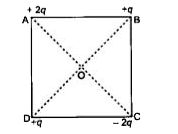
Four charges are arranged at the corners of a square ABCD as shown in the figure. Force on the positive charge kept at the centre O is:

A

along the diagonal AC

B

along the diagonal BD

C

perpendicular to side AB

D

zero Question

Text Solution

Verified by Experts

The correct Answer is:

a

Magnitude and polarity of charges at point B and D are same. Thus, force at O due to these charges cancel each other. Polarities of charges at A and C are opposite, therefore force on charge kept at the centre O is along the diagonal AC.
Promotional Banner

Similar Questions

Explore conceptually related problems

Four charges are arranged at the corners of a square ABCD as shown in the figure. The force on the charge kept at the centre O will be:

Four charges are arranged at the corners of a square ABCD as shown in the figure. The force on the charge kept at the ccentre O is

Four charges are arranged at the corners of a square ABCD, as shown. The force on a positive charge kept at the centre of the square is (A)zero (B)along diagonal AC (C)along diagonal BD (D)perpendicular to the side AB

Four charges are arranged at the corners of a square as shown in the figure. The direction of electric field at the centre of the square is along

Four point charges are placed at the corners of a square ABCD of side 10 cm, as shown in figure. The force on a charge of 1muC placed at the centre of square is

Four charges are arranged at the corners of a square ABCD of side d, as shown in Fig. Find the work required to put together this arrangement (b) A charge q_(0) brought to the center E of the square, the four charges being held fixed at the corners . How much extra work in needed to do this ?

Four particles of masses 2,2,4,4 kg are arranged at the corners A,B,C,D of a square ABCD of side 2m as shown in the figure. The perpendicular distance of their centre of mass from the side AB is

Four charges are placed at four corners of a square as shown in figure. The side of the square is a. Two charges are positive and two are negative, but their magnitudes are the same. Now, an external agent starts decreasing all the sides of the square slowly and at the same rate. What happens to the electrical potential energy of the system and what will be the nature of work done by the agent?

Four point masses are placed at the corners of a square of side 2 m as shown in the figure. Find the centre of mass of the system w.r.t. the centre of square.

Four point charges Q, q, Q and q are placed at the corners of a square of side' a' as shown in the figure. Find the . (a) resultnat electric force on a charge Q and . (b) potential energy of this system.
