Home
Class 12
PHYSICS
Four charges are placed at the vertices ...

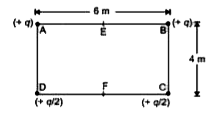
Four charges are placed at the vertices of a rectangle as shown in figure. The magnitude of cha nC. Assume E and F are the mid points of AB and DC respectively.

What is the potential at point F?

A

320 V

B

310 V

C

330 V

D

390 V

Text Solution

Verified by Experts

The correct Answer is:

c

AF = BF
`sqrt((AD)^2 + (DF)^2)`
`= sqrt((4)^2 + (3)^2) = 5 m`
Now potential at point F,
`V_F = 1/(4 pi epsilon_0) [q/(AF) + q/(BF) + (q//2)/(DF) + (q//2)/(CF)]`
`= 1/(4 pi epsilon_0) [q/5 + q/5 + (q//2)/(3) + (q//2)/3]`
`1/(4 pi epsilon_0) xx (11 q)/15 = (9 xx 10^9 xx 11 xx 50 xx 10^(-9))/(15)`
`= 390 V`
Promotional Banner

Similar Questions

Explore conceptually related problems

Six point charges are placed at the vertices of a hexagon of side 1 m as shown in figure. Net electric field at the centre of the hexagon is

Six charges are placed at the vertices of a rectangular hexagon as shown in the figure. The electric field on the line passing through point O and perpendicular to the plane of the figure as a function of distance x from point O is (assume x>>>a)

Four point charges are placed at the corners of a square ABCD of side 10 cm, as shown in figure. The force on a charge of 1muC placed at the centre of square is

In DeltaABC , D and E are the mid-points of AB and AC. Again, F and G are the mid-points of DB and EC. What is the ratio of areas of FDEG and BFGC?

In DeltaABC ,D and E are the mid-points of AB and AC. Again, F and G are the mid-points of DB and EC, If BC=12,what is the length of FG?

In a trapezium ABCD, if E and F be the mid-points of diagonal AC and BD respectively. Prove that EF=1/2(AB-CD).

In Delta ABC, AB = AC. D , E and F are mid-points of the sides BC, CA and AB respectively . Show that : AD is perpendicular to EF.

In Delta ABC, D,E and F are mid-point of sides AB ,BC and AC respectively , Prove that AE and DF bisect each other.

ABCD is a quadrilateral in which AD = BC. E, F, G and H are the mid-points of AB, BD, CD and AC respectively. Prove that EFGH is a rhombus.

If D, E, F are respectively the mid-points of AB, AC and BC respectively in a Delta ABC, " then " vec (BE) + vec(AF) =
