Home
Class 12
PHYSICS
A positive charge Q kept at the centre o...

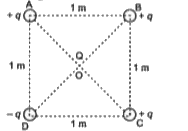
A positive charge Q kept at the centre of a square PQRS having four charges are arranged at the corners as shown in the figure. The force on the charge Q.

A

`(2Qq)/(4piepsi_0)`

B

`(Qq)/(4piepsi_0)`

C

0

D

None of these

Text Solution

Verified by Experts

The correct Answer is:

A

`(2Qq)/(4piepsi_0)`
Explanation: Forces `F_"OA" and F_"OC"` are equal and opposite to each other. So they will cancel out.
`F_"net"=F_"OD"+F_"OB"`
`=1/(4piepsi)[(Qq)/1^2+(Qq)/1^2]`
`=(2Qq)/(4piepsi_0)`
Promotional Banner

Similar Questions

Explore conceptually related problems

Four charges are arranged at the corners of a square ABCD as shown in the figure. The force on the charge kept at the ccentre O is

Four charges are arranged at the corners of a square ABCD as shown in the figure. The force on the charge kept at the centre O will be:

Two identical bar magnets are fixed with their centres at a distance d apart. A stationary charge Q is placed at P in between the gap of the two magnets at distance D from the centre O as shown in the figure. The force on the charge Q is

A thin metallic spherical shell contains a charge Q on it. A point charge q is placed at the center of the shell and another charge q_1 is placed outside it as shown in the figure. All the three charges are positive. Find the force on the charge a. at centre due to all charges. b. at center due to shell.

A thin metallic spherical shell carries a charge Q on it. A point charge Q_(1) is placed at the centre of the shell and another charge q is placed outside as shown in figure ahead. All the charges are positive . Discuss the various forces acting on Q_(1) .

A thin. Metallic spherical shell contains s charge Q on it. A point charge q is placed at the centre of the shell and another charge q_1 is placed outside it as shown in figure (30-Q1). All the three charges are positive. The force on the charge at the centre is

A charge Q is placed at the centre of the line joining two point charges +q and +q as shown in figure. The ratio of charges Q and q is

Four charges are arranged at the corners of a square as shown in the figure. The direction of electric field at the centre of the square is along

Four charges of +q, +q +q and +q are placed at the corners A, B, C and D of s square. The resultant force on the charge at D

Four positive charges (2sqrt2-1)Q are arranged at the four corners of a square. Another charge q is placed at the centre of the square. Resulting force acting on each corner charge is zero if q is
