Home
Class 10
CHEMISTRY
Consider the section of the periodic tab...

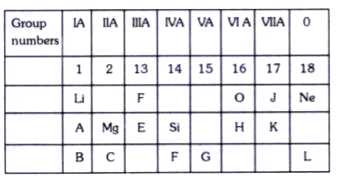
Consider the section of the periodic table given below.

Note : In this table B does not represent boron
C does not represent carbon
F does not represent fluorine
H does not represent hydrogen
K does not represent potassium
You must see the position of the element in the periodic table.
Some elements are given in their own symbol and position in the periodic table, while others are shown with a letter. With reference to the table:
Which is the most electronegative ?

A

A

B

D

C

O

D

J

Text Solution

Verified by Experts

The correct Answer is:

D

J is most electronegative since it needs only 1 electron to complete its inner shell and get stable configuration of Nobel gas which are inert in Nature
Promotional Banner

Topper's Solved these Questions

  • QUESTION PAPER 2022 TERM 1

    ICSE|Exercise MULTIPLE CHOICE QUESTIONS|40 Videos
  • SAMPLE PAPER 05

    ICSE|Exercise QUESTION|40 Videos

Similar Questions

Explore conceptually related problems

Consider the section of the periodic table given below. Note: In this table, B does not represent boron C does not represent carbon F does not represent fluorine H does not represent hydrogen K does not represent potassium You must see the position of the element in the periodic table. Some elements are given in their own symbol and position in the periodic table, while others are shown with a letter. With reference to the table: Write the formula of the compound between B and H.

Consider the section of the periodic table given below. Note : In this table B does not represent boron C does not represent carbon F does not represent fluorine H does not represent hydrogen K does not represent potassium You must see the position of the element in the periodic table. Some elements are given in their own symbol and position in the periodic table, while others are shown with a letter. With reference to the table: Write the formula of the compound between B and H.

Consider the section of the periodic table given below. Note : In this table B does not represent boron C does not represent carbon F does not represent fluorine H does not represent hydrogen K does not represent potassium You must see the position of the element in the periodic table. Some elements are given in their own symbol and position in the periodic table, while others are shown with a letter. With reference to the table: How many valence electrons are present in G?

Consider the section of the periodic table given below. Note : In this table B does not represent boron C does not represent carbon F does not represent fluorine H does not represent hydrogen K does not represent potassium You must see the position of the element in the periodic table. Some elements are given in their own symbol and position in the periodic table, while others are shown with a letter. With reference to the table: Draw the electron dot structure for the compound formed between C and K.

Consider the section of the periodic table given below. Note : In this table B does not represent boron C does not represent carbon F does not represent fluorine H does not represent hydrogen K does not represent potassium You must see the position of the element in the periodic table. Some elements are given in their own symbol and position in the periodic table, while others are shown with a letter. With reference to the table: In the compound between F and J, what type of bond will be formed ?

Consider the section of the periodic table given below. Note: In this table, B does not represent boron C does not represent carbon F does not represent fluorine H does not represent hydrogen K does not represent potassium You must see the position of the element in the periodic table. Some elements are given in their own symbol and position in the periodic table, while others are shown with a letter. With reference to the table: In the compound between F and J, what type of bond will be formed?

• In this table H does not represent hydrogen. • Some elements are given in their own symbol and position in the periodic table. • While others are shown with a letter. With reference to the table answer the following questions : Identify the most electronegative element.

In this table H does not represent hydrogen. Some elements are given in their own symbol and position in the periodic table. While others are shown with a letter. With reference to the table answer the question : Identify the least reactive element of group 1.

• In this table H does not represent hydrogen. • Some elements are given in their own symbol and position in the periodic table. • While others are shown with a letter. With reference to the table answer the following questions : Identify the most reactive element of group 1.

• In this table H does not represent hydrogen. • Some elements are given in their own symbol and position in the periodic table. • While others are shown with a letter. With reference to the table answer the following questions : How many valence electrons are present in Q?

ICSE-SAMPLE PAPER 04-QUESTIONS
  1. What is formed when zinc reacts with sodium hydroxide?

    Text Solution

    |

  2. Choose the correct answer from the options given below : Hydroxide o...

    Text Solution

    |

  3. The starting material which takes part in chemical reaction is called ...

    Text Solution

    |

  4. During ionisation metals lose electrons, this change can be called :

    Text Solution

    |

  5. Alkaline earth metals include:

    Text Solution

    |

  6. Methyl orange is :

    Text Solution

    |

  7. The formula which gives the simple ratio of each kind of atoms present...

    Text Solution

    |

  8. Why do atoms share electrons in covalent bonds?

    Text Solution

    |

  9. The hydroxide which is soluble in excess of NaOH is .............

    Text Solution

    |

  10. The metallic electrode which does not take part in an electrolytic rea...

    Text Solution

    |

  11. Identify the element belonging to third period and 17th group of the p...

    Text Solution

    |

  12. Brine is the common name of

    Text Solution

    |

  13. Covalent bond is formed between :

    Text Solution

    |

  14. Name the reagent from the following which can be used to distinguish z...

    Text Solution

    |

  15. The formula which gives the simple ratio of each kind of atoms present...

    Text Solution

    |

  16. Select the correct answer from the list given in brackets : When di...

    Text Solution

    |

  17. Consider the section of the periodic table given below. Note ...

    Text Solution

    |

  18. Consider the section of the periodic table given below. Note ...

    Text Solution

    |

  19. Consider the section of the periodic table given below. Note ...

    Text Solution

    |

  20. Consider the section of the periodic table given below : In this t...

    Text Solution

    |
