Home
Class 14
MATHS
The table given below shows the number o...

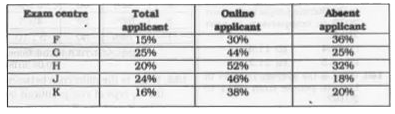
The table given below shows the number of applicants who have applied for exam at various centres as percentage of total number of applicants. The table also shows the number online applicants and absent applicants as a percentage of total applicants of each centre. Total number of applicants is 1200000.

What is the ratio of total number of present applicants from exam centre K to total number of offline applicants from exam centre J?

A

`40 : 41`

B

`80 : 81`

C

`10 : 9`

D

`7 : 11`

Text Solution

Verified by Experts

The correct Answer is:

B
Promotional Banner

Topper's Solved these Questions

  • COMPOUND INTEREST

    GAGAN PRATAP |Exercise MULTIPLE CHOICE QUESTIONS|158 Videos
  • DISCOUNT

    GAGAN PRATAP |Exercise MULTIPLE CHOICE QUESTIONS|117 Videos

Similar Questions

Explore conceptually related problems

The table given below shows the number of applicants who have applied for exam at various centres as percentage of total number of applicants. The table also shows the number online applicants and absent applicants as a percentage of total applicants of each centre. Total number of applicants is 1200000. नीचे दी गई तालिका में विभिन्न परीक्षा केन्द्रों में परीक्षा का नामांकन भरने वाले अभ्यर्थियों को संख्या को कुल अभ्यर्थियों की संख्या के प्रतिशत के रूप में दर्शाया गया है। यह तालिका प्रत्येक परीक्षा केन्द्र के ऑनलाइन अभ्यर्थियों तथा अनुपस्थित अभ्यर्थियों की संख्या को कुल अभ्यर्थियों की संख्या के प्रतिशत के रूप में दर्शाती है। अभ्यर्थियों की कुल संख्या 1200000 है। If A equals to 15% of total applicants who are present at exam centre F and B equals to present applicants at exam centre K, then A is what percent of B? यदि A परीक्षा केन्द्र F पर उपस्थित अभ्यर्थियों की कुल संख्या के 15% के बराबर है तथा B परीक्षा केन्द्र K पर उपस्थित अभ्यर्थियों के बराबर है, तो A, B का कितना प्रतिशत है?

Total number of ground in Mendeleef's table

GAGAN PRATAP -DATA INTERPRETATION (DI)-MULTIPLE CHOICE QUESTION
  1. The table given below shows the number of applicants who have applied ...

    Text Solution

    |

  2. The table given below shows the number of applicants who have applied ...

    Text Solution

    |

  3. The table given below shows the number of applicants who have applied ...

    Text Solution

    |

  4. The table given below shows the number of applicants who have applied ...

    Text Solution

    |

  5. The given table shows the number (in percent) of employees working in ...

    Text Solution

    |

  6. The given table shows the number (in percent) of empoloyees working in...

    Text Solution

    |

  7. The given table shows the number (in percent) of employees working in ...

    Text Solution

    |

  8. The given table shows the number (in percent) of employees working in ...

    Text Solution

    |

  9. The given table shows the number (in percent) of employees working in ...

    Text Solution

    |

  10. The table given below shows the production of maize by 5 different sta...

    Text Solution

    |

  11. The table given below shows the production of maize by 5 different sta...

    Text Solution

    |

  12. The table given below shows the production of maize by 5 different sta...

    Text Solution

    |

  13. The table given below shows the production of maize by 5 different sta...

    Text Solution

    |

  14. The table given below shows the production of maize by 5 different sta...

    Text Solution

    |

  15. Study the given graph and answer the question that follows If 20%...

    Text Solution

    |

  16. Study the given graph and answer the questopm the follows The num...

    Text Solution

    |

  17. Study the given graph and answer the question that follows Break up ...

    Text Solution

    |

  18. Study the given graph and answer the question that follows. By wh...

    Text Solution

    |

  19. Study the graph and answer the question that follows आरेख का अध्ययन ...

    Text Solution

    |

  20. Study the given graph and answer the question that follows. The t...

    Text Solution

    |
