Home
Class 12
PHYSICS
Three equal charges of 5.0 muC each are ...

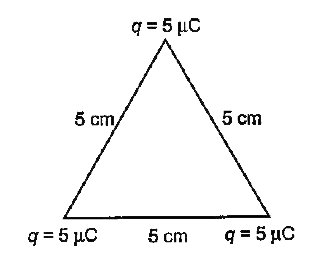
Three equal charges of `5.0 muC` each are placed at the three vertices of an equilateral triangle of side 5.0cm each. Calculate the electrostatic potential energy of the system of chages.

A

13.5 J

B

17.5 J

C

27J

D

15J

Text Solution

Verified by Experts

The correct Answer is:
A


`U=(1)/(4pi epsilon_(0)) ((3q^(2))/(r ))`
`=9 xx 10^(9) xx ((3xx5 xx 10^(-6) xx 5 xx 10^(-6)))/(5xx10^(-2)) =13.5J`
Promotional Banner

Similar Questions

Explore conceptually related problems

Construct an equilateral triangle of sides 6 cm each.

Three particles, each having a charge of 10 mu C are placed at the coners of an equilateral triangle of side 10 cm . The electrostatic potential energy of the system is (Given (1)/(4pi epsilon_(0)) = 9 xx 10^(9)N-m^(2)//C^(2))

A point charge .q. is kept at each of the vertices of an equilateral triangle having each side .a.. Total electrostatic potential energy of the system is:

Three charges 2 mu C , -4 mu C and 8 mu C are places at the three vertices of an equilateral triangle of side 10 cm. The potential at the centre of triangle is

Three charges Q, (+q) and (+q) are placed at the vertices of an equilateral triangle of side l as shown in the figure. It the net electrostatic energy of the system is zero, then Q is equal to

Three charges Q, (+q) and (+q) are placed at the vertices of an equilateral triangle of side l as shown in the figure. It the net electrostatic energy of the system is zero, then Q is equal to

If 3 charges are placed at the vertices of equilateral triangle of charge 'q' each. What is the net potential energy, if the side of equilateral Delta is l cm ?

Three equal masses of 1 kg each are placed at the vertices of an equilateral triangle of side 1 m, then the gravitational force on one of the masses due to other masses is (approx.)

Find the potential energy of a system of 3 particles kept at the vertices of an equilateral triangle of side r.

Three point masses 'm' each are placed at the three vertices of an equilateral traingle of side 'a'. Find net gravitational force on any point mass.

