Home
Class 14
REASONING
In the following questions onel two stat...

In the following questions onel two statements are given followed by two/four conclusions I, II, III and IV you have consider the two statements to be true even if they seem to be at variance from commonly known facts. You have to decide which of the given conclusions, if any follow from the given statements
Statement
I. All Philosophers are fools
II. All fools are illiterate
Conclusions
I. All Philosophers are illiterate
II. All illiterates are Philosopher
III. All illiterates are fools
IV. Some illiterate are Philosophers.

A

Only IV follows

B

I and IV follows

C

Only II follows

D

III and IV follows

Text Solution

Verified by Experts

The correct Answer is:
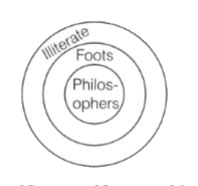
B

Promotional Banner

Similar Questions

Explore conceptually related problems

In this question two statements are given, followed by two Conclusions, I and II. You have to consider the statements to be true even if they seem to be at variance from commonly known facts. You have to decide which of the given Conclusions, if any, follows from the given statements. Statements : I. All clouds are fogs. II. All fogs are white. Conclusions : I. Some white are clouds. II. Some fogs are clouds.

In each of the following questions, two/four statements are given followed by two/four conclusions I, II, III and IV. You have to consider the statements to be true even it they seem to be at variance from commonly known facts. You have to decide which of the given conclusions, if any, follow from the given statements. Statements : a. All apples are bananas. b. All bananas are sweet. Conclusions : I. Some apples are sweet. II. Some bananas are apples.

In each of the following questions, two statements are given followed by two/four conclusions I, II, III and IV. You have to consider the two statements to be true even if they seem to be at variance from commonly known facts. You have to decide which of the given conclusions, if any, follow from the given statements. Statements : (a) All pens are papers. (b) No as a eraser paper. Conclusions : I. No eraser is a pen. II. Some papers are pens.

In the following question, two statements are given each followed by two Conclusions I and II. You have to consider the statements to be true even if they seem to be at variance from commonly known facts. You have to decide which of the given Conclusions, if any, follows from the given statements. Statements : I. All dogs are bullocks. II. All bullocks are goats. Conclusions : I. All dogs are goats. II. All goats are dogs.

In each of the following questions, two statements are given followed by two/four conclusions I, II, III and IV. You have to consider the two statements to be true even if they seem to be at variance from commonly known facts. You have to decide which of the given conclusions, if any, follow from the given statements. Statements : (a) some players are men. (b) Some men are singers. Conclusions : I. Some singers are men. II. Some players are singers.

In each of the following questions, two statements are given followed by two/four conclusions I, II III and IV. You have to consider the two statements to be true even if they seem to be at variance from commonly known facts. You have to decide which of the given conclusions, if any, follow from the given statements. Statements : a) Some buses are four wheelers. (b) All four wheelers are vans. Conclusions : I. Some vans are buses. II. Some buses arc vans.

In each of the following questions, two/four statements are given followed by two/four conclusions I, II, III and IV. You have to consider the statements to be true even it they seem to be at variance from commonly known facts. You have to decide which of the given conclusions, if any, follow from the given statements. Statements : 1. All apples are bananas. 2. All bananas are sweet. Conclusions: I. Some apples are sweet. II. Some bananas are apples.

In each of the following questions, two statements are given followed by two/four conclusions I, II, III and IV. You have to consider the two statements to be true even if they seem to be at variance from commonly known facts. You have to decide which of the given conclusions, if any, follow from the given statements. Statements : (a) No mobile is a watch. (b) All watches are calculators. Conclusions : I. No calculator is a mobile. II. Some calculators are mobiles.

In each of the following questions, two statements are given followed by two/four conclusions I, II, III and IV. You have to consider the two statements to be true even if they seem to be at variance from commonly known facts. You have to decide which of the given conclusions, if any, follow from the given statements. Statements : (a) No girl is a parrot. (b) Sowmya is a girl. conclusions : I. Sowmya is not a parrot. II. All girls are not Sowmya.

Recommended Questions
  1. In the following questions onel two statements are given followed by t...

    Text Solution

    |

  2. रासायनिक समीकरण देते हुए स्पष्ट कीजिये कि क्लोरोबेन्जीन से निम्नलिख...

    Text Solution

    |

  3. जैव-विकास क्या है? इसके पक्ष में दिए गए किन्ही दो परमानो के बारे में ल...

    Text Solution

    |

  4. किन्ही दो संयोजक कड़ी वाले जन्तुओ के नाम तथा वे किस संघ से संबंधित कड़ी ...

    Text Solution

    |

  5. 60 W-220 V तथा 100 W-220 V के दो बल्ब श्रेणीक्रम में जोड़कर 220 व...

    Text Solution

    |

  6. दिए गए परिपथ में धारा I का मान ज्ञात कीजिये ?

    Text Solution

    |

  7. दिए गये विघुत परिपथ की सहायता से ज्ञात कीजिए - (i) परिपथ में धारा , ...

    Text Solution

    |

  8. एक राजमार्ग पर दो बिन्दु A और B एक दूसरे से 90 किमी की दूरी पर है। एक ...

    Text Solution

    |

  9. एक रेखिक समीकरण दी गई है । दो चरो में एक ऐसी और रेखिक समीकरण लिख...

    Text Solution

    |

