Home
Class 14
REASONING
In question below one or two statements ...

In question below one or two statements are given followed by two conclusions I and II. You have to consider the statement to be true, even if it seems to be at variance from commonly known facts. You are to decide which of the given conclusions can definitely be drawn from the given statement. Indicate your answer.
Statements: (a) Some schools are Laboratories .
(b) All Laboratories are theaters .
Conclusions: I. Some theatres are schools.
II. No school is a theater

A

Neither conclusion I nor II follow

B

Conclusion I follows

C

Conclusion II follows

D

Conclusion I & II follows

Text Solution

Verified by Experts

The correct Answer is:
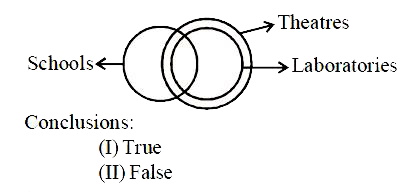
B


Conclusion :
(I) True
(II) False.
Promotional Banner

Similar Questions

Explore conceptually related problems

In each of the following questions, one or two statements is/are given followed by two conclusions I and II. You have to consider the statements to be true, even consider the statement to be tue, even if it seems to be at variance from commonly known facts. You are to decide which of the given conclusions can definitely be drawn from the given statement. Indicate your answer. Statements : (a) Some schools are Laboratories. (b) All Laboratories are theatres. Conclusions : I. Some theatres are schools. No school is a theatres.

Two statements is are given followed by two conclusions I and II. You have to consider the statements to be true, even if it seems to be at variance from commonly known facts. You are to decide which of the given conclusions can definitely be drawn from the given statements. Indicate your answer. Statements : Some scales are pencils. Some erasers are pencils. Conclusions : I. Some pencils are erasers. II. Some penciles are scales.

Two statements are given, followed by two conclusions, I and II. You have to consider the statements to be true, even if they seem to be at variance from commonly known facts. You are to decide which of the given conclusions can definitely be drawn from the given statements. Indicate your answer. Statements : D All players are singers. All dancers are singers. Conclusions: I. Some singers are dancers. II. Some dancers are players.

Two statements are given, followed by two conclusions, I and II. You have to consider the statements to be true, even if they seem to be at variance from commonly known facts. You are to decide which of the given conclusions can definitely be drawn from the given statements. Indicate your answer. Statements : All men are aggressive. All children are aggressive. Conclusions : I. Men are children. II. Children are men.

Two statements are given followed by two conclusions I and II. You have to consider the statements to be true, even if they seem to be at variance from commonly known facts. You are to decide which of the given conclusions definitely follows from the given statements. Indicate your answer. Statements : All pencils are rails. All rails are stations. Conclusions : I. All stations are pencils. II. Some stations are pencils.

Two statements are given followed by two Conclusions I and II. You have to be consider the statements to be true, even if it seems to be at variance from commonly known facts, You are to decide which of the given conclusion can definitely be drawn from the given statement. Indicate your answer. Statements : All pens are pencils. No pencil is an eraser. Conclusions : I. No eraser is a pen. II. No pen is an eraser.

In the following questions, two statements are given followed by two conclusions I and II. You have to consider the two statements to be true, even if they seem to be at variance from commonly known facts. You are to decide which of the given conclusions can definitely be drawn from the given statements. Indicate your answer. Statements : All soldiers are men. Some citizens are soldiers. Conclusions : I. Some citizens are men. II. All soldiers are citizens.

In each of the following questions one or two statements are given, followed by two Conclusions, I and II. You have to consider the statement to be true, even if it seems to be at variance from commonly known facts. You have to decide which of the given conclusions can definitely be drawn from the given statement. Indicate your answer. Statements 1. Authors are learned people. 2. Some doctors are authors. Conclusions I. Some doctors are learned people. II. Some learned people are doctors.

Two statements are given followed by two Conclusions/Assumption, I and II. You have to consider the statements to be true, even if it seems to be at variance from commonly known facts. You are to decide which of the given conclusions/assumptions can definitely be drawn from the given statement. Indicate your answer. Statements a. All children are students. b. All students are players. Conclusions I. All cricketers are students. II. All children are players.

One or two statements are given followed by two conclusions, I and Il. You have to consider the statement to be true, even if it seems to be at variance from commonly known facts. You are to decide which of the given conclusions/assumptions can definitely be drawn from the given statement. Indicate your answer. Statements : All boys are tall. Rajiv is a boy. Conclusions : I. Rajiv is tall. II. Rajiv is not tall.

Recommended Questions
  1. In question below one or two statements are given followed by two conc...

    Text Solution

    |

  2. क्लोरोफॉर्म को प्रकाश एवं वायु के प्रभाव से बचाने के लिए क्या सावधानि...

    Text Solution

    |

  3. एक इलेक्ट्रॉन तथा एक प्रोटॉन जिनकी गतिज उर्जाएँ समान है, एकसमान चुम्बक...

    Text Solution

    |

  4. एक रेखिक समीकरण दी गई है । दो चरो में एक ऐसी और रेखिक समीकरण लिख...

    Text Solution

    |

  5. दो पाँसे एक साथ उछाले जाते हैं। प्रायिकता ज्ञात कीजिए, जबकि ऊपर पड़ने ...

    Text Solution

    |

  6. ठोस पदार्थो में दोष (defects in solids) से संबंधित कौन-सा (से) वक्तव्...

    Text Solution

    |

  7. समान चालकता सेल में लिए गए दो विलयनों A तथा B के प्रतिरोध क्रमशः 50 ओम...

    Text Solution

    |

  8. नीचे कुछ अभिक्रियाएँ दी गयी है- (a) ACl(2)+BtoBCl(2)+A (b) B+DCl t...

    Text Solution

    |

  9. दो सेलो के मानक विधुत वाहक बल नीचे दिए गये है । 2Ag+Pt^(2+)to2Ag^(+)...

    Text Solution

    |

