Home
Class 7
PHYSICS
A student used the stroking method to ma...

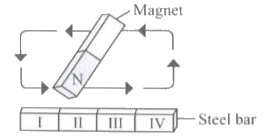
A student used the stroking method to magnetise a steel bar as shown in the figure.

If the steel bar was divided into parts I, II, III and IV, which of these parts would be the north-pole?

A

I

B

II

C

III

D

IV

Text Solution

Verified by Experts

The correct Answer is:

A

While stroking, the part from where we lift the magnet becomes the south pole. So part I becomes north pole.
Promotional Banner

Topper's Solved these Questions

  • NSO QUESTION PAPER 2018- 19 SET - B

    SCIENCE OLYMPIAD FOUNDATION |Exercise ACHIEVERS SECTION|1 Videos
  • NSO QUESTION PAPER 2019- 20 SET - B

    SCIENCE OLYMPIAD FOUNDATION |Exercise ACHIEVERS SECTION|2 Videos

Similar Questions

Explore conceptually related problems

A bar magnet is moved over a steel bar as shown in the figure. Choose the correct alternative from the following

Arrange the following statement is sequential order to magnetize a steel bar using single touch method. (a) Once, it has reached the other end, lift the magnet away from the steel bar and again bring it to the starting point. (b) Keep a steel bar to be magnetized on a wooden table. (c) Take a strong magnet and bring one of the poles of the magnet near one end of the steel bar and gently rub from one end to the other end. (d) Repeat this process several times.

A very stiff bar (AB) of negligible mass is suspended horizontally by two vertical rods as shown in figure. Length of the bar is 2.5 L. The steel rod has length L and cross sectional radius of r and the brass rod has length 2L and cross sectional radius of 2r . A vertically downward force F is applied to the bar at a distance x from the steel rod and the bar remains horizontal. Find the value of x if it is given that ratio of Young’s modulus of steel and brass is (Y_(s))/(Y_(B)) = 2 .

In the single touch method of magnetization , the north pole of a bar magnet is rubbed against a steel rod. Then the polarity of the end of the steel rod at which the magnet leaves

In which part of a bar magnet, the magnetisation is zero?

Figure shows the p-V diagram of an ideal gas undergoing a change of state from A to B. Four different parts I, II, III and IV as shown in the figure may lead to the same change of state. ltBrgt
