Home
Class 14
REASONING
In questions below, some statements are ...

In questions below, some statements are given followed by three/two conclusions/assumptions respectively. You have to consider the statements to be true even if they seem to be at variance from commonly known facts. You have to decide which of the given conclusions/assumptions if any, follow from the given statements.
Statement : Pictures can tell a story. All story books have pictures. Some story books have words.
Conclusions: I. Pictures can tell a story better than words can.
II. The stories in story books are very simple.
III. Some story books have both words and pictures.

A

Only conclusion I follows

B

Only conclusion II follows

C

Only conclusion III follows

D

Both conclusions I and II follow

Text Solution

Verified by Experts

The correct Answer is:
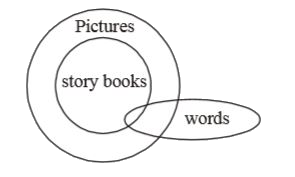
C


Conclusions : (a) False
(b) False
(c) True
(d) False
Promotional Banner

Similar Questions

Explore conceptually related problems

In each of the following questions, some statements are given following by three/ two conclusions/assumptions respectively. You have to consider the statements to be true even if they seem to be at variance from commonly known facts. You have to decide which of the follow from the given statements. Statements : Pictures can tell a story. All story books have pictures. Some story books have words. Conclusions: I. Pictures can tell a story better than words can. II. The stories in story books are very simple. III. Some story books have both words and pictures.

In this question some statements are given. You have to consider the statements to be true even if they seem to be at variance from commonly known facts. You have to decide which of the given conclusion, if any, follows from the given statement. All men are mortal. Ramu is a man.

Two statements are given, each followed by two Conclusions/Assumptions I and II. You have to consider the statement to be true even if they seem to be variance from commonly known facts. You have to decide which of the given conclusions/assumptin, if any, follows from the given statements. Statements : (i) Some papers are pens. (ii) All the pencils are pens. Conclusions : I. Some pens are pencils. II. Some pens are papers.

In the question two statements are given followed by two conclusions, I and II You have to consider the statements to be true even if it seems to be at variance from commonly known facts. You have to decide which of the given conclusions, if any, follows from the given statements. Statement I: All tickets are coupons Statement II : All cards are tickets Conclusion I: Some coupons are cards Conclusion II: Some cards are coupons .

In each of the following questions one/two statements are given followed by two conclusions and assumption (I) and (II). You have to consider the two statements to be true even if they seem to be at variance from commonly known facts. You have to decide which of the given conclusions and assumption, if any , follow from the given statement. Statements : All hens are cocks. No cock is black. Conclusions : I. All cocks are hens. II. No hen is black.

In the question, two statements are given, followed by two conclusions I and II. You have to consider the statements to be true even if it seems to be at variance from commonly known facts. You have to decide which of the given conclusion, if any, follow(s) from the given statements. Statement 1: All storms are cyclones. Statement 2: All cyclone are tornadoes. Conclusion I: Some tornadoes are storms. Conclusion II: Some cyclones are storms.

In the question, two statements are given, followed by two conclusion, I and II. You have to consider the statements to be true even if they seem to be at variance from commonly known facts. You have to decide which of the given conclusions, if any, follows from the given statements. Statement1: All boots are sneakers. Statement 2: All sneakers are shoes. Conclusion I: Some shoes are boots. Conclusion II: Some sneakers are boots

In the question, two statements are given, followed by two conclusions, I and II. You have to consider the statements to be true even if it seems to be at variance from commonly known facts. You have to decide which of the given conclusions, if any, follow(s) from the given statements. Statement I: No ties are bows. Statement 2: All bows are silk. Conclusion I: some ties are silk. conclusion II: Some silk are bows.

Recommended Questions
  1. In questions below, some statements are given followed by three/two co...

    Text Solution

    |

  2. संयोजक कड़ी से आप क्या समझते है? उस जीवश्म जंतु का नाम बताइए जो प्रमाणि...

    Text Solution

    |

  3. किन्ही दो संयोजक कड़ी वाले जन्तुओ के नाम तथा वे किस संघ से संबंधित कड़ी ...

    Text Solution

    |

  4. एक इलेक्ट्रॉन तथा एक प्रोटॉन जिनकी गतिज उर्जाएँ समान है, एकसमान चुम्बक...

    Text Solution

    |

  5. प्रदत्त चित्र में दो लम्बे समान्तर धारावाही चालकों में 1 ऐम्पियर तथा ...

    Text Solution

    |

  6. श्री मोहित ने एक निश्चित दूरी के लिए ट्रेडमिल पर चलने का फैसला किया है...

    Text Solution

    |

  7. एक मित्र दूसरे से कहता है कि 'यदि मुझे एक सौ दे दो, तो मैं आपसे दो गुन...

    Text Solution

    |

  8. KCl, NaCl प्रकार के समान जालक में क्रिस्टलीकृत होता है । दिया है r(Na^...

    Text Solution

    |

  9. क्या मानक अवस्थाओं में Fe^(3+),Br^(-) में Br(2) ऑक्सीकृत कर सकता है ? ...

    Text Solution

    |

