Study the pictograph and find the value of `((P-Q+R))/(98)xx S`.
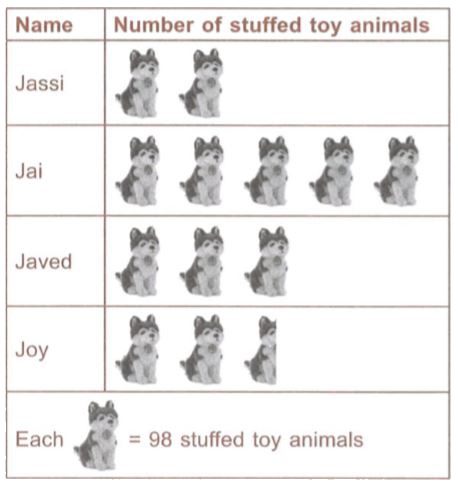
(i) The number of stuffed toy animals Jassi and Joy both have is ___P
(ii) Javed has ____Q more stuffed toy animals than Jassi.
(iii) The total number of stuffed toy animals owned by all the students is ___(R).
(iv) The number of stuffed toy animals Joy has less than Javed is ___S
Study the pictograph and find the value of `((P-Q+R))/(98)xx S`.
(i) The number of stuffed toy animals Jassi and Joy both have is ___P
(ii) Javed has ____Q more stuffed toy animals than Jassi.
(iii) The total number of stuffed toy animals owned by all the students is ___(R).
(iv) The number of stuffed toy animals Joy has less than Javed is ___S
(i) The number of stuffed toy animals Jassi and Joy both have is ___P
(ii) Javed has ____Q more stuffed toy animals than Jassi.
(iii) The total number of stuffed toy animals owned by all the students is ___(R).
(iv) The number of stuffed toy animals Joy has less than Javed is ___S
A
784
B
796
C
854
D
None of these
Text Solution
Verified by Experts
The correct Answer is:
A



Topper's Solved these Questions
Similar Questions
Explore conceptually related problems
The following pie-chart shows the percentage-wise distribution of the number of students in five different schools P, Q, R, S and T. The total number of students in all five schools together is 8400. Find the average number of students in schools R and S together.
The given graph shows the amount of pollutants in four rivers P, Q, R and S. The river that can continue to support the most number of aquatic plants and animals is _______.
The table contains the total number of students hired by Itcompanies I, II, III and the respective percentages of such hiring from colleges P, Q, R and S. What is the total number of students hired by Company Ii from Collages P, R and S ?
The pie-chart shows the percentage-wise distribution of the number of students in five different schools P,Q,R,S and T . The total number of students in all five schools together is 10,500 . Study the pie -chart and answer the question . The number of students in school R is what per cent of the total number of students in schools Q and T together ?
Directions: Study the following information to answer the given Questions: Eight persons are sitting in a round table viz. P, Q, R, S, T, U, V, and W. All are facing inside the table. They all have different ages viz. 8, 10, 15, 11, 12, 13, 23 and 25 but not necessarily in the same order. T is sitting 2nd to the left of P whose age is an odd number. Q is sitting beside the one whose age is not a prime number. There are two persons between R and Q. The person whose age is multiple of 5 is sitting opposite to each other. V’s age is cubic number and sits immediate left of Q. S is not the immediate neighbour of T and Q. R is to the immediate left of T. The sum of ages of W and T is 23. V sits 3rd to the right of T whose age is a prime number. W’s age is the second youngest among all. U’s age is the square number and sits beside the person whose age is a prime number. The sum of the age of R and V is 19. The age of S is 12. The person whose age 10 years is not a neighbor of T. The age of Q is less than the age of P. How many persons have age less than the age of S?
Directions: Study the following information to answer the given Questions: Eight persons are sitting in a round table viz. P, Q, R, S, T, U, V, and W. All are facing inside the table. They all have different ages viz. 8, 10, 15, 11, 12, 13, 23 and 25 but not necessarily in the same order. T is sitting 2nd to the left of P whose age is an odd number. Q is sitting beside the one whose age is not a prime number. There are two persons between R and Q. The person whose age is multiple of 5 is sitting opposite to each other. V’s age is cubic number and sits immediate left of Q. S is not the immediate neighbour of T and Q. R is to the immediate left of T. The sum of ages of W and T is 23. V sits 3rd to the right of T whose age is a prime number. W’s age is the second youngest among all. U’s age is the square number and sits beside the person whose age is a prime number. The sum of the age of R and V is 19. The age of S is 12. The person whose age 10 years is not a neighbor of T. The age of Q is less than the age of P. What is the sum of ages of P and R?
Directions: Study the following information to answer the given Questions: Eight persons are sitting in a round table viz. P, Q, R, S, T, U, V, and W. All are facing inside the table. They all have different ages viz. 8, 10, 15, 11, 12, 13, 23 and 25 but not necessarily in the same order. T is sitting 2nd to the left of P whose age is an odd number. Q is sitting beside the one whose age is not a prime number. There are two persons between R and Q. The person whose age is multiple of 5 is sitting opposite to each other. V’s age is cubic number and sits immediate left of Q. S is not the immediate neighbour of T and Q. R is to the immediate left of T. The sum of ages of W and T is 23. V sits 3rd to the right of T whose age is a prime number. W’s age is the second youngest among all. U’s age is the square number and sits beside the person whose age is a prime number. The sum of the age of R and V is 19. The age of S is 12. The person whose age 10 years is not a neighbor of T. The age of Q is less than the age of P. Who is sitting opposite to P?
Directions: Study the following information to answer the given Questions: Eight persons are sitting in a round table viz. P, Q, R, S, T, U, V, and W. All are facing inside the table. They all have different ages viz. 8, 10, 15, 11, 12, 13, 23 and 25 but not necessarily in the same order. T is sitting 2nd to the left of P whose age is an odd number. Q is sitting beside the one whose age is not a prime number. There are two persons between R and Q. The person whose age is multiple of 5 is sitting opposite to each other. V’s age is cubic number and sits immediate left of Q. S is not the immediate neighbour of T and Q. R is to the immediate left of T. The sum of ages of W and T is 23. V sits 3rd to the right of T whose age is a prime number. W’s age is the second youngest among all. U’s age is the square number and sits beside the person whose age is a prime number. The sum of the age of R and V is 19. The age of S is 12. The person whose age 10 years is not a neighbor of T. The age of Q is less than the age of P. What is the age of T?
Directions: Study the following information to answer the given Questions: Eight persons are sitting in a round table viz. P, Q, R, S, T, U, V, and W. All are facing inside the table. They all have different ages viz. 8, 10, 15, 11, 12, 13, 23 and 25 but not necessarily in the same order. T is sitting 2nd to the left of P whose age is an odd number. Q is sitting beside the one whose age is not a prime number. There are two persons between R and Q. The person whose age is multiple of 5 is sitting opposite to each other. V’s age is cubic number and sits immediate left of Q. S is not the immediate neighbour of T and Q. R is to the immediate left of T. The sum of ages of W and T is 23. V sits 3rd to the right of T whose age is a prime number. W’s age is the second youngest among all. U’s age is the square number and sits beside the person whose age is a prime number. The sum of the age of R and V is 19. The age of S is 12. The person whose age 10 years is not a neighbor of T. The age of Q is less than the age of P. What is the position ofQ wiht respect to U?
SCIENCE OLYMPIAD FOUNDATION -DATA HANDLING-Achievers section (Hots)
- The line graph shows the number of teddy bears Latika sold from Janua...
Text Solution
|
- Study the bar graph and state whether the given statements is true or ...
Text Solution
|
- Study the pictograph and find the value of ((P-Q+R))/(98)xx S. (...
Text Solution
|
- Jenny made the frequency table to show the number of times each vowel ...
Text Solution
|
- The given line graph shows the number of cars and motorcycles sold fro...
Text Solution
|