Home
Class 6
MATHS
Fill in the blanks. (i) An expression ...

Fill in the blanks.
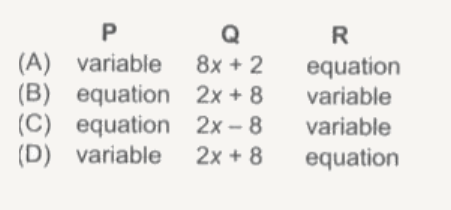
(i) An expression with a variable, constant and the sign of equality is called an `underline(" P ")`.
(ii) 8 more than 2 times the number `x` can be written in algebraic form as `underline(" Q ")`.
(iii) An equation is a condition on a `underline(" R ")`.

Text Solution

Verified by Experts

The correct Answer is:

B
Promotional Banner

Topper's Solved these Questions

  • ALGEBRA

    SCIENCE OLYMPIAD FOUNDATION |Exercise EVERYDAY MATHEMATICS|5 Videos
  • BASIC GEOMETRICAL IDEAS

    SCIENCE OLYMPIAD FOUNDATION |Exercise Achievers Section (HOTS)|5 Videos

Similar Questions

Explore conceptually related problems

Fill in the blanks by choosing the correct option . order of the reaction is the underline (x) of the powers to which concentration terms are raised in expermentally determined rate equation . The unit of first order rate constant is underline (Y) the unit of first order rate constant when concentration is measured in terms of pressure and time in muutes is underline(Z)

Get the algebraic expressions in the following cases using variables, constants and arithmetic operations. (i) Subtraction of z from y. (ii) One-half of the sum of numbers x and y. (iii) The number z multiplied by itself. (iv) One-fourth of the product of numbers p and q. (v) Numbers x and y both squared and added. (vi) Number 5 added to three times the product of numbers m and n. (vii) Product of numbers y and z subtracted from 10. (viii) Sum of numbers a and b subtracted from their product.

P @ Q means P is greater than Q. P underline"@" Q means P is either greater than or equal to Q. P = Q means P is equal to Q. P © Q means P is smaller than Q. P underline"©" Q means P is either smaller than or equal to Q. Statements: I underline"©" J, K = J underline"©" L, H underline"@" J Conclusions: I. J = L II. I underline"@" H

P @ Q means P is greater than Q. P underline"@" Q means P is either greater than or equal to Q. P = Q means P is equal to Q. P © Q means P is smaller than Q. P underline"©" Q means P is either smaller than or equal to Q. Statements: L underline"©" K, M © N, K = M Conclusions: I. N @ L II. K underline"©" N

P @ Q means P is greater than Q. P underline"@" Q means P is either greater than or equal to Q. P = Q means P is equal to Q. P © Q means P is smaller than Q. P underline"©" Q means P is either smaller than or equal to Q. G underline"@" F, D underline"©" E, E = F Conclusions: I. E © G II. E = G

P ox Q means P is greater than Q. P underline(©) Q means P is either greater than or equal to Q. P = Q means P is equal to Q. P @ Q means P is smaller than Q. P underlinecancel("@") Q means P is either smaller than or equal to Q. Statements: A underline(©) N, J@ U, S ox A, J = N Conclusions: I. J @ S II. U ox N

P o+ Q means P is greater than Q. P underline"©" Q means P is either greater than or equal to Q. P = Q means P is equal to Q. P @ Q means P is smaller than Q. P underlinecancel("@") Q means P is either smaller than or equal to Q. Statements: L underline"©" A, S @ E, A = S, G o+ L Conclusions: I. A @ E II. G o+ A
