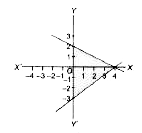
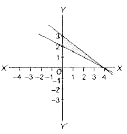
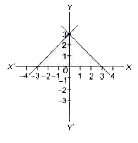
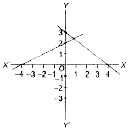
To determine which graph represents the lines given by the equations \(2x + 4y = 8\) and \(3x - 4y = 12\), we will first find the coordinates for each line by determining their intercepts.
### Step 1: Find the intercepts for the first equation \(2x + 4y = 8\).
1. **Find the y-intercept** (set \(x = 0\)):
\[
2(0) + 4y = 8 \implies 4y = 8 \implies y = 2
\]
So, the y-intercept is \((0, 2)\).
2. **Find the x-intercept** (set \(y = 0\)):
\[
2x + 4(0) = 8 \implies 2x = 8 \implies x = 4
\]
So, the x-intercept is \((4, 0)\).
### Step 2: Find the intercepts for the second equation \(3x - 4y = 12\).
1. **Find the y-intercept** (set \(x = 0\)):
\[
3(0) - 4y = 12 \implies -4y = 12 \implies y = -3
\]
So, the y-intercept is \((0, -3)\).
2. **Find the x-intercept** (set \(y = 0\)):
\[
3x - 4(0) = 12 \implies 3x = 12 \implies x = 4
\]
So, the x-intercept is \((4, 0)\).
### Step 3: Plot the points on a graph.
- For the first equation \(2x + 4y = 8\), we have the points \((0, 2)\) and \((4, 0)\).
- For the second equation \(3x - 4y = 12\), we have the points \((0, -3)\) and \((4, 0)\).
### Step 4: Draw the lines based on the points.
- Draw a line through the points \((0, 2)\) and \((4, 0)\) for the first equation.
- Draw another line through the points \((0, -3)\) and \((4, 0)\) for the second equation.
### Step 5: Identify the correct graph.
Now that we have plotted both lines, we need to compare them with the provided options to find the graph that matches our plotted lines.
### Conclusion:
The graph that correctly represents the lines \(2x + 4y = 8\) and \(3x - 4y = 12\) is the one that shows the line passing through \((0, 2)\) and \((4, 0)\) along with the line passing through \((0, -3)\) and \((4, 0)\).