

Home
Class 6
CHEMISTRY
Sudha took lemon juice in two flasks. Sh...

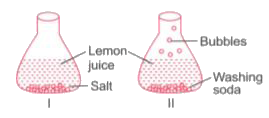
Sudha took lemon juice in two flasks. She put salt in flask 1 and washing soda in flask II. She observed lots of bubbles in flask Il but nothing in flask I. What could be the reason for this?

A

In flask I, a chemical change takes place.

B

In flask II, a chemical change takes place and bubbles of carbon dioxide are seen.

C

In flask II, a physical change takes place producing lots of bubbles.

D

In flask I, salt reacts with lemon juice and forms a new compound.

Text Solution

Verified by Experts

The correct Answer is:
B

Lemon juice (acid) reacts with washing soda (base) and liberates carbon dioxide gas i.e., a new substance is formed. Thus, it is a chemical change. Addition of salt in lemon juice is a physical change as salt only gets dissolved in lemon juice, no chemical reaction takes place.
Promotional Banner

Topper's Solved these Questions

  • CLASS 6 SAMPLE PAPER FINAL 4

    SCIENCE OLYMPIAD FOUNDATION |Exercise Section C - Science |4 Videos

Similar Questions

Explore conceptually related problems

A house wife churned full cream with a milk churner (i) What will she observe after churning the milk ? (ii) What could be the possible reason for the observation ?

Two reactants in a flask at room temperature are producing bubbles of a gas that turn limewater milky. The reactants could be

Which fo the following is a correct statement ? ltbtgt (i) Titration is a process in which the solutions of two reagents are allowed to react . (ii) Titration is carried out by adding the standard solution fo one reagant taken in a burette to the known volume (10 ro 20 cm^3 , mesured by a pipette) of the solution of the other reagent taken in a flask called then titration flask. (iii) The solution taken the burette is called the titrant while that taken in the titration flask is called the analyte. (iv) An acid-base indicator is an organic due which changes color wiht the pH of the solution at the equivalence point .

A substance ''A'' decomposes in solution following the first order kinetics. Flask I contains L of 1 M solution of A and falsk II constains 100 mL of 0.6 M solution. After 8 hr , the concentration, of A in flask I becomes 0.25 M . What will be the time for concentration of A in flask II to become 0.3 M ?

Two flask A and B have equal volume. Flask A contains H_(2) and is maintained at 300 K while flask B contains an equal mass of CH_(4) gas and is maintained at 600 K. (i) Which flask contains a greater number of molecules? How many times more? (ii) In which flask is the pressure greater ? How many times greater ? (iii) In which flask will the molecules moves faster ? (iv) In which flask will the number of collisions with the wall greater?

Figure shows two flasks connected to each other. The volume of the flask 1 is twice that of flask 2 . The system is filled with an ideal gas at temperature 100 K and 200 K respectively. If the mass of the gas in 1 be m then what is the mass of the gas in flask 2

SCIENCE OLYMPIAD FOUNDATION -CHANGES AROUND US-MULTIPLE CHOICE QUESTION
  1. Which of the following features are related to evaporation of water? ...

    Text Solution

    |

  2. Sudha took lemon juice in two flasks. She put salt in flask 1 and wash...

    Text Solution

    |

  3. Study the given Venn diagram carefully The centre point X rep...

    Text Solution

    |

  4. A metallic piece (X) is dropped into copper sulphate solution. After s...

    Text Solution

    |

  5. Read the given passage and fill in the blanks by selecting an appropri...

    Text Solution

    |

  6. Mark the incorrect statement

    Text Solution

    |

  7. Few changes are given below. Mark the correct option from the given co...

    Text Solution

    |

  8. Nitu mixed some iron filings with sulphur powder in a China dish. She ...

    Text Solution

    |

  9. What is common among the following phenomena? 1. Change of season...

    Text Solution

    |

  10. Observe the two figures given below. In figure la solution of sugar in...

    Text Solution

    |

  11. Identify the reversible and irreversible changes among the following: ...

    Text Solution

    |

  12. Study the given flow chart carefully,

    Text Solution

    |

  13. A potter shapes pots out of clay (Process 1). He then bakes the pots i...

    Text Solution

    |

  14. Match column with column Il and select the correct option from the giv...

    Text Solution

    |

  15. Consider the following phenomena : (i) Forest fire (ii) Growth of ...

    Text Solution

    |

  16. Observe the given figure carefully and select the correct statement.

    Text Solution

    |

  17. Swati classified a few changes occurring around us as shown in the tab...

    Text Solution

    |

  18. Read the given statements and mark the correct option Statement 1: ...

    Text Solution

    |

  19. Study the given Venn diagram and identify points 1, 2 and 3.

    Text Solution

    |

  20. Study the given Venn diagram. If 1 represents slaking of lime...

    Text Solution

    |