Home
Class 9
BIOLOGY
A list of animals (i-vii) is given. Clas...

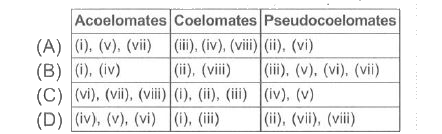
A list of animals (i-vii) is given. Classify them as acoelomates, coelomates and pseudocoelomates and select the correct option.
(i) Adamsia (ii) Wuchereria (iii) Nereis (iv) Earthworm (v) Planaria (vi) Ascaris (vii) Liver fluke (viii) Scorpion

Text Solution

Verified by Experts

The correct Answer is:

A

Acoelomates are those animals which do not have coelom (body cavity), e.g., coelentrates (Adamsia) and flatworms (Planaria and liver fluke). Coelomates are the organisms with true coelom, e.g., annelids (Nereis and earthworm) and arthropods (scorpion). Pseudocoelomates have false coelom, e.g., nematodes (Wuchereria and Ascaris).
Promotional Banner

Topper's Solved these Questions

  • DIVERSITY IN LIVING ORGANISMS

    SCIENCE OLYMPIAD FOUNDATION |Exercise ACHIEVERS SECTION (HOTS)|5 Videos
  • CLASS 9 SAMPLE PAPER FINAL 4

    SCIENCE OLYMPIAD FOUNDATION |Exercise SCIENCE|2 Videos
  • IMPROVEMENT IN FOOD RESOURCES

    SCIENCE OLYMPIAD FOUNDATION |Exercise ACHIEVERS SECTION (HOTS)|5 Videos

Similar Questions

Explore conceptually related problems

Given figure represents longitudinal section of a monocotyledonous embryo. Identify the parts labelled as A,B, C and D from the list (i-vii) and select the correct option (i) Scutellum (ii) Coleoptile (iii) Shoot apex (iv) Epiblast (v) Radicle (vi) Root Cap (vii) Colerhiza

Select the correct option representing the excretory organs present in (i) earthworm, (ii) centipede, (iii) prawn, and (iv) flatworm.

Classify the following organisms based on absence of true coelom as acoelomate, pseudocoelomate, and coelomate : Spongilla, Sea anemone, Planaria, Liver fluke, Wuchereria, Ascaris, Nereis, Earthworm, Scorpion, Birds, Fishes and Horse

How many fishes in the list given below are marine fishes :- (i) Hilsa (ii) Catla (iii) Rohu (iv) Sardine (v) Mrigal (vi) Mackeral (vii) Pomfret

Name the excretory organ present in the following animals : (i) Earthworm (ii) Centipedes (iii) Prawn (iv) Star fish (v) Man (vi) Flat worms
