Home
Class 9
CHEMISTRY
Three invisible radiations X, Y and Z ar...

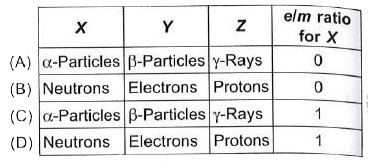
Three invisible radiations `X, Y` and `Z` are passed through an electric field. `X` goes straight, `Y` deviates towards the positive end while `Z` deviates towards the negative end. The particles present in `X, Y` and `Z` and the `e//m` ratio for `X` are

A

`A`

B

`B`

C

`C`

D

`D`

Text Solution

Verified by Experts

The correct Answer is:

B

As X goes undeviated in the electric field, we can infer that it consists of chargeless particles (neutrons). Y deviates towards positive end of electric field, it means y consists of negatively charged particles (electrons). Z deviates towards negative end of the electric field, this indicates that Z consists of positively charged particles (protons).
Since X consists of neutrons, charge of neutron = 0 and mass of neutron = 1 u
`:.` e/m for X = 0/1 = 0
Promotional Banner

Topper's Solved these Questions

  • STRUCTURE OF ATOM

    SCIENCE OLYMPIAD FOUNDATION |Exercise ACHIEVERS SECTION (HOTS)|5 Videos
  • NSO QUESTION PAPER 2020 SET 1

    SCIENCE OLYMPIAD FOUNDATION |Exercise ACHIEVERS SECTION|1 Videos

Similar Questions

Explore conceptually related problems

If x, y, z are positive real numbers such that x+y+z=a, then

In three numbers, X,Y and Z, two times of X is equal to three times of Y. and four times of Y is equal to five times of Z. What is the ratio of X, Y and Z ?

If X_(x=1)Y_(y=2)Z_(z=2). for three matrices X,Y and Z, find the values of m,p and b .

Three positive distinct numbers x, y, z are three terms of geometric progression in an order and the numbers x + y, y + z, z + x are three terms of arithmetic progression in that order. Prove that x^x . y^y = x^y . Y^z . Z^x .

If x,y,z are positive distinct integers, then (x+y) (y+z) (z+x), is

Given: electric potential, phi = x^(2) + y^(2) +z^(2) . The modulus of electric field at (x, y, z) is

Three positive distinct numbers x,y,z are three terms of geometric progression in an order , and the number x+y,y+z,z+x are three terms of arithmetic progression in that order . Prove that x^(x).y^(y).z^(z)=x^(y).y^(z).z^(x)
