Home
Class 9
PHYSICS
A box of 5 kg mass moves up a ramp from ...

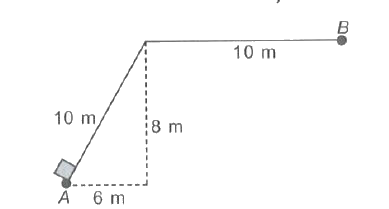
A box of 5 kg mass moves up a ramp from point A to point B at a constant speed. Given that the surfaces are smooth (frictionless). What is the gain in the potential energy by the box? (g = 10 m/`s^(2)`)

A

400 J

B

100 J

C

200 J

D

220 J

Text Solution

Verified by Experts

The correct Answer is:

A

Gravitational potential energy
E = mgh `= 5 xx 10 xx 8 = 400 J`
Promotional Banner

Topper's Solved these Questions

  • WORK AND ENERGY

    SCIENCE OLYMPIAD FOUNDATION |Exercise ACHIEVERS SECTION (HOTS) |5 Videos
  • SOUND

    SCIENCE OLYMPIAD FOUNDATION |Exercise ACHIEVERS SECTION (HOTS) |5 Videos

Similar Questions

Explore conceptually related problems

A box of 5 kg mass moves up a ramp from point A to point B at a constant speed. Given that the surfaces are smooth (frictionless). What is the gain in the potential energy by the box? (Take "g = 10 m/s"^2 )

A particle is released at point A. Find Kinetic energy at point P Given m = 1 kg and all surfaces are frictionless

To what height should a box of mass 150 kg be lifted, so that its potential energy may become 7350 joules ? ( g = 9.8 m//s^(2) ).

A body of mass 10kg is at height of 10m at point A as shown on a smooth track. Find speed at B.

The rear side of a truck is open and a box of 40 kg mass is placed 5 m from the open end The coefficient of friction between the box and the surface below it is 0.15 On a straight road the truck starts from rest and accelerates with 2 m//s^(2) At what distance from the starting point does the box fall off the truck ? Ignore the size of the box .

A block of mass m is initially moving to the right on a horizontal frictionless surface at a speed v. It then compresses a spring of spring constant k. At the instant when the kinetic energy of the block is equal to the potential energy of the spring, the spring is compressed a distance of :

A body of mass 2 kg is moved from a point A to a point B by an external agent in a conservative force field. It the velocity of the body at the points A and B are 5 m/s and 3 m/s respectively and the work done by the external agents is –10 J, then the change in potential energy between points A and B is-

A bike of mass 200 kg (with rider) is running on the road with constant speed 5 m//s , the reaction exerted on the bike by the road at the lowest point will be ( g= 10 m//s^(2) )

A wire 2 m in length suspended vertically stretches by. 10 mm when mass of 10 kg is attached to the lower end. The elastic potential energy gain by the wire is (take g = 10 m//s^(2) )

A ball of mass 1 kg carrying a charge 10^(-8)C moves from a point A at potential 600 V to a point B at zero potential. The change in its kinetic energy is
