Home
Class 9
PHYSICS
The diagram shows a cyclist moving down ...

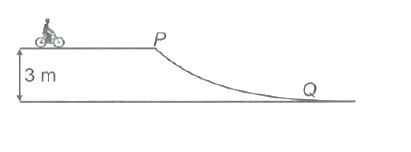
The diagram shows a cyclist moving down a small hill at P before travelling on a flat road after point Q. The total mass of the cyclist and his bicycle is 60 kg and the speed of the cyclist at P is 10 m `s^(-1)`. Which of the following is incorrect?
(Take acceleration due to gravity, g = 10 m `s^(-2)`)

A

The kinetic energy at P is 3000 J.

B

The loss of gravitational energy between P and Q is 1800 J.

C

Total energy is 4800 J.

D

The cyclist does not require a greater power when he travels at a higher constant speed.

Text Solution

Verified by Experts

The correct Answer is:

D

(A) `K=(1)/(2) xx 60 xx 10xx10=3000J`
(B) `PE=60 xx 10xx3=1800J`
(C ) Total energy = KE + Loss of gravitational potential energy = 3000 + 1800 = 4800 J
(D) When he travels at a higher constant speed, so a higher rate of work is done against air resistance.
`:.` Higher power is required.
Promotional Banner

Topper's Solved these Questions

  • WORK AND ENERGY

    SCIENCE OLYMPIAD FOUNDATION |Exercise ACHIEVERS SECTION (HOTS) |5 Videos
  • SOUND

    SCIENCE OLYMPIAD FOUNDATION |Exercise ACHIEVERS SECTION (HOTS) |5 Videos

Similar Questions

Explore conceptually related problems

A man cycling up a smooth inclne road, climbs the road at a constant spped of 2m/s. The total mass of the man and the cycle is 150 kg and the inclination of the road with the horizonal is 30^(@) . What is the minimum horse power spend by the man? [Take g=10m//s^(2) and 1 horse power =750 watt]

In the system shown in the adjoining figure, the acceleration of the 1 kg mass is m//s^(2) . (take g = 10 m//s^(2) )

A boy climbs up a hill, which rises 1 in every 25, on his bicycle. The mass of the boy and his bicycle is 120 kg. What is the power applied by the body if he is cycling at the rate of 6 km/h hour? (Assume the friction is absent and g=10m//s^(2) )

A cyclist going around a circular road of radius 10 m is observed to be bending inward 30^@ with vertical. Frictional force acting on the cyclist is (Given:g=10 m//s^2 , mass of the cyclist is 90 kg)

A train moving at 15 m/sec takes 20 seconds to pass a cyclist moving in the same direction as that of the train. How much time will be train need to pass the cyclist, if the cyclist moves in a direction opposite to that of the train and if the speed of the cyclist is 5m/sec and the length of the cycle is 1 m? 9. 95 s e c b. 10 s e c c. 10. 05 s e c d. 12 s e c

A lorry of mass 2000 kg is traveling up a hill of certain height at a constant speed of 10 m/s. The frictional resistance is 200 N, then the power expended by the coolie is : (g=10 m//s^(2))

A mass is suspended from a vertica spring which is executing SHM of frequency 5 Hz. The spring is unstretched at the highest point of oscillation. Maximum speed of the mass is (take, acceleration due to gravity, g=10m//s^(2) )

A simple pendulum of length 1 m has a wooden bob of mass 1 kg. It is struck by a bullet of mass 10^(-2) kg moving with a speed of 2 xx 10^(2) m s^(-1) . The height to which the bob rises before swinging back is (Take g = 10 m s^(-2) )
