
Home
Class 8
CHEMISTRY
Each of the given beakers contains two ...

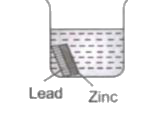
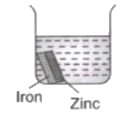
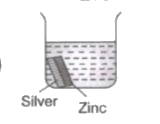
Each of the given beakers contains two metal strips of same size fastened together and immersed in hydrochloric acid. After some time, which beaker will contain the least amount of zinc ions?

A

B

C

D

Text Solution

AI Generated Solution

The correct Answer is:

To solve the question, we need to analyze the reactivity of the metals involved and how they interact with hydrochloric acid (HCl). The question asks which beaker will contain the least amount of zinc ions after the reaction has taken place. ### Step-by-Step Solution: 1. **Identify the Metals**: We have two metal strips in each beaker, and we need to consider their reactivity with hydrochloric acid. The metals mentioned are magnesium and zinc. 2. **Understand Reactivity**: Reactivity series indicates that magnesium is more reactive than zinc. This means that magnesium will react more readily with hydrochloric acid compared to zinc. 3. **Reaction with Hydrochloric Acid**: When magnesium reacts with hydrochloric acid, it will produce magnesium ions and hydrogen gas. The reaction can be represented as: \[ \text{Mg} + 2\text{HCl} \rightarrow \text{Mg}^{2+} + 2\text{Cl}^- + \text{H}_2 \] Zinc will also react with hydrochloric acid, producing zinc ions and hydrogen gas: \[ \text{Zn} + 2\text{HCl} \rightarrow \text{Zn}^{2+} + 2\text{Cl}^- + \text{H}_2 \] 4. **Comparing the Reactions**: Since magnesium is more reactive than zinc, in a beaker where magnesium is present, it will react with hydrochloric acid first and more vigorously than zinc. This means that in the beaker with magnesium, zinc will not have the opportunity to react as much because the magnesium will consume the acid. 5. **Conclusion**: Therefore, the beaker that contains magnesium along with zinc will have the least amount of zinc ions produced because the magnesium will react with the hydrochloric acid before zinc can react significantly. ### Final Answer: The beaker containing magnesium will have the least amount of zinc ions. ---

To solve the question, we need to analyze the reactivity of the metals involved and how they interact with hydrochloric acid (HCl). The question asks which beaker will contain the least amount of zinc ions after the reaction has taken place. ### Step-by-Step Solution: 1. **Identify the Metals**: We have two metal strips in each beaker, and we need to consider their reactivity with hydrochloric acid. The metals mentioned are magnesium and zinc. 2. **Understand Reactivity**: Reactivity series indicates that magnesium is more reactive than zinc. This means that magnesium will react more readily with hydrochloric acid compared to zinc. ...
Promotional Banner

Topper's Solved these Questions

  • METALS AND NON-METAL

    SCIENCE OLYMPIAD FOUNDATION |Exercise ACHIEVERS SECTION (HOTS) |5 Videos
  • COMBUSTION AND FLAME

    SCIENCE OLYMPIAD FOUNDATION |Exercise MULTIPLE CHOICE QUESTION (ACHIEVERS SECTION (HOTS))|5 Videos
  • NSO MODEL TEST PAPER -1

    SCIENCE OLYMPIAD FOUNDATION |Exercise ACHIEVERS SECTION |1 Videos

Similar Questions

Explore conceptually related problems

The beakers shown contain equal amounts of water and another material. Which list shows the solubility of the different materials in the beakers, from most to least soluble

The statement below is followed by two conclusions labelled I and II. Decide which conclusion(s) logically and definitely follow(s) from the information given in the statement only. Statement: Rain water is the purest form of water. Conclusions: I. Rain water contains impurities. II. Rain water will contain the least amount of impurities.

Each of the three beakers A, B, and C contained 50 mL of distilled water. A student placed five reisins in each beaker. The raisins for each beaker weighed the same. The beakers were kept at room temperature. The raisins were removed from beaker A after 10 minutes, from beaker B after 20 minutes and from beaker C after one hour. On calculating the percentage of water absorbed by the raisins, it was found that:

Observe the following diagram and answer any four questions from (i) and (v) given below. During an experiment, Rehana took three beakers A, B and C filled with aqueous solutions of glucose, alcohol and hydrochloric acid respectively as shown in the following figure : If the property of ion formation is considered, which of the following options is correct ?

There are two cylinder shaped wooden billets, each having a mass of mass 45kg , in a vertical wall sewage, which contains water in it. the two billets have the same size and the same material, they touch each other and the walls of the sewage. One of them is totally under the water, whilst only half of the other one is immersed into the water. Friction is negligible everywhere. (density of water is 1000kg//m^(3) and g=10m//s^(2) ). Choose the correct option(s)
