Four substances were tested for their electrical conductivity by placing in contact with anode and cathode in a cell. The results are shown in the table. Study the table and answer the following questions.
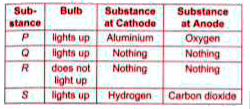
In substance Q, bulb lights up but no substance is found either at cathode or at anode, why?
Four substances were tested for their electrical conductivity by placing in contact with anode and cathode in a cell. The results are shown in the table. Study the table and answer the following questions.
In substance Q, bulb lights up but no substance is found either at cathode or at anode, why?
In substance Q, bulb lights up but no substance is found either at cathode or at anode, why?
A
Because Q is non-electrolyte.
B
Because Q is an element which remains unchanged when it conducts electricity.
C
Because Q is an electrolyte that conducts electricity when it is in the molten state.
D
Because Q is a poor conductor of electricity.
Text Solution
Verified by Experts
The correct Answer is:
B



Topper's Solved these Questions
Similar Questions
Explore conceptually related problems
Four substances were tested for their electrical conductivity by placing in contact with anode and cathode in a cell. The results are shown in the table. Study the table and answer the following questions. Which solutions could be alumina and magnesium nitrate respectively?
A group of materials 'P' can be sub-divided into three groups 'Q', 'R' and 'S' as the basis of their characteristics The substance belonging to group 'Q' may be solid, liquids and gases. These are poor conduction of electricity. The substances included in group 'R' are solids which are good conductors of electricity. Group 'S' consists of substances which have the characteristics common to the substances belonging to groups 'Q' and 'R'. Based upon the above observations, answer the following questions : (a) To which class of substances materials present in group 'P' belong ? (b) Name the type of substances 'Q'. Give two examples. (c ) Name the type of substances 'R'. Give two examples. (d) Name the type of substances 'S'. Give two examples.
Electrolysis is the process in which electrical energy is converted to chemical energy. In electrolytic cell, oxidation takes place at anode and reduction at cathode. Electrode process depends on the electrode taken for electrolysis. Amount of substance liberated at an electrode is directly propertional to the amount of charge passed through it. The mass of substance liberated at electrode is calculated using the following relation : m= ("ItE")/(96500) Here, E represents the equivalent mass and 96500 C is called the Faraday constant. Faraday (96500 C) is the charge of 1 mole electron, i.e., 6.023 xx 10^(23) electrons, it is used to liberate one gram equivalent of the substance. The passage of current liberates H_(2) at cathode and Cl_(2) at anode. The solution is :
Ekta and Vaibhav performed an experiment and found refractive indices of various media as mentioned in the following table. Observe the table and answer the questions based on it. Arrange the following substances from denser to rarer medium. Benzene, Alcohol, Water, Turpentine oil, Rock salt
Electrolysis is the process in which electrical energy is converted to chemical energy. In electrolytic cell, oxidation takes place at anode and reduction at cathode. Electrode process depends on the electrode taken for electrolysis. Amount of substance liberated at an electrode is directly propertional to the amount of charge passed through it. The mass of substance liberated at electrode is calculated using the following relation : m= ("ItE")/(96500) Here, E represents the equivalent mass and 96500 C is called the Faraday constant. Faraday (96500 C) is the charge of 1 mole electron, i.e., 6.023 xx 10^(23) electrons, it is used to liberate one gram equivalent of the substance. On electrolysis of dilute sulphuric acid using platinum electrodes, the product obtained at the anode will be :
Electrolysis is the process in which electrical energy is converted to chemical energy. In electrolytic cell, oxidation takes place at anode and reduction at cathode. Electrode process depends on the electrode taken for electrolysis. Amount of substance liberated at an electrode is directly propertional to the amount of charge passed through it. The mass of substance liberated at electrode is calculated using the following relation : m= ("ItE")/(96500) Here, E represents the equivalent mass and 96500 C is called the Faraday constant. Faraday (96500 C) is the charge of 1 mole electron, i.e., 6.023 xx 10^(23) electrons, it is used to liberate one gram equivalent of the substance. Calculate the volume of gas liberated at the anode at STP during the electrolysis of a CuSO_(4) solution by a current of 1 A passed for 16 minutes and 5 seconds :
Electrolysis is the process in which electrical energy is converted to chemical energy. In electrolytic cell, oxidation takes place at anode and reduction at cathode. Electrode process depends on the electrode taken for electrolysis. Amount of substance liberated at an electrode is directly propertional to the amount of charge passed through it. The mass of substance liberated at electrode is calculated using the following relation : m= ("ItE")/(96500) Here, E represents the equivalent mass and 96500 C is called the Faraday constant. Faraday (96500 C) is the charge of 1 mole electron, i.e., 6.023 xx 10^(23) electrons, it is used to liberate one gram equivalent of the substance. The platinum electrodes were immersed in a solution of cupric sulphate (CuSO_(4)) and electric current is passed through the solution. after sometime, it was observed that the colour of copper sulphate disappeared with evolution of a gas at the electrode. The colourless solution contains :
Electrolysis is the process in which electrical energy is converted to chemical energy. In electrolytic cell, oxidation takes place at anode and reduction at cathode. Electrode process depends on the electrode taken for electrolysis. Amount of substance liberated at an electrode is directly propertional to the amount of charge passed through it. The mass of substance liberated at electrode is calculated using the following relation : m= ("ItE")/(96500) Here, E represents the equivalent mass and 96500 C is called the Faraday constant. Faraday (96500 C) is the charge of 1 mole electron, i.e., 6.023 xx 10^(23) electrons, it is used to liberate one gram equivalent of the substance. The quantity of electricity required to liberate 112 cc hydrogen at S.T.P. from acidified water is :
Electrolysis is the process in which electrical energy is converted to chemical energy. In electrolytic cell, oxidation takes place at anode and reduction at cathode. Electrode process depends on the electrode taken for electrolysis. Amount of substance liberated at an electrode is directly propertional to the amount of charge passed through it. The mass of substance liberated at electrode is calculated using the following relation : m= ("ItE")/(96500) Here, E represents the equivalent mass and 96500 C is called the Faraday constant. Faraday (96500 C) is the charge of 1 mole electron, i.e., 6.023 xx 10^(23) electrons, it is used to liberate one gram equivalent of the substance. How many faradays are required to reduce 1 mol BrO_(3)^(-) to Br^(-) ?
Read the given passage and answer the questions. P, Q, R are different colourless solids, while S is a colourless solution. They are in random order) Sodium chloride (NaCl), Calcium Carbonate (CaCO_(3)) , Acetic acid (CH_(3)COOH) and Phenolphthalein indicator. Small amount of the above substances were added in pairs (e.g. P with Q, Q with R etc.) to a small amount of water in a test tube. They give the following results as shown in the observation table. Observation Table: If acetic acid and hydrochloric acid of same concentration are taken, HCl is a stronger acid because it contains:
SCIENCE OLYMPIAD FOUNDATION -CHEMICAL EFFECTS OF ELECTRIC CURRENT-ACHIEVERS SECTION (HOTS)
- There are two different solutions in set up P and Q as shown in figure...
Text Solution
|
- Four substances were tested for their electrical conductivity by placi...
Text Solution
|
- Four substances were tested for their electrical conductivity by placi...
Text Solution
|
- The bumpers and door handles of motor cars, taps etc. are coated with...
Text Solution
|
- Which of the following compound(s) is manufactured by using the chemic...
Text Solution
|