Home
Class 8
CHEMISTRY
Four substances were tested for their el...

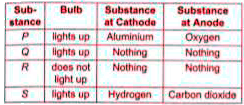
Four substances were tested for their electrical conductivity by placing in contact with anode and cathode in a cell. The results are shown in the table. Study the table and answer the following questions.

Which solutions could be alumina and magnesium nitrate respectively?

A

P and Q

B

R and Q

C

P and S

D

P is the alumina but none of P, Q, R, S is magnesium nitrate.

Text Solution

Verified by Experts

The correct Answer is:

D

When electricity is passed through molten alumina during electrolysis, the alumina splits up into its elements aluminium and oxygen. In the electrolysis of magnesium nitrate, oxygen is formed at anode and hydrogen is formed at cathode.
Promotional Banner

Topper's Solved these Questions

  • CHEMICAL EFFECTS OF ELECTRIC CURRENT

    SCIENCE OLYMPIAD FOUNDATION |Exercise ACHIEVERS SECTION (HOTS)|5 Videos
  • COAL AND PETROLEUM

    SCIENCE OLYMPIAD FOUNDATION |Exercise MULTIPLE CHOICE QUESTION (ACHIEVERS SECTION (HOTS))|5 Videos

Similar Questions

Explore conceptually related problems

The pH values of many common liquids are given in the table below. Study the table and answer the questions that follow. Which of these is a neutralisation reaction?

The pH values of many common liquids are given in the table below. Study the table and answer the questions that follow. Which of these is a valid conclusion that can be drawn from the table?

Study the following experimental set-up and answer the following questions. What will happen if copper sulphate solution in test tube A is replaced by magnesium nitrate solution?

Study the following table carefully and answer the questions given below ? How many countries are developed and developing respectively

The pH values of many common liquids are given in the table below. Study the table and answer the questions that follow. Which of the following would be the best for a person suffering from acidity?

The results given in the below table were obtained during kinetic studies of the following reaction : 2A+BtoC+D X and Y in the given table are respectively :
