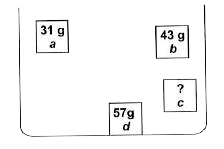
Four objects a, b, c and d, of the same volume but different masses, are put into a tank of water as shown below : Which of the following is most likely to be the mass of object c?
A
35 g
B
28 g
C
51 g
D
80 g
Text Solution
Verified by Experts
The correct Answer is:
C
As the objects have same volume but different masses, the object having higher mass, is more denser and sinks at the bottom while the object having lower mass, is less denser and floats at the top of the water.
Topper's Solved these Questions
NSO MODEL TEST PAPER 01
SCIENCE OLYMPIAD FOUNDATION |Exercise ACHIEVERS SECTION|2 Videos
MOTION AND MEASUREMENT OF DISTANCES
SCIENCE OLYMPIAD FOUNDATION |Exercise ARCHIEVERS SECTION (HOTS) |4 Videos
NSO MODEL TEST PAPER 02
SCIENCE OLYMPIAD FOUNDATION |Exercise ACHIEVERS SECTION|2 Videos
Similar Questions
Explore conceptually related problems
Which of the following is a most likely product from the reaction as shown below ?
The most precise reading of the mass of an object among the following is
Four vessels A, B, C and D have different shapes and hold different amount of water. Which of the following is correct.
Three blocks , labeled A , B and C , are floating in water as shown in the figure . Blocks A and B have the same mass and volume . Block C has the same volume , but is submerged to a greater depth than the other two blocks . Which one of the following statements concerning this situation is false ?
An object comprises of a uniform ring of radius R and its uniform chord AB (not necessarily made of the same material) as shown. Which of the following can not be the centre of mass of object
Three blocks, labeled A, B and C are floating in water as shown in the drawing blocks A and B have the same mass and volume Block C has the same volume but is submerged to a greater depth that the other two blocks which one of the following statements concerning this situation is/are true?
Four bodies of equal mass start moving with same speed as shown in the figure. In which of the following combination the centre of mass will remain at origin
Which of the following points is the likely position of the centre of mass of the system shown in Fig.
SCIENCE OLYMPIAD FOUNDATION -NSO MODEL TEST PAPER 01-ACHIEVERS SECTION