Home
Class 8
PHYSICS
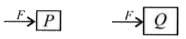
Two forces of equal magnitude F act on t...

Two forces of equal magnitude F act on two isolated bodies P and Q as shown in the figure. The mass of body Q is three times that of body P. The magnitude of the acceleration of P is

A

Three times that of Q

B

(1/3) that of Q

C

Nine times that of Q

D

(1/9) that of Q.

Text Solution

Verified by Experts

The correct Answer is:

A

Let the mass of body P = m
the mass of body Q = 3m
As, force acts on P = force acts on Q , `F_P = F_Q`
or `ma_P=3ma_Q therefore a_p=3a_Q`
[Here `a_P` and `a_Q` are accelerations of P and Q respectively]
Promotional Banner

Topper's Solved these Questions

  • NSO QUESTION PAPER 2017-18 SET-A

    SCIENCE OLYMPIAD FOUNDATION |Exercise ACHIEVERS SECTION |3 Videos
  • NSO MODEL TEST PAPER -1

    SCIENCE OLYMPIAD FOUNDATION |Exercise ACHIEVERS SECTION |2 Videos
  • NSO QUESTION PAPER 2017-18 SET-B

    SCIENCE OLYMPIAD FOUNDATION |Exercise ACHIEVERS SECTION |3 Videos

Similar Questions

Explore conceptually related problems

Equal forces F act on isolated bodies A and B as shown in figure. The mass of B is three times that of A. The magnitude of the acceleration of A is:

The potential energy of a body mass m is U=ax+by the magnitude of acceleration of the body will be-

Two forces with equal magnitudes F act on a body and the magnitude of the resultant force is F /3. The angle between the two forces is

A uniform metallic rod AB of length 1.4 m is lifted by two forces P and Q acting along the directions as shown in the figure. If the magnitudes of P and Q are 20 N and 50 N, respectively, find the magnitude and the position of the resultant normal force that acts on the rod.

Two horizontal forces of magnitudes of 10N and P N act on a particle. The force of magnitude 10N acts due west and the force of magnitude P N acts on a bearing of 30^(@) east of north as shown in (figure) The resultant of these two force acts due north. Find the magnitude of the resultant.

The displacement of a body is given to be proportional to the cube of time elapsed. The magnitude of the acceleration of the body is

Two forces with equal magnitudes F act on body and the magnitude of the resultant forces is (F)/(3). The angle between the two forces is

Two particles P and Q are moving as shown in the figure. At this moment of time the angular speed of P w.r.t. Q is

Three forces act on a body. The body will certainly have an acceleration of these are:
