Refer to the given food web in an aquatic ecosystem. In which of the following species would a toxic pollutant present in water body probably reach the highest concentration. [The arrows represent energy flow and the letters represent different species.]
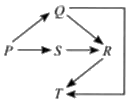
Refer to the given food web in an aquatic ecosystem. In which of the following species would a toxic pollutant present in water body probably reach the highest concentration. [The arrows represent energy flow and the letters represent different species.]
A
S
B
Q
C
R
D
T
Text Solution
Verified by Experts
The correct Answer is:
D
In the given food web, T is the top consumer, so, accumulation of a toxic pollutant will be maximum in this species .



Topper's Solved these Questions
Similar Questions
Explore conceptually related problems
The rate of a reaction, which may also be called its velocity or speed, can be defined with relation to the concentration of any of the reacting substances, or to that of any product of the reaction. If the species chosen is a reactant which has a concentration c at time t the rate is - dc/dt, while the rate with reference to a product having a concentration x at time t is dx/dt. Any concentration units may be used for expressing the rate, thus, if moles per liter are employed for concentration and seconds for the time, the units for the rate are moles "liter"^(-1) sec^(-1) . For gas reactions pressure units are sometimes used in place of concentrations, so that legitimate units for the rate would be (mm. Hg) sec^(-1) and atm. sec^(-1) The order of a reaction concerns the dependence of the rate upon the concentrations of reacting substances, thus, if the rate is found experimentally to be proportional to the alpha^(th) power of the concentration of one of the reactants A, to the beta^(th) power of the concentration of a second reactant B, and so forth, via., rate kC_(A)^(alpha) C_(B)^(beta)" " (1) the over-all order of the reaction is simply n = alpha +beta + ---------(2) Such a reaction is said to be of the alpha^(th) order with respect to the substance A, the beta^(th) order with respect to B and so on... (Laidler, K. J., & Glasstone, S. (1948). Rate, order and molecularity in chemical kinetics. Journal of Chemical Education, 25(7), 383.) In the following questions, a statement of assertion followed by a statement of reason is given. Choose the correct answer out of the following choices on the basis of the above passage. Assertion: Rate of reaction is a measure of change in concentration of reactant with respect to time. Reason: Rate of reaction is a measure of change in concentration of product with respect to time.
How many of the following statements (s) are correct ? (i) Genus comprises a group of related species which has more characters in common in comparison to species . (ii) 'pardus' and 'leo' are two different species but both belong to the genus Felis. (iii) Each genus may have one or more than one specific epithets representing different organisms . (iv) A species is a group of individuals with highest fundamental similarities and maximum number of organisms.
Read the passage given below and answer the following questions: Boiling point or freezing point of liquid solution would be affected by the dissolved solids in the liquid phase. A soluble solid in solution has the effect of raising its boiling point and depressing its freezing point. The addition of non-volatile substances to a solvent decreases the vapor pressure and the added solute particles affect the formation of pure solvent crystals. According to many researches the decrease in freezing point directly correlated to the concentration of solutes dissolved in the solvent. This phenomenon is expressed as freezing point depression and it is useful for several applications such as freeze concentration of liquid food and to find the molar mass of an unknown solute in the solution. Freeze concentration is a high quality liquid food concentration method where water is removed by forming ice crystals. This is done by cooling the liquid food below the freezing point of the solution. The freezing point depression is referred as a colligative property and it is proportional to the molar concentration of the solution (m), along with vapor pressure lowering, boiling point elevation, and osmotic pressure. These are physical characteristics of solutions that depend only on the identity of the solvent and the concentration of the solute. The characters are not depending on the solute’s identity. (Jayawardena, J. A. E. C., Vanniarachchi, M. P. G., & Wansapala, M. A. J. (2017). Freezing point depression of different Sucrose solutions and coconut water.) Identify which of the following is a colligative property :
Read the passage given below and answer the following questions: Boiling point or freezing point of liquid solution would be affected by the dissolved solids in the liquid phase. A soluble solid in solution has the effect of raising its boiling point and depressing its freezing point. The addition of non-volatile substances to a solvent decreases the vapor pressure and the added solute particles affect the formation of pure solvent crystals. According to many researches the decrease in freezing point directly correlated to the concentration of solutes dissolved in the solvent. This phenomenon is expressed as freezing point depression and it is useful for several applications such as freeze concentration of liquid food and to find the molar mass of an unknown solute in the solution. Freeze concentration is a high quality liquid food concentration method where water is removed by forming ice crystals. This is done by cooling the liquid food below the freezing point of the solution. The freezing point depression is referred as a colligative property and it is proportional to the molar concentration of the solution (m), along with vapor pressure lowering, boiling point elevation, and osmotic pressure. These are physical characteristics of solutions that depend only on the identity of the solvent and the concentration of the solute. The characters are not depending on the solute’s identity. (Jayawardena, J. A. E. C., Vanniarachchi, M. P. G., & Wansapala, M. A. J. (2017). Freezing point depression of different Sucrose solutions and coconut water.) When a non volatile solid is added to pure water it will:
Read the passage given below and answer the following questions: Boiling point or freezing point of liquid solution would be affected by the dissolved solids in the liquid phase. A soluble solid in solution has the effect of raising its boiling point and depressing its freezing point. The addition of non-volatile substances to a solvent decreases the vapor pressure and the added solute particles affect the formation of pure solvent crystals. According to many researches the decrease in freezing point directly correlated to the concentration of solutes dissolved in the solvent. This phenomenon is expressed as freezing point depression and it is useful for several applications such as freeze concentration of liquid food and to find the molar mass of an unknown solute in the solution. Freeze concentration is a high quality liquid food concentration method where water is removed by forming ice crystals. This is done by cooling the liquid food below the freezing point of the solution. The freezing point depression is referred as a colligative property and it is proportional to the molar concentration of the solution (m), along with vapor pressure lowering, boiling point elevation, and osmotic pressure. These are physical characteristics of solutions that depend only on the identity of the solvent and the concentration of the solute. The characters are not depending on the solute’s identity. (Jayawardena, J. A. E. C., Vanniarachchi, M. P. G., & Wansapala, M. A. J. (2017). Freezing point depression of different Sucrose solutions and coconut water.) Colligative properties are:
Read the passage given below and answer the following questions: Boiling point or freezing point of liquid solution would be affected by the dissolved solids in the liquid phase. A soluble solid in solution has the effect of raising its boiling point and depressing its freezing point. The addition of non-volatile substances to a solvent decreases the vapor pressure and the added solute particles affect the formation of pure solvent crystals. According to many researches the decrease in freezing point directly correlated to the concentration of solutes dissolved in the solvent. This phenomenon is expressed as freezing point depression and it is useful for several applications such as freeze concentration of liquid food and to find the molar mass of an unknown solute in the solution. Freeze concentration is a high quality liquid food concentration method where water is removed by forming ice crystals. This is done by cooling the liquid food below the freezing point of the solution. The freezing point depression is referred as a colligative property and it is proportional to the molar concentration of the solution (m), along with vapor pressure lowering, boiling point elevation, and osmotic pressure. These are physical characteristics of solutions that depend only on the identity of the solvent and the concentration of the solute. The characters are not depending on the solute’s identity. (Jayawardena, J. A. E. C., Vanniarachchi, M. P. G., & Wansapala, M. A. J. (2017). Freezing point depression of different Sucrose solutions and coconut water.) Assume three samples of juices A, B and C have glucose as the only sugar present in them. The concentration of sample A, B and C are 0.1M, .5M and 0.2 M respectively. Freezing point will be highest for the fruit juice: