Home
Class 9
PHYSICS
A 1 kg mass is projected down a rough ci...

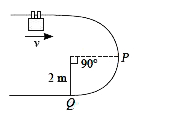
A 1 kg mass is projected down a rough circular track (radius = 2 m) placed in vertical plane as shown. The speed of the mass at point P is 3 m/s and at point Q is 6 m/s. How much work is done on the mass between points P and Q by the force of friction? (Take `"g = 10 m/s"^2`)

A

`-7.5` J

B

`-8.5` J

C

`-6.5` J

D

`-24` J

Text Solution

Verified by Experts

The correct Answer is:

C
Promotional Banner

Topper's Solved these Questions

  • NSO QUESTION PAPER 2018 SET B

    SCIENCE OLYMPIAD FOUNDATION |Exercise ACHIEVERS SECTION|4 Videos
  • NSO QUESTION PAPER 2018 SET A

    SCIENCE OLYMPIAD FOUNDATION |Exercise ACHIEVERS SECTION|4 Videos
  • NSO QUESTION PAPER 2019 SET A

    SCIENCE OLYMPIAD FOUNDATION |Exercise ACHIEVERS SECTION|2 Videos

Similar Questions

Explore conceptually related problems

A 1 kg mass is projected down a rough circule track (redius = 2.0 m) placed in vertical plane as shown. The speed of the massat point A is 3 m//s and at point B , it is 6.0 m//s . How much is work is done on the mass between A and B by the force of friction?

A car of mass 300 kg is travelling on a circular track of radius 100 m with a constant speed of 60 m/s Calculate the angular momentum ?

A rope of mass 5 kg is hanging between two supports as shown. The tension at the lowest point of the rope is close to (take g = 10 m//s^(2) )

A body of mass 10kg is at height of 10m at point A as shown on a smooth track. Find speed at B.

A small block of mass 1 kg is kept on a rough inclined wedge of inclination 45^@ fixed in an elevator. The elevator goes up with a uniform velocity v=2 m//s and the block done not slide on the wedge. Find the work done by the of friction on the block in 1s . (g=10 m//s^(2))

A cylinder of mass 1/sqrt(3)kg is placed on the corner of two inclined planes as shown in the figure.Find the normal reaction in newtons at contact point of cylinder with the slope of inclination 30^(@) g=10m/s^(2)

A block of mass 50 kg slides over a horizontal distance of 1m. If the coefficient of friction between their surface is 0.2, then work done against friction is (take g = 9.8 m//s^(2) ) :

A body of mass 1 kg is moving in a vertical circular path of radius 1 m. The difference between the kinetic energies at its highest and lowest positions is [take g=10 m//s^2 ]
