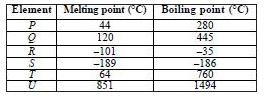
The table shows the melting points and boiling points of six elements P, Q, R, S, T and U. These elements represent consecutive members of periods 3 and 4 of the periodic table. 0.2 mol of the chloride of element U reacts with excess of silver nitrate to form 57.4 g of silver chloride. The formula of chloride is (Given : Atomic mass of N = 14 u, O = 16 u, CI = 35.5 u, Ag = 108 u)
A
Ucl
B
`U Cl_2`
C
`U Cl_3`
D
`U Cl_5`
Text Solution
Verified by Experts
The correct Answer is:
B
Topper's Solved these Questions
NSO QUESTION PAPER 2016 SET B
SCIENCE OLYMPIAD FOUNDATION |Exercise Achievers Section|2 Videos
NSO QUESTION PAPER 2016 SET A
SCIENCE OLYMPIAD FOUNDATION |Exercise Achievers Section|3 Videos
NSO QUESTION PAPER 2017 SET A
SCIENCE OLYMPIAD FOUNDATION |Exercise Achievers Section|2 Videos
Similar Questions
Explore conceptually related problems
The table shows the melting points and boiling points of six elements P, Q, R, S, T and U. These elements represent consecutive members of periods 3 and 4 of the periodic table. If S is a noble gas, then the bond formed between T and R is
When 0.01 mole of a cobalt complex is treated with excess of silver nitrate solution 4.035 g of silver chloride is precipitated. The formula of the complex is :
Which of the following complexes produces three moles of silver chloride when its mole is treated with excess of silver nitrate ?
SCIENCE OLYMPIAD FOUNDATION -NSO QUESTION PAPER 2016 SET B -Achievers Section