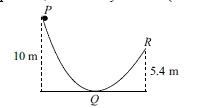
A bead slides from point P on a friction less wire with initial velocity of `4 m s^(-1)` as shown in figure. On reaching point R, its velocity will be (Take g = `10 m s^(-2)`)
A
Zero
B
`10.4 ms^(-1)`
C
`6.4 ms^(-1)`
D
`8.2 ms^(-1)`
Text Solution
Verified by Experts
The correct Answer is:
B
Topper's Solved these Questions
NSO QUESTION PAPER 2019 SET A
SCIENCE OLYMPIAD FOUNDATION |Exercise ACHIEVERS SECTIONS|2 Videos
NSO QUESTION PAPER 2018 SET B
SCIENCE OLYMPIAD FOUNDATION |Exercise ACHIEVERS SECTION|1 Videos
NSO QUESTION PAPER 2019 SET B
SCIENCE OLYMPIAD FOUNDATION |Exercise ACHIEVERS SECTION|1 Videos
Similar Questions
Explore conceptually related problems
Find the horizontal velocity of the particle when it reach the point Q. Assume the block to be frictionless. Take g=9.8 m//s^(2) .
A particle is thrown with a velocity of u m/s. it passes A and B as shown in figure at time t_(1) = 1 " s " and t_(2) = 3 s . The value of u is (g = 10 m/ s^(2) )
A particle is thrown with a velocity of u m/s. It passes A and B as shown in figure at time t_(1) = 1 s and t_(2) = 3 s. The value of u is (g = 10 m//s^(2))
A body is projected with an initial velocity 20 m//s at 60^(@) to the horizontal. Its initial velocity vector is "___" (g=10 m//s^(2))
A car moves along a straight path with variable velocity as shown in the figure. When the car is at possiting A, its velocity is 10 m s^(-1) and when it is at position B, its velocity is 20 m s^(-1) . If the car takes 5 seconds of time to move from A to B, find the acceleration of the car.
A particle of mass 20 g is released with an initial velocity 5m//s along the curve from the point A, as shown in the figure. The point A is at height h from point B. The particle slides along the frictionless surface. When the particle reaches point B, its angular momentum about O will be : (Take g=10m//s^2 ).
A body is thrown vertically upwards with a velocity of 98 m//s . If g = 9.8 m//s^(2) , when will it reach its highest point ? What will be its maximum height ?
SCIENCE OLYMPIAD FOUNDATION -NSO QUESTION PAPER 2019 SET A-ACHIEVERS SECTIONS