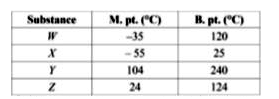
The melting and boiling points of four different substances are given in the table. If all the given substances are heated from `0^(@)C` to `100^(@)C`, substance `ul((i))` will remain in solid state only, substance `ul((ii))` will change from liquid to gas and substance `ul((iii))` will change from solid to liquid.(i), (ii) and (iii) are respectively ?
A
Y, X and Z
B
W, X and Y
C
Y, W and Z
D
W X and Z
Text Solution
Verified by Experts
The correct Answer is:
A
Topper's Solved these Questions
NSO QUESTION PAPER 2019 SET B
SCIENCE OLYMPIAD FOUNDATION |Exercise ACHIEVERS SECTION|2 Videos
NSO QUESTION PAPER 2019 SET A
SCIENCE OLYMPIAD FOUNDATION |Exercise ACHIEVERS SECTIONS|1 Videos
NSO QUESTION PAPER 2020 SET 1
SCIENCE OLYMPIAD FOUNDATION |Exercise ACHIEVERS SECTION|2 Videos
Similar Questions
Explore conceptually related problems
The melting and boiling points of four different substances are given in the table. All the substances are heated from 0^@ C to 100^@ C. The substance which will change from solid to liquid and the substance which will change from liquid to gas are respectively
The melting point of a solid has the same numerical value as the _____ of the liquid state of the same substance.
Melting and boiling points of five different substances are given in the table. Study the given data and select the correct statements. I. V has the least ordered arrangement of particles at room temperature. II. W is solid at 100^(@)C and liquid at 200^(@)C . III. X, Y and Z will have fixed volume but no fixed shape at 40^(@)C . IV. V will exist in liquid state at -210^(@)C .
The table shown below gives information about four substances: A, B, C and D. Identify Ionic compounds from the above given substances.
SCIENCE OLYMPIAD FOUNDATION -NSO QUESTION PAPER 2019 SET B-ACHIEVERS SECTION