Home
Class 12
PHYSICS
A rod of mass m and length L is hinged a...

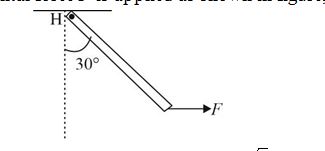
A rod of mass m and length L is hinged at its top end. If the rod is in equilibrium making an angle of 30° with the vertical when a horizontal force F is applied as shown in figure, then the value of F is:

A

`mg//2`

B

2mg

C

`mg//2sqrt(3)`

D

`sqrt(3)`mg

Text Solution

Verified by Experts

The correct Answer is:

C
Promotional Banner

Similar Questions

Explore conceptually related problems

A rod AB of mass M and length L is shown in figure. End A of rod is hinged and end B is lying on the ground. Find the Vertical component of the force applied by the hinge

A uniform rod of mass m is kept in equilibrium making angle 30° with horizontal as shown, with a thread. The tension in the thread is?

A rod AB of mass M and length L is shown in figure. End A of rod is hinged and end B is lying on the ground. Find the Horizontal component of the force applied by the hinge

A rod of mass m and length l is hinged at 'its' end and released from rest in position shown. Find the force exerted by the hinge when the rod becomes horizontal

In the figure a uniform rod of mass 'm' and length 'l' is hinged at one end and the other end is connected to a light vertical of spring constant 'k' as shown in figure. The spring has extension such that rod is equilibrium when it is horizontal . The rod rotate about horizontal axis passing through end 'B' . Neglecting friction at the hinge find (a) extension in the spring (b) the force on the rod due to hinge.

A rod of mass m and length l is himged about one of its ends. The rod is released from horizontal position. When the rod becomes vertical, calculate (i) angular speed of the rod (ii) Hinge reaction.

A rod PQ of mass M and length L is hinged at end P . The rod is kept horizontal by a massless string tied to point Q as shown in the figure. When string is cut, the initial angular accleration of the rod is.

A uniform rod of mass M and length L is hinged at its lower end on a table. The rod can rotate freely in vertical plane and there is no friction at the hinge. A ball of mass M and radius R = (L)/(3) is placed in contact with the vertical rod and a horizontal force F is applied at the upper end of the rod. (a) Find the acceleration of the ball immediately after the force starts acting. (b) Find the horizontal component of hinge force acting on the rod immediately after force F starts acting.
