Home
Class 12
PHYSICS
For the arrangement shown in figure, mas...

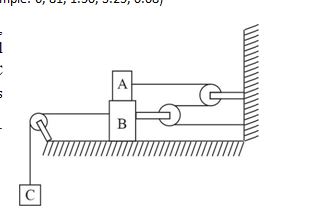
For the arrangement shown in figure, mass of A is 50 kg, mass of B is 70 kg, coefficient of static friction of all plane surfaces is `mu_s=0.3` If the largest value of mass C (in kg), so that blocks A and B remain at rest) is M Find `M/9` (neglect friction in the pulleys). `[g =10m//s^2 ]`

Text Solution

Verified by Experts

The correct Answer is:

9
Promotional Banner

Similar Questions

Explore conceptually related problems

What is the largest mass of C in kg that can be suspended without moving blocks A and B ? The static coefficent of friction for all plane surface of contact is 0.3 Mass of block A is 50 kg and block B is 70 kg . Neglect feriction in the pulleys.

In the arrangement shown in the figure, friction exists only between the two blocks, A and B. The coefficient of static friction mu_(s)=0.6 and coefficient of kinetic friction mu_(k)=0.4 , the masses of the blocks A and B are m_(1)=20 kg and m_(2)=30kg , respectively. Find the acceleration (in ms^(-2) ) of m_(1) , if a force F=150N is applied, as shown in the figure. [Assume that string and pulleys are massless]

In the arrangement shown in figure coefficient of friction between 5kg block and incline plane is mu=0.5 . Friction force acting on the 5kg block is

Three blocks A , B and C , whose masses are 9kg , 9kg and 18kg respectively as shown in the figure, are released from rest. The co-efficient of friction between block A and the horizontal surface is 0.5 & the co-efficient of friction between block B and the horizontal surface is 0.5 . Find the acceleration of block C just release [Take g=10m//s^(2) ]. All strings and pulleys are ideal

If the mass of the block A = 10 kg and the coefficient of static and kinetic friction is 0.2, then the mass of block B to start the motion is

In the figure, m_(1)=m_(2)=10 kg . The coefficients of friction between A, B and B , surface are 0.2 . Find the maximum value of m_(3) so that no block slips ( All the pullies are ideal and strings are massless).

The blocks A and B are arranged as shown in the figure. The pulley is frictionless. The mass of A is 10 kg . The coefficient of friction of A with the horizontal surface is 0.20. The minimum mass of B to start the motion will be

In the arrangement shown in figure pulleys are mass of block A,b and C is m_(1) = 5 kg m_(2) = 4 kg and m_(3) = 2.5 kg respectively .Co-efficient acceleration of friction for both the plane is mu = 0.50 Calculate acceleration of which block when system is released from rest

A block of mass M is sliding down the plane. Coefficient of static friction is mu_(s) and kinetic friction is mu_(k) . Then friction force acting on the block is :
