Home
Class 11
PHYSICS
Two particles of masses m(1) and m(2) in...

Two particles of masses `m_(1)` and `m_(2)` in projectile motion have velocities `vec(v)_(1)` and `vec(v)_(2)` , respectively , at time `t = 0`. They collide at time `t_(0)`. Their velocities become `vec(v')_(1)` and `vec(v')_(2)` at time ` 2 t_(0)` while still moving in air. The value of `|(m_(1) vec(v')_(1) + m_(2) vec(v')_(2)) - (m_(1) vec(v)_(1) + m_(2) vec(v)_(2))|`

A

2.5s

B

4s

C

1s

D

`(10)/(sqrt2)s`

Text Solution

Verified by Experts

The correct Answer is:
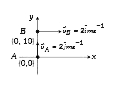
A

Position after time .t. Position of A is `(0, v_(A) t)` Position of B is `(v_(B)t, 10)` Distance between them - `l^(2)= (0- v_(B) t)^(2) + (v_(A) t- 10)^(2)`
`rArr l^(2)= 4t^(2) + 4t^(2)+ 100- 40t = 8t^(2)- 40t + 100`
For maxima and minima
`(dl)/(dt)= 0 rArr 16t - 40= 0 rArr t= (40)/(16)= 2.5s`
Now, `(d^(2)l)/(dt^(2))= 16(+ve) gt 0`, t value gives minima
Promotional Banner

Topper's Solved these Questions

  • BASIC MATHEMATICS AND VECTORS

    ERRORLESS|Exercise NCERT Based Questions (Addition and Subtraction of Vectors )|34 Videos
  • BASIC MATHEMATICS AND VECTORS

    ERRORLESS|Exercise NCERT Based Questions (Multiplication of Vectors )|23 Videos
  • BASIC MATHEMATICS AND VECTORS

    ERRORLESS|Exercise Assertion & Reason|15 Videos
  • ELASTICITY

    ERRORLESS|Exercise ASSERTION & REASON |10 Videos

Similar Questions

Explore conceptually related problems

Two particles of masses m_1 and m_2 in projectile motion have velocities vecv_1 and vecv_2 respectively at time t=0. They collide at time t_0. Their velocities become vecv_1' and vecv_2' at time 2t_0 while still moving in air. The value of |(m_1vecv_1' + m_2vecv_2') - (m_1vecv_1 + m_2vecv_2)| is

If two bodies are in motion with velocity vec(v)_(1) and vec(v)_(2) :

If vec(v)_(1)+vec(v)_(2) is perpendicular to vec(v)_(1)-vec(v)_(2) , then

Two point masses 1 and 2 move with uniform velocities vec(v)_(1) and vec(v)_(2) , respectively. Their initial position vectors are vec(r )_(1) and vec(r )_(2) , respectively. Which of the following should be satisfied for the collision of the point masses?

A moving particle of mass m collides elastically with a stationary particle of mass 2m . After collision the two particles move with velocity vec(v)_(1) and vec(v)_(2) respectively. Prove that vec(v)_(2) is perpendicular to (2 vec(v)_(1) + vec(v)_(2))

Two particles having masses m_(1) and m_(2) are moving with velocities vec(V)_(1) and vec(V)_(2) respectively. vec(V)_(0) is velocity of centre of mass of the system. (a) Prove that the kinetic energy of the system in a reference frame attached to the centre of mass of the system is KE_(cm) = (1)/(2)mu V_(rel)^(2) . Where mu=(m_(1)m_(2))/(m_(1)+m_(2)) and V_(rel) is the relative speed of the two particles. (b) Prove that the kinetic energy of the system in ground frame is given by KE=KE_(cm)+(1)/(2)(m_(1)+m_(2))V_(0)^(2) (c) If the two particles collide head on find the minimum kinetic energy that the system has during collision.

Two bodies having masses m_(1) and m_(2) and velocities v_(1) and v_(2) colide and form a composite system. If m_(1)v_(1) + m_(2)v_(2) = 0(m_(1) ne m_(2) . The velocity of composite system will be

Two cars of same mass are moving with velocities v_(1) and v_(2) respectively. If they are stopped by supplying same breaking power in time t_(1) and t_(2) respectively then (v_(1))/(v_(2)) is

If |vec(V)_(1)+vec(V)_(2)|=|vec(V)_(1)-vec(V)_(2)|and V_(2) is finite, then

ERRORLESS-BASIC MATHEMATICS AND VECTORS-NCERT Based Questions (Fundamentals of Vectors)
  1. Find the vector that must be added to the vector hat(i)-3hat(j)+2hat(k...

    Text Solution

    |

  2. which of the following is not the vector quantity?

    Text Solution

    |

  3. Consider the quantities , pressure, power, energy impulse, gravitation...

    Text Solution

    |

  4. The X and Y components of a force F acting at 30^(@) to x-axis are res...

    Text Solution

    |

  5. The angle made by the vecotr vec(A)= hat(i)+hat(j) with x-axis is

    Text Solution

    |

  6. Any vector in an arbitrary direction can always be replaced by two (or...

    Text Solution

    |

  7. If vecP= vecQ then which of the following is NOT correct?

    Text Solution

    |

  8. Which of the following is independing of the choice of co-ordinate sys...

    Text Solution

    |

  9. With respect to a rectangular Cartesian coordinate system, three vecto...

    Text Solution

    |

  10. Surface area is

    Text Solution

    |

  11. Angular momentum is

    Text Solution

    |

  12. Two vectors are given by vec(A) = hat(i) + 2hat(j) + 2hat(k) and vec(B...

    Text Solution

    |

  13. Figure 2 (EP). 13 shows the orientation of two vectors vec u and vec ...

    Text Solution

    |

  14. The component of a vector r along X-axis will have maximum value if

    Text Solution

    |

  15. Vector vec(A) makes equal angles with x-,y-,and z-axis. Find the value...

    Text Solution

    |

  16. If vec(A)= 2hat(i)+4hat(j)-5hat(k) then the direction of cosins of the...

    Text Solution

    |

  17. If a vector vec(A) make angles alpha , beta and gamma, respectively ,...

    Text Solution

    |

  18. The angles with a vector hat(i)+hat(j)+sqrt(2hat(k)) makes with X,Y an...

    Text Solution

    |

  19. Two particles of masses m(1) and m(2) in projectile motion have veloci...

    Text Solution

    |

  20. The following sets of three vectors act on a body, whose resultant ...

    Text Solution

    |

